Friday, March 08, 2013

#163 John Briggs

#163 John Briggs photo briggs_zps98ea6875.jpg
One of the sad by-products of my own disorganization is that I can't track down the source of this card. If you sent me John Briggs, don't hesitate to let me know, and I will give credit where it is due.

Anyhow, this is a fairly unique photo for the 1965 Topps set, zooming in on Briggs as he seemingly plays catch with an unseen teammate. I'm skeptical as to the presence of an actuall ball in his glove, but I can't say for sure that there's not one in there. Call me a ball agnostic. On second thought...don't. It might lead to some misunderstandings.

Fun facts about John Briggs:

-John was born in Paterson, NJ, and signed with the Phillies as an 18-year-old in 1962. His bonus was a mere $8,000.

-He spent only one season in the minors before getting called up, batting .297 and slugging an even .500 with 21 home runs for Class A Bakersfield in 1963.

-The first two home runs of his career were a leadoff shot (June 21, 1964 against Frank Lary of the Mets) and a walkoff job (May 10, 1965 against Bob Purkey of the Cardinals).

-Briggs spent seven seasons in Philly as a part-timer, seeing action at first base and all three outfield positions. His best overall effort with the Phillies was in 1966, when he batted .282/.380/.490 with 10 home runs in 297 plate appearances.

-John found increased playing time and power after an April 1971 trade to the Brewers. He hit 21 home runs in both the 1971 and 1972 seasons, and set a personal best with 30 doubles in 1974.

-On August 4, 1973, he went 6-for-6 with a pair of doubles in a 9-4 win over the Indians.

-The Twins acquired Briggs in June 1975, but released him the following spring. He played out 1976 in Japan with the Lotte Marines before hanging up his spikes.

-In 12 seasons in the majors, John hit .253 with a .355 on-base percentage and slugged .416. He totaled 139 home runs and 507 RBI.

-Back in New Jersey, Briggs joined the Passaic County Sherriff's Department, retiring as a lieutenant in 2008. He also coached baseball and counseled children in Paterson, and there's a field named for him in West Side Park.

-John still lives in Paterson with his wife Renvy and their two teenage sons, Jalen and Julian.
 photo c11ee261-afbf-4fd5-a1c3-e03213c68ab7_zps12e7a3f9.jpg

Monday, March 04, 2013

#573 Red Sox Rookie Stars: Jim Lonborg, Mike Ryan, Bill Schlesinger, and Jerry Moses

 photo cdf54795-af6b-4bf6-a080-0882874710d4_zps1d549510.jpg
Right. So I had a grand, heartfelt farewell address written for this, the last card to be posted to The Great 1965 Topps Project. Then I actually doubled back to update the Checklist page, and...there are 12 cards that I have in my possession that I've never scanned, written up, and posted to the blog. You'll have me to kick around for at least another month. Whoops! Still, this IS the last pesky high-series rookie card, courtesy of Max. It features one big league mainstay, two role players, and a cup-of-coffee guy. We've done worse with Rookie Stars player selection. So here goes.

Fun facts about Jim Lonborg:

-Jim was born in Santa Maria, CA, and signed with the Red Sox in 1963 after earning a biology degree at Stanford University.

-His high school teammate and good friend Mel Queen went on to pitch for the Reds and Angels, and also married Lonborg's sister.

-Jim jumped to the major leagues at age 23 in 1965 and took his lumps, putting up a 9-17 record and a 4.47 ERA.

-Lonborg came of age in Boston's 1967 "Impossible Dream" season, going 22-9 with a 3.16 ERA to tie former teammate Earl Wilson for the American League lead in wins. He also led the loop with 246 strikeouts en route to his lone All-Star berth, a sixth-place finish in MVP voting, and a near-unanimous selection as AL Cy Young Award winner.

-He pitched to a 2.63 ERA in three starts in the 1967 World Series, shutting out the Cardinals in Game Two and outlasting Steve Carlton in Game Five before running out of gas in the decisive Game Seven.

-An offseason skiing accident in the winter of 1967-1968 caused severe ligament damage in Jim's left knee. He tried to rush back from surgery and wound up damaging his rotator cuff while compensating for the knee; he would never be as effective as he had been before these injuries.

-He was sent to Milwaukee in a 10-player deal after the 1971 season. After a solid year with the Brewers (14-12, 2.83 ERA, 107 ERA+), the righty was traded to the Phillies, this time in a seven-man swap. He would remain with Philly throughout the decade, winning 75 games in six-plus seasons and appearing in the NLCS in both 1976 and 1977.

-In parts of 15 seasons, "Lonnie" was 157-137 with a 3.86 ERA. He was selected to the Red Sox Hall of Fame in 2002.

-After hanging up his spikes, Jim matriculated from Tufts University Dental School. He has had his own dental practice in Hanover, MA since the mid-1980s.

-According to comedy writer and former baseball announcer Ken Levine, the photo of "Sam Malone" that hung above the bar on the popular sitcom "Cheers" was actually a photo of Lonborg. The character (played by Ted Danson) was a former Red Sox pitcher.

Fun facts about Mike Ryan:

-Haverhill, MA native Mike Ryan grew up as a Red Sox fan, then signed with the team as a teenager in 1960.

-After four years as a light-hitting, defensively-adept catcher in the Boston farm system, Mike got a one-game cup of coffee on October 3, 1964, going 1-for-3 with a two-run single and an intentional walk in a 7-0 Sox victory.

-Though Ryan hit just .159 in 33 games in 1965, he had two home runs at Tiger Stadium on May 2, 1965. It was only his second big league game; there would be 634 more, but never again did he homer twice in a game.

-He was traded to the Phillies prior to the 1968 season. As the team's primary catcher in 1969, Mike hit a career-best 12 home runs and drove in 44, but still had just a .204 batting average.

-Every dog has his day: Mike hit home runs off of Hall of Famers Juan Marichal and Tom Seaver in 1969.


-Tim McCarver's arrival in Philadelphia pushed Ryan back to the bench, where he remained through the 1973 season. He was dealt to Pittsburgh in 1974, appeared in only 15 games, and retired at age 32.

-In parts of 11 seasons, Mike batted .193 with 28 home runs and 161 RBI. He also had a .991 fielding percentage and threw out 44% of would-be base stealers.

-Of all position players since 1930, only shortstop Ray Oyler (.175) had a lower batting average with at least 1,000 career at-bats than Ryan.

-He was a minor-league manager in the Pirates (1975-1976) and Phillies (1977-1978) organizations before becoming the Phils' major league bullpen coach in 1980, a position he held until retiring from the game in 1995.

-Mike lives with Suzanne, his wife of more than 40 years, in Wolfeboro, NH.

Fun facts about Bill Schlesinger:

-Bill was born in Cincinnati, OH, the son of a hardware store owner. During his childhood, several Reds players worked for his father in the offseason, including Gus Bell, Johnny Temple, Ted Kluszewski, and Roy McMillan.

-He actually never played organized baseball growing up, as he failed to make the cut both in high school and in college at the University of Cincinnati. However, his father's connections proved valuable, as Red Sox scout Denny Galehouse took a flyer on Schlesinger for a $1,000 signing bonus in 1963.

-Incredibly, Bill not only made the cut with Boston's New York/Penn League team in Wellsville, NY, but was named a league All-Star. His resume included a .341 average, a .624 slugging percentage, 31 doubles, and league-leading totals of 129 runs scored and 37 home runs. He even stole 18 bases.

-The Red Sox invited him to major league camp in 1965, and he went north with the team. He suspects that he was chosen over Jerry Moses because the latter was a more highly-regarded prospect and the team did not want to hinder his development.

-Indeed, the BoSox did not use Schlesinger in a game until May 4, 1965. He pinch hit for pitcher Dave Morehead leading off the sixth inning, and tapped a comebacker to Angels hurler Marcelino Lopez, who threw him out at first base. In his SABR biography, the player offers an amusing retelling of this experience, complete with a wipeout on the dugout steps and a weighted donut that would not come off of his bat.

-He had no way of knowing at the time, but that one inauspicious at-bat was to be Bill's lone major league experience. He was placed on waivers three days later and claimed by the Athletics.

-The outfielder wound up back in Boston's farm system twice more in his career. He also played in the Cubs and Phillies organizations.

-In August of 1969, Bill was to be promoted to the major leagues by the Phillies, but was hit in the face by a Larry Sherry pitch while still at AAA. He couldn't see at all for a few days afterward, and ultimately lost 40% of his vision. He finally retired in the spring of 1971 after the Pirates sent him home from their camp.

-He returned home to Cincinnati and inherited Pleasant Ridge Hardware when his father passed away in 1972.

-Bill ended up playing slow-pitch softball for 25 years, and is in the Greater Cincinnati Softball Hall of Fame.

Fun facts about Jerry Moses:

-A native of Yazoo City, MS, Jerry turned down a football scholarship from Bear Bryant at the University of Alabama and signed with the Red Sox for a $50,000 bonus in 1964.

-His father Sammy was a baseball scout for 25 years, working for the Pirates, Angels, and Dodgers.

-Bonus baby rules did force Boston to put Moses on the big league roster for three months in 1965. He had just four pinch-hit appearances all year, but the second of those came on May 25, 1965. That day, the rookie hit a booming home run off of Minnesota's Jim "Mudcat" Grant, who would win 21 games that season.

-After a six-game September cameo in 1968, Jerry shared catching duties in Beantown in 1969. In 53 games he hit .304 with 4 home runs and 17 RBI.

-His only career grand slam was the decisive blow in a 9-4 win over the Indians on April 20, 1969. The young catcher later doubled in an insurance run to give him a career-best 5 RBI on the day.

-He hit .278 with 14 doubles, 3 homers, and 23 RBI in the first half of the 1970 season to earn an All-Star nod. The catcher would finish with career highs of 92 games played, 18 doubles, 6 home runs, and 35 RBI while batting .263.

-The Red Sox traded Moses to the Angels in October of 1970, and he played for seven teams over the final six years of his career. The others were the Indians, Yankees, Tigers, Padres, and White Sox. In between, he was also the property of the Mets for a few months.

-Jerry retired after the White Sox released him in late 1975, looking for more economic security than a backup catcher could get in those days. In parts of nine seasons, he batted .251 with 25 home runs and 109 RBI.

-Though Moses hit only 25 career homers, he victimized two pitchers twice, and both were famous for giving up moon shots: Al Downing (who served up Hank Aaron's 715th in 1974) and Hall of Famer Bert Blyleven (who set a single-season record by surrendering 50 HR in 1986).

-These days, Jerry enjoys golfing, coaching, watching the New England Patriots, and spending time with his six grandchildren.
#573 Red Sox Rookie Stars: Jim Lonborg, Mike Ryan, Bill Schlesinger, and Gerry Moses (back) photo lonborgrcb_zps86e0cb86.jpg

Friday, February 15, 2013

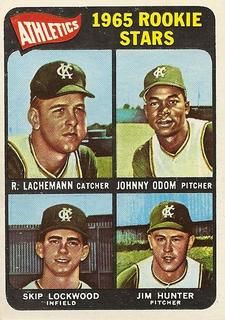
#526 Athletics Rookie Stars: Rene Lachemann, Johnny Odom, Skip Lockwood, and Jim Hunter

#526 Athletics Rookie Stars: Rene Lachemann, Johnny Odom, Skip Lockwood, Jim Hunter
Yikes! The way I've been procrastinating on these last few posts, you'd think that I was drawing things out so that the blog wouldn't have to end. As sentimental as I am, I do want to wrap things up here for closure's sake. So here we are at the penultimate stop on this collecting journey, and this one comes from Max. You probably know Johnny Odom and Bill Hunter as "Blue Moon" and "Catfish", respectively. This is one of the more valuable cards in the set, which is undoubtedly due to the runaway popularity of Rene Lachemann.

Fun facts about Rene Lachemann:

-A native of Los Angeles, Rene played collegiately at the University of Southern California (that's USC to you) before signing with the Athletics in 1964.

-He was only 20 when he debuted with Kansas City in 1965. His first career hit was a pinch-hit home run against Chicago's Gary Peters on May 13.

-As the primary backup to Billy Bryan, Lachemann hit .227 (the overall team average was just .240) with 9 home runs and 29 RBI in 235 plate appearances.

-On September 8, 1965, he replaced Bert Campaneris behind the plate in the tenth inning of a game against the Angels. That was, of course, the game in which Campy played all nine positions as a stunt. Rene singled twice in a losing cause.

-Rene spent most of 1966 at AA Mobile and had a double in five big league plate appearances that season.

-His only other taste of the big leagues came in 1968, when he batted .150 in a 19-game stint in Oakland.

-In parts of three major league seasons, Rene had a .210 average, 9 home runs, and 33 RBI.

-Continued playing with the Athletics' AAA club through 1972, finishing with a minor league stat line of .250/.316/.415 and 104 home runs in 8 seasons.

-Though he was just 28 at the time, Lachemann went straight into managing when his playing career was through. From 1973 through 1980, he skippered in the Oakland and Seattle organizations, then took over as Mariners manager in midseason 1981 following Maury Wills' termination. He had a 140-180 record when the club fired him in 1983. Next came a single, 94-loss campaign helming the Brewers. Rene spent the subsequent decade coaching for Boston and Oakland before being tabbed as the first manager of the Florida Marlins in 1993. It was more of the same there, as he was relieved of his duties in mid-1996 with a 221-285 overall mark. In the ensuing years, he's coached for the Cardinals, Cubs, Mariners, Athletics, and Rockies.

-His older brother Marcel pitched for the Athletics from 1969-1971, compiling a 3.44 ERA in 102 innings of relief. He has been a pitching coach for several big league teams, and worked on Rene's Marlins staff in 1993 and 1994. Marcel also got a brief tenure as Angels manager, 1994-1996. A third brother, Bill, was a catcher in the Dodgers' farm system in the late 1950s and also had a lengthy career as a coach and minor league skipper.

Fun facts about Johnny Odom:

-Johnny was born in Macon, GA and signed with Kansas City out of high school in 1964.

-The talent-poor A's gave the young pitcher five starts at the end of the 1964 season. In his second-ever appearance, he scattered six walks and two hits in blanking the Orioles 8-0. However, the teenager was knocked out of the box in his other four starts and finished with a 10.06 ERA.

-Odom stuck in the majors for good in 1966, when he went 5-5 with a 2.49 ERA in 14 starts despite walking 53 men and striking out just 47.

-He was an All-Star in both 1968 (16-10, 2.45 ERA, 113 ERA+) and 1969 (15-6, 2.92 ERA, 117 ERA+).

-Johnny was more fleet of foot than most pitchers, and was used as a pinch runner 105 times. He was only 6-for-11 stealing, though, and he made the final out of Game 5 of the 1972 World Series on a reckless dash home from second base. Joe Morgan gunned him out, but the A's won the Series in seven.

-That 1972 season was also Odom's last as an effective pitcher. He went 15-6 with a 2.50 ERA (115 ERA+) for the World Champs and allowed only three runs (two earned) in 25.1 postseason innings.

-From 1973 through the end of his career in 1976, Johnny posted a sorry 10-28 record with a 5.04 ERA for the Athletics, Indians, Braves, and White Sox. He was finished at age 31.

-His last big-league win was July 28, 1976, a 2-1 White Sox victory over the A's. Odom held his former team hitless for five innings, but walked nine and allowed an unearned run on a Jim Essian throwing error. Francisco Barrios cleaned up the mess with four innings of no-hit relief. How many guys can say that their final 'W' in the majors was a no-hitter?

-In a career that spanned 13 seasons, Johnny had a record of 84-85 with a 3.70 ERA.

-Odom was arrested in 1985 for selling cocaine. On December 11, while facing a trial on the drug charges, he had a six-hour standoff with police while holding his then-wife Gayle captive with a shotgun. Ultimately, he spent six weeks in rehab for alcohol addiction and served a 55-day prison sentence. By all accounts, he turned his life around; he later remarried and owned a house-painting service for some time. He was inducted into the Georgia Sports Hall of Fame in 2004 and is now retired.

Fun facts about Skip Lockwood:

-Skip (born Claude Edward Lockwood) was born in Roslindale, MA, and lettered in basketball, track, and baseball in high school. He batted .416 and won 22 games as a pitcher in his senior year, convincing the Athletics to meet his demand of a $135,000 signing bonus.

-Due to bonus baby rules, the 18-year-old made Kansas City's big league roster in 1965. The would-be third baseman collected just 41 plate appearances in 42 games, batting a mere .121 with no extra-base hits.

-Lockwood continued to struggle as a hitter and lost some time to service in the Army Reserve. In late 1967, the Athletics converted him to pitching in hopes that they could slip him through the Rule V draft and then continue developing him as an infielder. But the Astros claimed him and let him pitch, and he stuck with it even after being returned to the A's.

-The Seattle Pilots nabbed Skip in the expansion draft and he pitched in six major league games in 1969, sporting a 3.52 ERA in 23 innings.

-He spent parts of the next four seasons with the Milwaukee Brewers (the relocated and rebranded Pilots). In 1971, he had his best year as a starter, going 10-15 with a 3.33 ERA for a 92-loss Brewers club.

-On May 30, 1972, Lockwood one-hit the Yankees in a 3-1 win. He also walked six batters, but a sixth-inning single by Rusty Torres was the only safety that New York managed.

-After one season with the Angels, Skip came to the Mets in 1975 and had some success as a reliever. 1976 saw him go 10-7 with a 2.67 ERA and a team-high 19 saves. He also struck out 108 men in 94.1 innings. It was the first of four straight seasons that he led the Mets in saves.

-Lockwood finished his career with the Red Sox in 1980, as shoulder problems hastened his exit from the game. In parts of 12 seasons as a big league pitcher, he was 57-97 with a 3.55 ERA and 68 saves.

-Though he began his baseball career straight out of high school, Skip continued his education throughout the years. He has a B.S. in speech from Emerson College, a master's degree in business and industrial communication from Fairfield University, and a second master's in finance and economics from MIT. He also did some Ph.D. coursework in sports psychology, but did not complete the degree.

-Lockwood and his wife Kathy have five children. He is currently working as a motivational speaker, and according to his website, he is working on a book about his baseball career.

Fun Facts about Jim (Catfish) Hunter:

-Jim was born in Hertford, NC. After compiling a 26-2 record at Perquimans High School, he signed with the A's in 1964 for a $75,000 bonus.

-His nickname was bestowed upon him by the marketing-conscious Athletics' owner, Charles O. Finley. "Charlie O" concocted a story about the pitcher catching a large catfish as a boy, and the moniker stuck.

-In 1965, he made 20 starts and a dozen relief appearances as a 19-year-old for Kansas City and held his own, going 8-8 with a 4.26 ERA.

-On May 8, 1968, he threw the first perfect game by an American League pitcher in 46 years, blanking the Twins 4-0 while striking out 11. The notoriously stingy Charlie Finley gave his starter a $5,000 bonus on the spot.

-Catfish's many accomplishments included 8 All-Star appearances and the 1974 American League Cy Young Award (25-12, 2.49 ERA, 23 complete games). He was also the last A.L. pitcher to win 20 or more games in 5 consecutive seasons, which he did from 1971 through 1975.

-Hunter was one of the better-hitting pitchers of his time, batting .226 with 6 homers and 51 RBI in 710 career plate appearances. In 1971, he rapped out a .350 average (36-for-103) with a home run and 12 RBI.

-He was a member of five World Series champions, and he particularly excelled in his three Fall Classics with the A's. From 1972-1974, he had a 4-0 record in five Series starts, and even earned a save in the opener of the 1974 championship. In that span, his World Series ERA was 2.19.

-By 1974, Hunter became embroiled in a contract dispute with Finley, who had failed to make agreed-upon payments to a life insurance fund for the player. Arbitrator Peter Seitz ruled that Finley had indeed breached the contract, and declared Hunter a free agent. The decision effectively nullified baseball's reserve clause, and after a spirited bidding war, the righthander signed with the Yankees for a then-record five years, $3.75 million.

-Though his Yankee career started phenomenally (23-14, 2.58 ERA, league-leading 30 CG and 1.01 WHIP in 1975), the effects of diabetes and years of heavy workload soon showed, and he retired when his contract expired at the end of the 1979 season. In a 15-year career, he was 224-166 with a 3.26 ERA and 181 complete games.

-Hunter was inducted into the Baseball Hall of Fame in 1987, and the Athletics retired his #27 in 1991. His plaque in Cooperstown features no insignia on the cap, since he preferred not to choose either one of his teams over the other. He spent his retirement on his farm in Hertford, and was only 53 when he died in 1999 after battling amyotrophic lateral sclerosis, also known as Lou Gehrig's Disease.
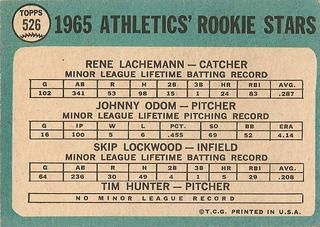
#526 Athletics Rookie Stars: Rene Lachemann, Johnny Odom, Skip Lockwood, Jim Hunter (back)

Saturday, December 08, 2012

#461 Braves Rookie Stars: Clay Carroll and Phil Niekro

#461 Braves Rookie Stars: Clay Carroll and Phil Niekro
Yikes. A three-month hiatus in the midst of posting the last few cards of the set is bad form on my part. But some of you have hung around for the five years it took to complete this project, and I appreciate your patience and persistence. As a reminder, this card and those that come after (whenever that might be!) were sent along by Max, who is a happenin' sort of dude. Thanks again! It's worth noting that this is Clay Carroll's rookie card, but it's Phil Niekro's second Topps card. He appeared with Phil Roof on a 1964 Rookie Stars card, the first of many cards for ol' Knucksie...

Fun facts about Clay Carroll:

-A native of Clanton, AL, Clay signed with the Braves in 1961, when he was 19 years old.

-He impressed as a rookie reliever in September 1964, allowing only 4 runs in 20.1 innings (1.77 ERA). He earned his first career save with four scoreless frames against the Cubs on September 20.

-1966 was Clay's first full big league season, and he led the majors with 73 games pitched. He posted an 8-7 record with a 2.37 ERA and 11 saves.

-Following a June 1968 trade to the Reds, Carroll became the go-to guy in the Cincinnati bullpen. He would make 486 appearances for the team over the next 8 seasons, with a cumulative 2.73 ERA (129 ERA+), a 71-43 record, and 119 saves.

-He hit the only home run of his big league career on May 30, 1969. It was a tiebreaking shot off of Bob Gibson in the top of the tenth inning, sealing a 4-3 Reds win!
-Clay saved some of his best pitching for the postseason, starring for the Reds in 1970, 1972, 1973, and 1975. In a losing effort in the 1970 World Series, he allowed only five hits and two walks (one intentional) in nine scoreless innings of relief against the Orioles. The righty struck out 11 batters while appearing in all but one game of the series, and his 3.2 shutout innings in Game 4 earned him the lone Cincy win in the Fall Classic.

-"The Hawk" was an All-Star in both 1971 and 1972. In the latter season, he had a 2.25 ERA and set a National League record with 37 saves to earn Fireman of the Year honors. No Senior Circuit pitcher surpassed that total until Bruce Sutter blew past him with 45 saves in 1984.

-Carroll also pitched for the White Sox, Cardinals, and Pirates, and retired after the 1978 season. In parts of 15 seasons, he had a record of 96-73 with a 2.94 ERA and 143 saves.

-He was inducted into the Reds' team Hall of Fame in 1980.

-Sadly, Carroll lost his wife Frances and their 11-year-old son Bret in 1985 when Frances' son (Clay's stepson) Frederick Nowitzke pulled out a gun and opened fire on the family. Frederick also shot Clay in the head, but the ex-pitcher survived. Nowitzke is currently serving a life sentence in Miami-Dade County, FL for first-degree murder.

Fun facts about Phil Niekro:

-He was born in Blaine, OH and signed with the Milwaukee Braves in 1958 after completing high school.

-Phil's big league debut didn't come until 1964, his age-25 season. This was due in part to military service.

-His younger brother Joe was another prominent knuckleball pitcher, and accumulated 221 wins for the Astros and a half-dozen other teams from 1967 through 1988. The Niekros pitched together for the Braves (1973-1974) and Yankees (1985), and the duo holds a major league record for wins by a pair of brothers with 538 in total.

-Among the elder Niekro's accomplishments were three 20-win seasons, a league-leading 1.87 ERA as a swingman in 1967, four years of league-leading complete game totals, and a league-best 262 strikeouts in 1977. He also won five Gold Gloves and was a five-time All-Star.

-Phil no-hit the Padres on August 5, 1973 in a 9-0 laugher. He was able to pitch around three walks and two Atlanta errors.

-Despite spending the majority of his career with subpar Braves teams, Niekro reached the 300-win plateau by virtue of his longevity, remaining active past his 48th birthday! Late in his career he twirled for the Yankees, Indians, and Blue Jays before a final encore in Atlanta in 1987. In his astounding 24-year career, he won 318 games and lost 274, completed 245, and had a 3.35 ERA.

-Phil is responsible for several notable "lasts", including: the last active member of the Milwaukee Braves, the last active player born in the 1930s, the last pitcher to both win and lose 20 games in the same season, the last pitcher to start 41 up through 44 games in a year, and the last pitcher to throw 305 up through 342 innings in a single season.

-He managed Atlanta's AAA Richmond team in 1991, and later helmed the Colorado Silver Bullets, an all-female traveling baseball team. The Bullets played exhibitions against men's semi-pro clubs.

-Phil was inducted into the Baseball Hall of Fame in 1997, and his #35 has been retired by the Braves.

-There are several memorable quotes about Niekro's dancing knuckleball, but my favorite might come from former outfielder Rick Monday, who said, "It actually giggles at you as it goes by."
#461 Braves Rookie Stars: Clay Carroll and Phil Niekro (back)

Friday, September 07, 2012

#350 Mickey Mantle

#350 Mickey Mantle
Well, what have we here? The Final Four in my nearly five-year set collecting journey all came from Max of the Starting Nine blog. That shouldn't come as a surprise, since Max has been one of the most prolific contributors to my cause. In return for this beautiful card of the Mick (as well as three 1965 Rookie Stars cards to be revealed later), I sent off some assorted Mets, football Giants, and Saints ephemera and a couple of Rookie Trophy cards: Willie McCovey's 1960 Topps #316 and Billy Williams' 1962 Topps #288. There will be more goodies headed Max's way as soon as I get my lollygagging rear in gear and finish organizing my collection. Thanks a bunch as always!

Fun facts about Mickey Mantle:

-Mantle was born in Spavinaw, OK. His father, Elvin Charles "Mutt" Mantle, was a lead miner whose own baseball dreams were impressed upon the strong young boy. He was named after Hall of Fame catcher Mickey Cochrane, the elder Mantle's favorite player.

-After signing with the Yankees as a teenager in 1949, Mickey tore through the minor leagues, batting .357 and slugging .585 in parts of three seasons. His 1951 rookie season was uneven, featuring a midsummer demotion to AAA Kansas City, but he still finished with major league marks of .267/.349/.443 with 13 home runs and 65 RBI in 96 games. Not bad for a 19-year-old.

-The Mick started the first two games of the 1951 World Series as a rookie, but suffered a catastrophic knee injury as he pulled up to avoid colliding with Joe DiMaggio in the outfield and his cleats caught on a drainage cover. Despite a probable torn ACL in his right knee, Mantle took over as the starting center fielder in 1952, playing 142 regular-season games and batting .311/.394/.530 with 37 doubles (ultimately his career high), 23 homers, and 87 RBI. He led the American league with a .924 OPS, garnered the first of 16 All-Star selections, and OPS'd 1.061 in a World Series triumph over the Dodgers. He hit the first couple postseason home runs of his career, and later retired with a Series-record 18 round-trippers.

-In 1956, Mickey reached the stratusphere, capturing the American League Triple Crown (.353 AVG, 52 HR, 130 RBI) and the first of three AL Most Valuable Player awards. He achieved career highs in RBI, runs scored (132), slugging percentage (.705), and total bases (376). His adjusted OPS+ of 210 led the league, which should almost go without saying.

-Mantle successfully defended his MVP plaque in 1957, although his counting stats were held down by virtue of an increase in walks (from 112 to 146) and a decrease in overall plate appearances (from 653 to 623). The powerful and swift center fielder still topped the Yanks with 34 homers and 94 RBI and had high-water marks in batting average (.365), on-base percentage (.512!), and OPS+ (221!). Ted Williams (.388/.526/.711, 38 HR, 87 RBI) had superior numbers, but his poor defensive reputation combined with a prickly personality and the also-ran status of his Red Sox conspired to leave the Splendid Splinter a close runner-up for the league's top individual prize.

-Mickey himself had three second-place MVP finishes, the most famous coming in 1961. Mantle and teammate Roger Maris spent the year racing to catch Babe Ruth's single-season record of 60 home runs, but the affable and favored Mick fell short and finished with a still-impressive stat line of .317/.448/.687, 54 HR, 128 RBI. The quiet, workmanlike Maris hit his 61st in the final game of the year, much to the consternation of many star-chasing fans of the game, and beat out his more famous teammate for MVP honors for a second straight year.

-Alcoholism and injuries caught up to Mantle in his thirties, as he missed an average of 41 games per season from 1962 through 1968. He was still a productive player when able to take the field, as evidenced by a .412 OBP and 165 OPS+ in those waning years.

-He retired after the 1968 season, his eighteenth in the major leagues. Overall, Mantle batted .298/.421/.557 with 536 home runs and 1,509 RBI.

-The Yankees retired Mantle's #7 in 1969 and presented him with a plaque, which now hangs in Monument Park inside Yankee Stadium. He was a first-ballot Hall of Famer in 1974, and was inducted alongside good friend/teammate/partner in crime Whitey Ford.

-Mantle had an uneasy personal and professional life after baseball, which included a divorce from his long-suffering wife Merlyn, financial troubles stemming from several poor business deals, a rocky relationship with his four sons (all of whom developed substance abuse problems as well), and even a temporary ban from baseball. Commissioner Bowie Kuhn punished both Mantle and his contemporary Willie Mays for accepting community relations jobs with resort/casinos in 1983, but their bans were lifted two years later by Kuhn's successor Peter Ueberroth. Mickey finally quit drinking in 1994 at the urging of his family, friends, and doctor, but the damage had already been done. While receiving a liver transplant in June 1995, he learned that he had inoperable liver cancer. It soon spread to the rest of his body, and he died at age 63 on August 13, 1995.
#350 Mickey Mantle (back)

Tuesday, August 28, 2012

#581 NL Rookie Stars: Tony Perez, Kevin Collins, and Dave Ricketts

#581 NL Rookie Stars: Tony Perez, Kevin Collins, and Dave Ricketts
As you can see from the status of my set counter on the left side of the blog, I have completed this set, in a bit under five years! That means I've got some catching up to do. As has been the case on a few occasions, Ed tipped me off to a dealer selling this Tony Perez (and company) rookie card for a song...or ten songs, if you will. It's a very worthwhile investment, not just for Big Doggie's mischievous grin, but for the impenetrable thickness of Dave Ricketts' Coke-bottle glasses. Anyhow, let's push forward with this trio of mismatched National League rookies. After that, it's on with the Final Four of The Great 1965 Topps Project...huzzah!

Fun facts about Tony Perez:

-Tony was born in Ciego De Avila, Cuba. The Reds signed him prior to his 18th birthday in 1960.

-He debuted in late 1964, but did not become a full-time starter until 1967. That year Perez made the first of 7 All-Star Teams, hitting .290 with a team-best 26 home runs and 102 RBI as the regular third baseman. He hit the game-winning home run for the National League in the All-Star Game, a fifteenth-inning shot off of Catfish Hunter that helped wrap up the longest Midsummer Classic game ever.

-Tony had his best overall season in 1970, finishing third in MVP voting on the strength of career highs in nearly every offensive category: runs scored (107), homers (40), RBI (129), and AVG/OBP/SLG (.317/.401/.589). He slugged .750 in the Reds' three-game NLCS sweep of the Pirates, but had only one single in a five-game World Series loss to the Orioles.

-Though Perez's Cincinnati team of the 1970s was known as "The Big Red Machine", they had to wait until 1975 to get their first taste of championship glory. The slugger was instrumental in their thrilling seven-game World Series win over Boston, delivering a pair of homers and four RBI in a Game Five victory and his sixth-inning two-round homer keyed the Reds' Game Seven comeback from a three-run deficit.

-He had remarkable longevity, playing in the majors until age 44. He spent the last decade of his career with the Expos, Red Sox, and Phillies, and finally returned to the Reds in the mid-1980s as a part-timer.

-When Tony did hang up his spikes in 1986, he had totaled 379 home runs, 1,652 RBI, and 505 doubles in parts of 23 seasons. He batted .279/.341/.463.

-After a long wait, Perez was voted into the Baseball Hall of Fame in 2000, joining former teammates such as Joe Morgan and Johnny Bench. That same year, the Reds retired his number 24 jersey.

-He was hired to manage the Reds in 1993, but was fired just 44 games into the season with the team struggling at 20-24. Eight years later, he was on the other side of the coin, replacing John Boles as the Marlins' interim manager when that club got off to a 22-26 start. Under Perez, the Fish finished in fourth place in the N.L. East at 54-60 (76-86 overall).

-His son Eduardo played for several big league teams from 1993 through 2006, manning all four corner infield and outfield positions and batting .247 with 79 home runs. Another son, Victor, briefly played minor league ball in the Reds organization.

-Tony currently serves as special assistant to the general manager of the Marlins.

Fun facts about Kevin Collins:

-A native of Springfield, MA, Kevin signed with the Mets out of high school in 1964 for a $25,000 bonus.

-After shoulder surgery spoiled his selection to the Opening Day roster, New York called up the 18-year-old in September 1965, making him the fourth-youngest player in the league that season. His first hit was a single off of the Pirates' Bob Friend on September 22.

-After cups of coffee in 1965 and 1967, Collins spent much of the 1968 season on the Mets' bench, batting .201 with 13 RBI in 154 at-bats.

-He made his first big-league home run count, delivering a tie-breaking three-run shot in the ninth inning of a 4-1 win in Houston on August 6, 1968.

-In June 1969, Kevin was one of four players sent to the Expos in exchange for Donn Clendenon. On July 17, he hit the first pinch homer in Montreal team history, a three-run bomb off of future Hall of Famer Jim Bunning.

-Collins finished his major league career with two seasons of pinch-hit duty in Detroit, batting a career-high .268 in 1971 (albeit in 41 at-bats).

-In parts of 6 seasons, Kevin batted .209 with 6 homers and 34 RBI.

-He spent another three years playing in the minors for the Tigers and Indians before retiring from baseball at age 27.

-Collins worked for two decades for Mexican Industries, an automotive supply company started by former Tigers pitcher Hank Aguirre.

-Kevin is now retired and living in Sand Point, MI with his wife Linda. He has two children and three grandchildren, according to an article by Jon Springer.

Fun facts about Dave Ricketts:

-Dave was born in Pottstown, PA, which was also the birthplace of Bobby Shantz and Buck Weaver.
-After attending Duquesne University, where he also played basketball, he signed with the Cardinals in 1957.

-His older brother Dick played in the NBA for three seasons and pitched for the Cardinals in 1959, going 1-6 with a 5.82 ERA.

-Dave missed the 1958 and 1959 seasons due to military service.

-At age 27, Ricketts made his big league debut, going 2-for-4 against the Cubs on September 25, 1963.

-After another brief look at the majors in 1965, Dave finally settled in as Tim McCarver's backup in 1967. Playing in a career-high 52 games, he batted .273 with his only career home run and 14 RBI.

-He appeared in back-to-back World Series for the Cards, going 0-for-3 in the team's 1967 triumph over Boston and stroking a pinch single in his only at-bat in the 1968 loss to the Tigers.

-Ricketts was traded to the Pirates prior to the 1970 season, his final year in the big leagues.

-In parts of 6 seasons, he batted .249 with a home run and 20 RBI.

-Dave coached for the Pirates and Cardinals for two decades. He died of renal cancer on July 13, 2008, a day after his 73rd birthday.
#581 NL Rookie Stars: Tony Perez, Kevin Collins, and Dave Ricketts (back)

Thursday, June 21, 2012

#2 NL Batting Leaders: Roberto Clemente, Rico Carty, and Hank Aaron

#2 NL Batting Leaders: Clemente, Carty, and Aaron
Whoops! I just realized that I never posted the most recent addition to my set, which is this fine card from Greg Mader. Greg sent it as part of a custom-made Opening Day pack, and indeed it was waiting for me at home on April 7 when I got back from watching my Orioles beat Greg's Twins. Thanks again, Greg!

Here's some breaking news for you: Roberto Clemente was pretty darned good. In 1964, he was in the midst of his fifth of 12 All-Star seasons, and he hit .339 to capture his second batting crown. In 1961, he topped the National League with a .351 average, and he defended his 1964 title by swatting .329 the next season. After plunging all the way to fifth in the league with a .317 mark in 1966, Clemente rebounded to top the loop with a career-high .357 average in 1967. In all, he was a top-ten finisher in 13 of his 18 seasons, including each of the last dozen years of his career.

Finishing a not-very-close second in '64 was Rico Carty, who batted .330 in a great rookie season to lead the Braves. That's no small feat, as Hank Aaron hit .328 and Joe Torre clocked in at .321 to give Milwaukee the 2-3-4 finishers in the N. L. batting race. In 1970, Rico blew everyone else out of the water in capturing his lone batting title, with his .366 average well ahead of Torre and Manny Sanguillen's .325 marks. Meanwhile, Hammerin' Hank was a two-time batting champ in his younger days, with first-place finishes in 1956 (.328) and 1959 (.355). Though he totaled 12 top-ten finishes in his illustrious career, there were no more batting titles on the horizon for Aaron.

A few items of interest from the extended leaderboard on the card back:

-Lou Brock sits in sixth place with a .315 average. In 52 games with the Cubs, he was at .251. After being traded to St. Louis, he caught fire and rang up a .348 figure in 103 games. Lou wasted no time in giving the Cubs a case of buyers' remorse!

-I bet Joe Christopher cherished this card, which shows him and his even .300 average ranked just above Willie Mays' .296.

-Get a load of the run of great players in the second column: Willie Stargell, Pete Rose, Bill Mazeroski, Vada Pinson, Nellie Fox, and Ernie Banks, all in a row.

-Poor Al Spangler had his name misspelled as "Spankler". As if putting his .245 average on a batting leaders card wasn't cruel enough.
#2 NL Batting Leaders: Clemente, Carty, and Aaron (back)

Monday, April 09, 2012

#550 Mel Stottlemyre

#550 Mel Stottlemyre
I'm a few weeks overdue with this post, but getting there is half the fun. Our old friend Bob, a.k.a. the Commish, sent me this lovely specimen of a high-numbered Mel Stottlemyre rookie card. If you've skimmed over my checklist lately, you know that this was the last single-player card that I needed...besides that Mantle guy. There's no turning back now!

Fun facts about Mel Stottlemyre:

-Mel was born in Hazleton, MO but attended high school and junior college in Washington state before signing with the Yankees in 1961.

-He led the International League with a 1.42 ERA for Richmond and was 13-3 when New York called him up to the majors in August 1964. The rookie helped the Yanks capture the American League pennant with a 9-3 record and a 2.06 ERA in 13 games down the stretch, solidifying his place in the bigs for good.

-On September 26, 1964, Stottlemyre tormented the Senators by tossing a 2-hitter and going 5-for-5 at the plate with a double and a pair of RBI.

-Mel started three games in the 1964 World Series, earning a complete game victory in Game Two, permitting just two runs (one earned) in a seven-inning no-decision in Game Five, and unfortunately taking the loss on two days' rest in the deciding Game Seven. It would be his only postseason exposure.

-In his sophomore season, he made the first of five All-Star teams, posted a 20-9 record with a 2.63 ERA, and led the league with 18 complete games.

-Despite the Yankees' slide into mediocrity in the late 1960s, Mel had back-to-back 20-win seasons in 1968 (21-12, 2.45 ERA) and 1969 (20-14, 2.82 ERA, league-leading 24 complete games).

-A torn rotator cuff in 1974 ended his career at age 32. In an 11-year career spent entirely in the Bronx, he was 164-139 with a 2.97 ERA and 152 complete games. He is seventh in team history in career wins.

-Stottlemyre spent three decades as a pitching coach for the Mariners, Mets, Astros, and Yankees. He oversaw the Bombers' staff while they were busy winning five World Series at the end of the 20th century.

-His sons Mel, Jr. (Royals, 1990) and Todd (Blue Jays, A's, Cardinals, Rangers, and Diamondbacks, 1988-2002) were also big league pitchers.

-Mel was diagnosed with multiple myeloma a few years back, but the disease is now in remission. He lives in Issaquah, WA.
#550 Mel Stottlemyre (back)

Thursday, February 16, 2012

#510 Ernie Banks

#510 Ernie Banks
Back again so soon. Ed's dragging me to the finish line on this project, in this case spotting a pretty well-conditioned copy of this high-numbered Ernie Banks card at a hobby show for $20. It's the most I've paid yet, but I'd say it's worth the cost. Now the needs list is down to the Magnificent Seven!

Fun facts about Ernie Banks:

-Ernie was born in Dallas, TX and was signed by the Negro Leagues' Kansas City Monarchs in 1950. He had two stints with the club sandwiched around a tour in the Army, and signed with the Cubs in September 1953.

-The young shortstop jumped right to the major leagues, starting for Chicago in a September 17, 1953 loss to the Phillies. As the first black player in team history, he went 0-for-3 with a walk and a run scored, and batted .314 with a pair of homers in 10 games.

-Banks was runner-up to Wally Moon in 1954's N.L. Rookie of the Year voting. He played all 154 games for the Cubs, batting .275 with 19 home runs and 79 RBI. Only Hank Sauer (103 RBI) drove in more runs for the club.

-He broke out in 1955 with the first of 11 All-Star seasons, a third-place MVP finish, and a batting line of .295/.345/.596 with 44 homers and 117 RBI.

-Ernie had his greatest seasons back-to-back, winning the National League MVP honors in 1958 and 1959. In the former year, he batted a career-high .313 and led the Senior Circuit with 47 home runs (a record for shortstops at the time), 129 RBI, and a .614 slugging percentage. 1959 brought a .304/.374/.596 slash line, 45 homers, and a league-best 143 RBI.

-He won his one and only Gold Glove in 1960. The following season, the Cubs began transitioning him to first base, the position he played almost exclusively for the next decade.

-Banks played his entire 19-year career at Wrigley Field, where he was known as "Mr. Cub" and beloved for his production, leadership, and enthusiasm. Unfortunately, this also meant that he never got the opportunity to play in the postseason.

-He hit three home runs in one game four times in his career: August 4, 1955 (part of a 7-RBI outburst); September 14, 1957 (nightcap of a doubleheader - let's play two!); May 29, 1962 (4-for-5 with a double); and June 9, 1963 (two off of Sandy Koufax!).

-He retired in 1971 with a .274 average and an even .500 slugging percentage, as well as 512 home runs and 1,636 RBI. His total of 277 home runs as a shortstop was a record that stood for over two decades before being surpassed by Cal Ripken, Jr.

-Ernie was a first-ballot Hall of Famer in 1977, collecting 321 votes out of a possible 383 (83.8%). The 62 voters who didn't choose him should be given severe noogies. He's maintained a close relationship with the Cubs throughout the years, even spending a few years coaching at the end of his playing career. His #14 was retired in 1982, making him the first Cubbie to receive that honor, and in 2008 a statue in his likeness was dedicated outside of Wrigley Field.
#510 Ernie Banks (back)

Wednesday, February 01, 2012

#134 World Series Game Three: Mantle's Clutch HR

#134 World Series Game 3: Mantle's Clutch HR
That's 590 down and 8 to go! I might not get my hands on the Mick's regular base card any time soon, but a gen-u-ine World Series action photo beats some humpty-dumpty posed shot any day, if you ask me. Here's another card that I've bought off of Ed for $10.

To set the stage: it's Saturday, October 10, 1964. 67,101 fans have packed into Yankee Stadium to see if the Yankees can take a 2-1 lead over the Cardinals in the World Series. 18-game winner Jim Bouton starts for the Yanks, opposed by veteran and fellow 18-game winner Curt Simmons of St. Louis. Simmons, making his first postseason start in his 17th big league season, runs into trouble in the second inning. Elston Howard singles, Joe Pepitone walks, and Clete Boyer plates the game's first run with a double. New York strands two runners in scoring position as Bouton flies out, and Simmons bears down and shuts them out for the next six innings.

Bouton is also on his game, allowing only six Cardinal hits in nine innings. He gives up a single unearned run in the fifth inning to tie the game, though. Tim McCarver leads off the frame with a single but moves up to second base as Mickey Mantle misplays it in right field. Dal Maxvill advances the runner to third with a groundout, and Simmons evens things up with a two-out single. This sets the stage for a tense ninth inning.

Still trying for the complete game, Bouton is betrayed by his defense once more in the top of the ninth. McCarver leads off again and reaches first base as shortstop Phil Linz boots a ground ball. Mike Shannon, who hit into a fielder's choice to leave the bases loaded in the sixth, bunts McCarver to second. Pinch hitter Carl Warwick walks, and Bob Skinner bats for Simmons and moves the lead runner to third with a flyout to deep center field. Curt Flood lines out, leaving St. Louis hoping for extra innings. But it's not to be. Reliever Barney Schultz surrenders the game-winning home run to Mantle, the first batter in the home half of the ninth. It is the 16th of an eventual 18 home runs hit by Mickey in World Series play, and the last of those to be hit in New York. It also proves to be the last home win for the Yanks in the Fall Classic until the first game of the 1977 Series.
#134 World Series Game 3: Mantle's Clutch HR (back)