Showing posts with label team card. Show all posts

Tuesday, May 10, 2011

#481 Cleveland Indians Team

#481 Cleveland Indians Team
We have a team card! Man, as aesthetically pleasing as the rest of this set is, these team cards with their loud single-color backgrounds and grainy photos are the pits. This one looks like the Indians are being engulfed by a giant marshmallow Peep, like the Stay-Puft Man coated in yellow granulated sugar. Mmmm...

So yes. The 1964 Cleveland Indians. They were a perfectly ho-hum 79-83, good for a sixth place tie with the Twins in the 10-team American League, 20 games in the rear view of the pennant-winning Yankees. It extended a remarkable run of mediocrity for the Tribe, whose won-lost records since 1957 went as follows: 76-77, 77-76, 89-65 (the one outlier), 76-78, 78-83, 80-82, 79-83, 79-83. In '64, the Indians won and lost at about the expected pace: their Pythagorean record (based on runs scored and allowed) was 81-81 for the second straight year. This sort of win-one, lose-one pace did not electrify the local fans, as Cleveland Stadium housed only 653,293 spectators all year for an eighth-place rank in the A.L. Manager Birdie Tebbetts suffered a heart attack in April, and George Strickland posted a 33-39 record in his stead. Tebbetts returned in midseason, faring slightly better at 46-44.

The Tribe bats were thoroughly middle-of-the-pack: fourth in runs scored (689), sixth in batting average (.247), seventh in on-base percentage (.312), sixth in slugging (.380), fourth in home runs (164). Seven players reached double digits in home runs, with left fielder Leon Wagner leading the way with 31 homers and 100 RBI. He batted just .253, however, and reached base at a .316 clip. First baseman Bob Chance led the regulars with a .279 average and drove in 75 runs in 120 games. Catcher Johnny Romano topped the team with an .806 OPS, partially due to his 19 home runs. Utility man Chico Salmon chipped in with a .307 average in 286 at-bats. The Indians did lead the league in stolen bases with a total of 79, as Dick Howser (20 SB) and Vic Davalillo (22 SB) did most of the work.

The Cleveland pitchers were uninspiring on the whole, totaling 693 runs allowed to place seventh in the league. Their 3.75 ERA was sixth-best, and the only category they topped was strikeouts, with 1,162. The bright spots were 21-year-old flamethrower "Sudden Sam" McDowell, who went 11-6 with a 2.70 ERA and a team-best 177 punchouts, and 29-year-old Jack Kralick, who was the team's only All-Star with his 12-7 mark and 3.21 ERA. Luis Tiant made his debut in midseason and went 10-4 with a 2.83 ERA. More impressively, he completed 9 of 16 starts and fanned 105 batters in 127 innings. The bullpen was anchored by veteran Don McMahon: 6-4, 2.41 ERA, 16 saves. He struck out 92 batters in 101 innings across his 70 appearances.

Sadly, the Indians are still looking for their first World Series championship since 1948, having lost in the Fall Classic in 1954, 1995, and 1997.They endured a frustrating stretch from 1995 through 2001 that saw them win 6 out of 7 A.L. Central titles without a single Commissioner's Trophy to show for it all. Of course they've come out of nowhere to win 22 of their first 33 games in 2011, taking command of a lackluster division. Is it finally "next year" in Cleveland? Time will tell.
#481 Cleveland Indians Team (back)

Wednesday, February 16, 2011

#426 Milwaukee Braves Team

#426 Milwaukee Braves Team
If something about this card looks a little off to you, you're right. The inner border is black, whereas the rest of the Braves in 1965 Topps had green borders. Someone done goofed!

Though the Braves' 88-74 record in 1964 put them just 5 games behind the pennant-winning Cardinals, they finished fifth in the top-heavy National League. In his second season at the helm, manager Bobby Bragan oversaw a four-win improvement. Attendance was lukewarm at County Stadium, with a total of 910,911 fans putting the club sixth out of ten N.L. clubs in their penultimate season in Milwaukee.

The Bravos carried some big sticks, finishing first in the Senior Circuit with 803 runs scored, 274 doubles, and an overall batting line of .272 AVG, .333 OBP, and .418 SLG. The club also hit 159 home runs, trailing only the Giants' 165. Five Braves hit 20 home runs, though none topped 24. A star-studded outfield featured Rico Carty (.330/.388/.554, 22 HR, 88 RBI), Lee Maye (.304, 44 2B, 74 RBI), and Hank Aaron (.328/.393/.514, 24 HR, 95 RBI). The Hammer was an All-Star reserve, while catcher Joe Torre (.321/.365/.498, 20 HR, 109 RBI) was the lone Milwaukee starter in the Midsummer Classic.

It was pitching that stunted the Braves' progress in 1964. They were next-to-last with a 4.12 ERA, and they allowed a league-worst 160 home runs as a staff. The only regular with an ERA+ better than league average was reliever Bobby Tiefenauer (13 SV, 3.21 ERA, 111 ERA+, 73 IP). 23-year-old Tony Cloninger was the de facto ace (19-14, 15 CG, 3.56 ERA). Denny Lemaster (17-11, 4.15 ERA) led the team with 185 strikeouts. 43-year-old Warren Spahn (6-13, 5.29 ERA) showed his age in his Braves swan song.

As alluded to earlier, the Braves relocated to Atlanta prior to the 1966 season. They captured the first-ever N.L. West title in 1969 but were swept out of the playoffs by the Amazin' Mets. The team then plunged into laughingstock status in the mid-1970s under the ownership of the brash Ted Turner before Bobby Cox and John Schuerholz built a club that captured 14 straight division titles and made 5 World Series from 1991 through 2005. Even still, the Braves have had their share of disappointment with only one World Championship (1995) to show for that string of postseason appearances.
#426 Milwaukee Braves Team (back)

Wednesday, February 02, 2011

#267 Washington Senators Team

#267 Washington Senators Team
Wow. This card looks like Christmas threw up on it.

Anyways, you probably know the old saw about Washington: "First in war, first in peace, last in the American League." Well, thanks to a six-game improvement and the wretchedness of the Kansas City A's, Gil Hodges' Senators narrowly escaped the cellar in 1964 with a 62-100 record. I'm sure that was small consolation, as they finished 37 games behind the pennant-winning Yankees and a full 10 games back of the 8th-place Red Sox. The Sens were still last in the league in attendance, with 600,106 stubborn fans paying their way into RFK Stadium.

Washington's offense was missing in action, pushing across 578 total runs; only the Angels (544) scored fewer. The club had an A.L.-worst .231 average and .299 on-base percentage. The only statistical category in which they placed higher than seventh was strikeouts - with 1,124 whiffs, the Senators fanned more often than any other team. Center fielder Don Lock led them in on-base percentage (.346), slugging (.461), runs (73), home runs (28), and RBI (80). Left fielder Chuck Hinton was the only All-Star, as he paced the club in batting (.274), doubles (25), and triples (7). Right fielder Jim King finished a distant second on the squad with 18 homers and 56 RBI.

When assigning blame for the Sens' 100-loss season, there's plenty left for the pitchers. They were dead-last in the A.L. with 26 saves and 794 strikeouts, and third-worst with a 3.98 ERA. As you might imagine, it was not a stable pitching staff. An unfathomable 15 different men started at least one game, and only Claude Osteen and Buster Narum took the baton more than 24 times. The 24-year-old Osteen (15-13, 3.33 ERA, 13 CG) was the only starter with a winning record. Fireman Ron Kline (10-7, 2.32 ERA, 14 SV) was the glue that held the bullpen together.

In their decade in D.C. (1961-1971), the second incarnation of the Senators played losing baseball in every season but one. Ted Williams was hired as manager in 1969 and temporarily gave the club's hitters a boost, engineering a 21-win jump to an 86-76 record. Even that was good for only fourth place in the six-team A.L. East. In 1972, owner Bob Short moved the team to Texas, where they became the Rangers and continued to sputter. It would take until 1996 for the franchise to make its postseason debut, and they did not win their second-ever playoff game until 2010, when they finally advanced to the World Series only to lose in five games to the Giants. Washington went without a baseball team of any caliber until 2005, when the Expos left Montreal and became the Nationals, the third team in MLB history to call the nation's capital home. That team, of course, has five last-place finishes and a fourth-place finish to its name. The more things change, the more they stay the same.
#267 Washington Senators Team (back)

Friday, October 15, 2010

#403 Boston Red Sox Team

#403 Boston Red Sox Team
You know what's odd? This team card doesn't match the color scheme of the Red Sox player cards in this set. Those have green borders and yellow names, whereas this has a black border and white text. Someone fell asleep on the job.

The 1964 season was smack dab in the middle of a sustained drought for the Red Sox. They finished eighth out of the ten American League teams with a 72-90 record (27 games behind the Yankees), the sixth consecutive season that they landed in the second division. They would bottom out in ninth place in each of the following two seasons before staging a remarkable turnaround in 1967. The '64 club was managed by former Boston infielder Johnny Pesky, who was relieved of his duties with two games left and replaced by third base coach Billy Herman. The total home attendance for the year was 883,276. Despite drawing less than a million fans to Fenway, the Sox were fifth in the A.L. in attendance.

The BoSox finished fifth in runs scored with 688, a disappointment when you consider their other offensive statistics. They were first in batting average (.258), on-base percentage (.322), and doubles (253), and second in slugging (.416) and home runs (186). Eight players hit at least 13 homers, led by first baseman Dick Stuart (33 HR, 114 RBI) and outfielder/second baseman Felix Mantilla (a career-high 30 HR). Of course, no player other than Stuart even had as many as 70 RBI. 19-year-old Tony Conigliaro (.290 AVG, .883 OPS, 24 HR in 111 games) had a great rookie season in left field and center fielder Carl Yastrzemski (.289 AVG, .374 OBP) was productive despite missing the All-Star Game for the only time in a 17-year stretch of his career. Speaking of the Midsummer Classic, shortstop Eddie Bressoud (.293 AVG, .372, OBP, 41 2B) and third baseman Frank Malzone (.264, 13 HR, 56 RBI in the beginning of a decline phase) made the squad as reserves.

The Red Sox pitching was not a pretty sight in 1964. Second-to-last in ERA (4.50), complete games (21), and hits, walks, and runs allowed (793 R). Pitching in Fenway couldn't have helped, but no one on the staff had a winning record save for All-Star closer Dick Radatz (16-9, 2.29 ERA, 29 SV). Top starter Bill Monbouquette dropped from 20-10 in 1963 to 13-14, despite a negligible change in ERA (up from 3.81 to 4.01). He had five of the team's seven shutouts. Earl Wilson led Boston with 166 strikeouts, but was 11-12 with a 4.49 ERA. Manager Pesky gave Jack Lamabe a career-high 25 starts, and he responded with a disastrous 5.53 ERA...though it was better than his 8.14 mark in 14 relief appearances.

By 1964, Boston's infamous world championship drought had reached 46 years. They hadn't even won an American League pennant in 18 seasons. But after three straight years with 90 or more losses, they almost realized "the Impossible Dream" in 1967, scraping by the Twins and Tigers to capture the A.L. crown with 92 wins and enduring a heartbreaking World Series loss to the Cardinals in seven games. They would also drop seven-game Series to the Reds in 1975 and the Mets in 1986 before snapping their lengthy skid at 86 years with an incredible eight-game winning streak in the 2004 postseason. Now everyone is sick to death of them. ;)
#403 Boston Red Sox Team (back)

Thursday, August 19, 2010

#338 Philadelphia Phillies Team

Photobucket
I feel like I've beaten the dead horse that was the Phillies' 1964 season through numerous mentions in other player and team posts, but it was a collapse of historical proportions. Most teams would be encouraged and motivated by a 92-70 season that left them a game shy of the National League pennant, but it never should have come to that for manager Gene Mauch and his troops. 1,425,891 fans made old Connie Mack Stadium the fourth-best-attended facility in the N.L., and they bore witness to a club that had a 6.5 game lead on September 20 and squandered it all in the span of a week on an epic losing streak that ultimately totaled ten games. Ouch.

The Phils were third in the league with 693 runs scored. Right fielder Johnny Callison (the lone All-Star among Philly's bats with a .274 AVG, 31 HR, 104 RBI) and first baseman Dick Allen (.318, 29 HR, 91 RBI, 125 R) did the heavy lifting. The only other starters who batted higher than .251 were left fielder Wes Covington (.280, 13 HR, 58 RBI) and center fielder Tony Gonzalez (.278). Still, the club's .258 average and 130 homers were both good for fourth in the circuit. Their .315 OBP and .391 SLG were third-best.

Like the lineup, Philadelphia's pitching staff was top-heavy, with a 3.38 ERA (fourth in the N.L.) and 632 runs allowed (fifth). The one-two punch of Jim Bunning (19-8, 2.63 ERA) and Chris Short (17-9, 2.20) each received an All-Star nod. 24-year-old Dennis Bennett (12-14, 3.68) was a solid third starter, and Art Mahaffey (12-9, 4.52) and Ray Culp (8-7, 4.13) rounded out the rotation. Bunning and Short wore down while pitching on three and even two days' rest in September, and it seems likely that Mauch's lack of faith in his other pitchers exacerbated the team's collapse. In the bullpen, most of the work was done by Jack Baldschun (6-9, 3.12, 21 saves, 71 G) and Ed Roebuck (5-3, 2.21, 12 SV, 60 G).

The star-crossed 1964 Phillies represented the city's first real chance at a winner since the 1950 "Whiz Kids", who had come out of nowhere to capture the N.L. pennant. In the mid-70s, led by stars like Mike Schmidt and Steve Carlton, the Phils captured three straight Eastern Division crowns but were turned away in the NLCS each year from 1976-1978. They finally won the franchise's elusive first World Championship in 1980.
Photobucket

Monday, August 02, 2010

#316 Cincinnati Reds Team

#316 Cincinnati Reds Team
Are there any Reds fans out there who can tell me who the husky fellow is in the back row, far left? While we're at it, why are the trainers wearing caps? (Not that I'm complaining. That's a great look.)

1964 was a rollercoaster of a year for the Reds, who overcame the midseason loss of manager Fred Hutchinson (he stepped aside on August 13, worn out by cancer treatments) and erased an 8.5 game deficit in twelve days in September before a final-week swoon left them a game short of the pennant. The Phillies' late-September collapse was touched off by a three-game sweep at the hands of those Reds, who won nine straight from September 20-27 to briefly claim first place. When they lost two of three to the Pirates and suffered a two-game mini-sweep to the Phils, St. Louis squeaked by and earned a trip to the World Series. Interim manager Dick Sisler would be retained for the following season on the basis of the late-season rally anyhow. Cincy placed seventh in the ten-team National League with a total attendance of 862,466 at Crosley Field, but did draw about 4,000 more fans than they had in 1963.

Cincinnati's hitters were in the middle of the pack in the N.L., ranking fifth with 660 runs scored, fourth with 130 homers, and seventh in each of the "average" categories (.249 AVG/.308 OBP/.372 SLG). Of course the cornerstone of the offense was right fielder Frank Robinson, who paced the club in nearly every offensive category (.306/.396/.548, 103 R, 38 2B, 29 HR, 96 RBI). The other power sources on the team were center fielder Vada Pinson (23 HR, 84 RBI) and first baseman Deron Johnson (21 HR, 79 RBI). Only two Reds made the All-Star team, both as reserves: catcher Johnny Edwards (.281 AVG) and shortstop Leo Cardenas (32 2B, 69 RBI).

While there were no Reds pitchers in the Midsummer Classic, it was on the mound that this team excelled. A 3.07 ERA and 54 complete games were each the second-best totals in the league, and Cincy permitted the fewest overall runs (566) and struck out the most hitters (1,122). The rotation was six-deep, led by Jim O'Toole (17-7, 2.66 ERA) and Jim Maloney (15-10, 2.71 ERA, 214 K). Bob Purkey (11-9, 3.04) and Joey Jay (11-11, 3.39) were also dependable. The fifth-and-sixth-best starters were more than serviceable - John Tsitouris (9-13) had a 3.80 ERA that hovered near league-average and was second on the team with 146 strikeouts, and Joe Nuxhall (9-8) kept the club in games with a 4.07 ERA. On the rare occasion that a reliever was needed, the club was in good hands - the top four bullpen arms each had earned run averages below 3.00, and fireman Sammy Ellis won ten games, saved 14, and posted a 2.57 ERA. What an embarrassment of riches!

Cincinnati dabbled in mediocrity for the rest of the decade before steamrolling the opposition in the 1970s. "The Big Red Machine" won six division titles, four N. L. pennants, and two World Series in those ten years. Not too shabby.
#316 Cincinnati Reds Team (back)

Wednesday, March 10, 2010

#572 Baltimore Orioles Team

#572 Baltimore Orioles Team
Here they are, on full display: the oh-so-rare Orioles jerseys with block lettering! Baltimore wore these home uniforms for just one year -1964- before returning to their customary script lettering. Personally, I prefer the script to the somewhat austere-looking block. Your mileage may vary.

For much of 1964, the young and hungry Orioles had their way with the American League. After finishing within eight games of first place only once in their previous ten seasons in Charm City, Hank Bauer's boys spent 111 days in first place. The team ran out of steam in the end, being edged out by the Yankees by a 2.5 game margin. To add insult to injury, the White Sox slipped past them into second place, finishing a mere half a game ahead of the O's. Still, a new franchise record of 97 wins is nothing to sneeze at; neither is a healthy runs scored vs. runs allowed ratio of 679-567. Baltimore ranked fourth in the ten-team American League in attendance with 1,116,215 rooters passing through Memorial Stadium that year.

The O's didn't do a whole lot with the bats, ranking in the middle of the pack in most offensive categories, including sixth in runs. However, they were second in doubles with 229 and in steals with 78 (though 57 of those swipes came from All-Star shortstop Luis Aparicio). There were some individual standout performances, mostly notably AL MVP and All-Star starting third baseman Brooks Robinson. "Hoover" led the O's with a .317 average, 35 doubles, and an AL-best 118 RBI, and stroked 28 homers to boot. He and Aparicio also took home Gold Gloves. 22-year-old outfielder Boog Powell made his presence known by leading the league in slugging at .606. He also hit a team-best 39 homers, and batted .290 with a .399 on-base percentage and 99 RBI. Right fielder Sam Bowens set a new team record for rookies with his 22 round-trippers, and first baseman Norm Siebern joined Aparicio and Brooks on the All-Star team (.379 OBP, 24 doubles).

The pitching staff was an intriguing mix of savvy veterans and emerging youngsters, and they tossed up a cumulative 3.16 ERA that ranked fourth in the loop. Future Hall of Famer Robin Roberts was (at age 37) a full decade or more older than every other starting pitcher in the regular rotation. His 13-7 record and 2.91 ERA were strong, but qualified him for the third slot among O's starters. Righthander Milt Pappas had one of the best years of his career, going 16-9 with a 2.91 ERA and seven shutouts. But the real story was 19-year-old rookie Wally Bunker, who topped the team with a 19-5 record and a 2.69 ERA and 1.04 WHIP. He also completed a dozen games. Meanwhile, a trio of greybeards (Stu Miller, Harvey Haddix, and Dick Hall) shortened games in relief, led by Miller’s 23 saves and Hall’s ridiculous stat line of 9-1, 1.85 ERA, 0.84 WHIP. Overall the three were 21-13 with 40 saves, a 2.43 ERA, and a 1.01 WHIP. Not bad for a bunch with an average age of 35 and a half! NOTE: Hall does not have a card in the 1964-1966 Topps sets. I've heard that he had an exclusive contract with Fleer during that time, but I could be mistaken.

The future for the Orioles turned out to be as bright as their 1964 near-miss suggested. After another painful third-place finish in 1965, Baltimore picked up slugger Frank Robinson in a trade that proved to be a catalyst. The Birds won their first World Series in Robby’s debut season with his new team, and would go on to make four appearances in the Fall Classic during his six years with them (winning again in 1970 and losing in 1969 and 1971). They remained one of the top teams in the American League for another decade after Robinson’s departure, and in 2010 they will return to their rightful place among baseball’s elite.

(Just making sure that you’re still paying attention.)
#572 Baltimore Orioles Team (back)

Monday, March 08, 2010

#551 New York Mets Team

#551 New York Mets Team

Ah, the New York Mess. Sure, it’s an old and lame joke, but those first few Mets teams were pretty bedraggled, and they certainly look a mess with the orange and lime green color scheme that Topps chose for their team card.

In just their third year of existence, the Mets occupied a familiar slot: dead last in the National League. Their 53-109 record was a two-game improvement over the previous year, at least. Still, Casey Stengel’s boys finished 40 games off the pace of the pennant-winning Cardinals and a full 13 games behind ninth-place Houston. They allowed over 200 runs more than they scored (776 RA, 569 RS) and were at the bottom of the league in both counts. However, the grand opening of Shea Stadium in Flushing, NY allowed the large-market Mets to place second in the National League in total attendance with 1,732,597 visitors. You certainly couldn’t say that New York wasn’t big enough for two baseball teams!

Met hitters as a whole placed in the bottom three among NL teams in every significant category except doubles (they were fourth-worst with 195). They hit .246 with a .296 on-base percentage and slugged .348. The leading batsmen in the New York attack were 23-year-old second baseman Ron Hunt (.303, 6 HR, 42 RBI) and right fielder Joe Christopher (.300 with a team-leading 50 extra-base hits and 76 RBI). Third baseman Charley Smith was the only player to hit 20 home runs but mustered only a .275 on-base percentage.

The pitchers were even worse than the hitters, bringing up the rear in statistical categories such as ERA (4.25), saves (15), hits allowed (1511), and runs and earned runs allowed (776 and 680). They were also last in wins, obviously. The four primary starters each lost between 16 and 20 games, though none was exceptionally awful. Tracy Stallard in particular gave the club 225.2 innings with a 3.79 ERA, but you would’ve had to cut that number in half to come out ahead on that team. No Mets reliever topped five saves, but Bill Wakefield appeared in 62 games with a solid 3.61 ERA.

You probably know the rest of the story. The Mets lost 100 games five times in their first seven seasons, and set a team record with a 73-89 mark in their seventh year of existence. Then they stunned the baseball world by winning 100 the following year (1969), catching the Cubs down the stretch to capture the NL East crown. They rolled over the Braves in the NLCS and upset the 109-win Orioles in the World Series to earn the nickname “the Amazin’ Mets”. Of course, the 1973 New York squad took the dominant Oakland Athletics to seven games before losing the World Series, despite winning only 83 games in the regular season; if that’s not amazing, I don’t know what is!

#551 New York Mets Team (back)

Monday, January 25, 2010

#173 Detroit Tigers Team

#173 Detroit Tigers Team
The Tigers had a fair season in 1964, winning 85 and losing 77, but that was only good enough for fourth place in the American League, a distant 14 games behind the Yankees and a dozen back of the third-place Orioles. A 19-28 start buried the Bengals early; although the club went 66-49 after that low point on June 7, they had too much ground to cover. Manager Chuck Dressen's charges scored 699 runs and allowed 678. The Detroit fans were not exactly inspired by the team's near-.500 play, ranking sixth in the ten-team league with a total attendance of 816,139.

Detroit was a middle-of-the-road offense, ranking third in runs and OPS (.714) but seventh in doubles (199) and home runs (157). No player hit more home runs than shortstop Dick McAuliffe's 24. First baseman Norm Cash (23 HR) and utility player Don Demeter (22) were close behind. Cash paced the club with 83 RBI. The three Tiger All-Stars were catcher Bill Freehan (.300, 18 HR, 80 RBI), second baseman Jerry Lumpe (.256...second base must've been a weak offensive position in the A.L.), and right fielder Al Kaline (.293, 31 2B, 17 HR, 68 RBI).

The pitching wasn't much to write home about overall, as the Motor City Kitties ranked no higher than fifth in any statistical category; that includes a 3.84 team ERA that placed seventh out of ten A.L. teams. The staff was carried by the righty-lefty tandem of Dave Wickersham (19-12, 3.44 ERA, 11 CG) and Mickey Lolich (18-9, 3.26 ERA, 12 CG). Fred Gladding was the best among the relievers with a 3.07 ERA, seven wins, and seven saves.

While the Tigers stumbled in 1964, they did have plenty of talent. The promise of players like Freehan, Cash, McAuliffe, Kaline, Willie Horton, and Lolich would finally pay dividends in 1968, when the club stormed over the American League with 103 wins en route to a seven-game World Series victory over the defending champion Cardinals. Detroit made the most out of their sole Fall Classic appearance between 1946 and 1983!
#173 Detroit Tigers Team (back)

Wednesday, January 20, 2010

#513 New York Yankees Team

#513 New York Yankees Team
Here comes the last card from my first trade with Kris. Thanks again! This might be the best team card in the set, between the wacky 45-degree angle and the snazzy Yankees emblem resting between the two bat boys. As a bonus, it's waaayyy miscut. Two thumbs up!

By the time most fans saw this card, they were probably sick to death of the Yankees. As you can see, the Bronx Bombers were the American League Champions in 1964, winning 99 games and losing 63 to squeak past the 98-win White Sox and 97-win Orioles. New York spent only 38 days in first place all season, compared to 111 for Baltimore, but they stood alone atop the A.L. when it mattered most. It made for an astounding 15th pennant for the club in an 18-year span dating back to 1947, but this would prove to be their last trip to the postseason until 1976. Somewhat fittingly, this dynastic era for the Yanks ended with a World Series loss, as the Cardinals outlasted them in seven games. Try to dry your eyes.

In the regular season, New York scored 730 runs (second-best in the league) and allowed only 577 (fourth-best). They topped the junior circuit with a total attendance of 1,305,638 at the original Yankee Stadium.

Though the Yankees were #2 in the league in runs scored and batting average (.253), they were not an especially potent offensive club. Three starters topped 16 home runs: first baseman Joe Pepitone (28 HR, 100 RBI), center fielder Mickey Mantle (.303, 35 HR, 111 RBI), and right fielder Roger Maris (.281, 26 HR, 71 RBI). Despite his power, Pepitone failed to post a league-average OPS+, walking only 24 times for an anemic on-base percentage of .281. This didn't stop the decision-makers from tabbing him for the All-Star Game. In addition to Joe, three other New York hitters were selected for the Midsummer Classic: Mantle, catcher Elston Howard (.313, 15 HR, 84 RBI), and second baseman Bobby Richardson (.267, 25 2B...yes, he was voted in by his peers).

The Yank pitchers were no slouches, either; their 3.15 team ERA ranked third and only one pitcher threw at least 50 innings with an ERA above 3.84. The rotation was anchored by All-Star Whitey Ford (17-6, 2.13 ERA, 8 SHO), who was ably flanked by youngsters like Jim Bouton (18-13, 3.02) and Al Downing (13-8, 3.47). Aside from wins, the New York staff also led the league with 45 saves, topped by rookie Pete Mikkelsen's 15 closeouts.
#513 New York Yankees Team (back)

Monday, December 07, 2009

#379 San Francisco Giants Team

#379 San Francisco Giants Team Card
I don't know if you can see it, but there's a bright yellow line on the left border of this card. I guess that's a printing irregularity. Have you seen anything like it before?

Anyhow, the San Francisco Giants probably wish that division play had been in place in 1964. It's tough to win 90 games and finish fourth, as manager Alvin Dark's charges did. They spent 53 days in first place but were not on top from late July onward. The glow was still on the club seven years after their move west from New York, as 1,504,364 rooters helped them finish third in the National League in attendance.

The Giants were a patient and powerful team on offense, leading the N.L. in home runs and walks. Having MVP Willie Mays helped, as he clubbed 47 home runs, drove in 111, and reached base at a .383 clip. Other heavy hitters included corner infielders Orlando Cepeda and Jim Ray Hart, who each went deep 31 times; Cepeda also hit a team-best .304. Mays and Cepeda were All-Stars.

Pitching-wise, San Francisco finished third in ERA at 3.19. Juan Marichal was the ace, with a 21-8, 2.48 ERA, 22 complete game season. Oddly enough, Gaylord Perry was the only other pitcher to start more than ten games and post a winning record (12-11, 2.75). Marichal was the lone Giant pitcher in the Midsummer Classic.

The Giants would be in contention for the rest of the decade with negligible results, notching five consecutive second-place finishes from 1965-1969. They won the N.L. West in 1971, but bowed to the Pirates in the NLCS in four games. They wouldn't reach the World Series again until 1989, and still haven't won it all since 1954.
#379 San Francisco Giants Team Card (back)

Tuesday, November 03, 2009

#234 Chicago White Sox Team Card

#234 Chicago White Sox Team Card
Did you miss me? I can't make promises, but I'll try not to fall ill or to get distracted by my sister's wedding and/or weeklong training courses in D.C. Luckily, the latter two events were one-time occasions, so I'm going to get back on the horse with this very colorful team card. Peep those black, white, and red stirrups! It looks like the White Sox were trying to lay claim to the Red Sox as well.

The Al Lopez-managed White Sox finished close, but no cigar in 1964. 98 wins and 64 losses was good for second place, a game shy of the American League Champion Yankees. The Pale Hose spent 39 days in first place while jousting with New York and Baltimore, but couldn't keep pace down the stretch. The faithful fans on the South Side of Chicago packed Comiskey Park 1,250,053 strong, good for the second-highest attendance in the A.L.

The Sox were a middling offensive team, placing sixth in the league with a .247 average and seventh with 642 runs (3.96 per game). However, their patience was a virtue, as they topped the loop with 562 walks. The big producer was third baseman Pete Ward (.282, 23 HR, 94 RBI), though shortstop Ron Hansen (.261, 20 HR, 68 RBI) and right fielder Floyd Robinson (.301, 11 HR, 59 RBI) also contributed to the attack.

Pitching was the driving force in Chicago's success, with the Pale Hose hurlers relying on control (league-best 401 walks allowed) in allowing an A.L.-low 501 runs (3.09 per game). The team ERA was 2.72, with All-Stars Gary Peters (20-8, 2.50 ERA) and Juan Pizarro (19-9, 2.56) comprising a fierce 1-2 punch in the starting rotation. Joe Horlen (13-9, 1.88) and John Buzhardt (10-8, 2.98) rounded out the top four. 41-year-old closer Hoyt Wilhelm baffled batters with his knuckleball (12-9, 1.99, 27 saves).

The 1964 season was the midpoint of a heartbreaking three-year run in which the White Sox average 95.6 wins a year, but earned three second-place finishes. After a World Series appearance in 1959, the former "Go-Go Sox" were unable to maintain momentum. They slid into irrelevance in the second half of the 1960s and would not reach the postseason again until 1983.

#234 Chicago White Sox Team Card (back)

Sunday, June 21, 2009

#151 Kansas City Athletics Team Card

#151 Athletics Team Card
I appreciate the high visibility of the kelly green numbers on the Athletics' chests, as well as the white numbers on their green sleeves. It makes it much more feasible to identify individual players on a team card; for instance, I could tell you that the gentleman standing fourth from the right in the middle row is #25, Moe Drabowsky.

As I've mentioned in several individual player posts, the 1964 K.C. A's were just plain awful. The club started out 17-35, which cost manager Ed Lopat his job. They weren't any better under his replacement, finishing up 40-70 with Mel McGaha at the helm. Add it up and you get a 57-105 record, good for dead last in the American League and 42 games behind the first-place Yankees. Understandably, there weren't many people that were interested in seeing them play. 642, 478 fans came through the turnstiles at Municipal Stadium, and only the Senators drew smaller numbers than that.

The Athletics hitters didn't do much hitting, with a collective .239 average that was second-worst in the A.L. They did place third in the league with 166 home runs and 538 walks, though. Shortstop Wayne Causey batted .281 with 88 walks and 31 doubles, and first baseman Jim Gentile (28 home runs) and All-Star right fielder Rocky Colavito (34 HR, 102 RBI) supplied the lion's share of the power.

The pitching was a real weakness in Kansas City, as 12 of the 18 pitchers used by the team started at least one game and Orlando Pena led the club with 12 wins. John O'Donoghue was the only other hurler in double-digits, and the only pitchers with winning records were All-Star John Wyatt (9-8, 3.59 ERA, 20 SV) and reliever Wes Stock (6-3, 1.94 ERA, 5 SV). Overall, the club racked up a 4.71 ERA and was at the bottom of the league in hits, runs, walks, and home runs allowed. The less said about it, the better.

During the Athletics' brief stay in K.C. (1955-1967), they finished no higher than sixth place in the A.L. and lost 100 games in four seasons total. But by their second year in Oakland, owner Charlie O. Finley had assembled a contender. They had five consecutive trips to the postseason from 1971-1975, and won three straight World Series before the free agency era tore them down.
#151 Athletics Team Card (back)

Sunday, June 07, 2009

#126 Los Angeles Dodgers Team Card

#126 Dodgers Team Card
Wow, the entire Dodgers team went with the crossed-arms pose. The body language indicates hostility and anger, which fits nicely with the fiery red background. Grrr!

1964 was a disappointing season for the defending World Champion Dodgers, who suffered their first losing season since 1958. Walter Alston's charges went 80-82 to finish thirteen games back of the Cardinals in sixth place. Their Pythagorean record (expected W-L based on runs scored and allowed) was 86-76, which suggests some bad luck. At least the poor performance didn't keep the crowds away; L.A. packed a league-best 2,228,751 fans into Dodger Stadium.

The Dodgers offense could run, but that was about the extent of their production. They led the league in steals, with Maury Wills pacing the N.L. with 53 swipes and Willie Davis contributing 42. No one on the club topped a .300 average, with Davis' .294 being the top mark. Tommy Davis' 86 RBI paced the team, and Frank Howard (24 HR) outpaced everyone else by ten longballs. The Dodgers hit .250 as a club, sixth in the league, and their 614 runs were third-lowest in the loop.

As usual, the arms of the Dodgers were their calling card. The team's only two All-Stars were the right-left combo of Don Drysdale (18-16, 2.18 ERA, 0.97 WHIP, 237 K) and Sandy Koufax (19-5, 1.74 ERA, 0.93 WHIP, 223 K). Koufax and Drysdale finished 1-2 in the N.L. in ERA and WHIP, and Koufax was also the leader in winning percentage, strikeouts per nine innings, and shutouts (seven). There was a dropoff in the rotation after that pair, but the boys in blue still allowed the fewest runs in the National League (2.95 ERA) and topped the circuit in shutouts with eighteen. Ron Perranoski (3.09 ERA, 14 SV in 72 G) and Bob Miller (2.62 ERA, 9 SV in 74 G) held down the fort in relief and were the top two pitchers in the league in appearances.

The struggles of 1964 turned out to be an abberation for the Dodgers, as they would win the next two National League crowns as well as another World Championship in 1965.
#126 Dodgers Team Card (back)

Monday, April 27, 2009

#57 Cardinals Team Card

#57 Cardinals Team Card
The two things that stand out about this team card (other than the lemon yellow background) are the classic striped stirrups and the grinning bus driver in the middle row, far right. It was nice of the Cardinals to let Jackie Gleason in on their team portrait. At the time this photo was taken, this was Johnny Keane's St. Louis team. Of course, we've already seen him bolt to the Yankees, leaving the Cards in the hands of Red Schoendienst.

The Cardinals won the whole ball of wax in 1964, besting an end-of-an-era Yankee team in a back-and-forth seven-game World Series. In the regular season, they had the same 93-69 record that they had compiled the previous season. Whereas they finished six games behind the Dodgers in 1963, the Redbirds managed to eke out the National League pennant by a single game over both the Reds and Phillies the following year. The Giants (three games) and Braves (five games) also finished within striking distance in a thrilling pennant race. St. Louis scored 715 runs (second-best in the N.L.), and allowed 652 (fourth-worst), and outplayed their run differential by five wins. 1,143,294 fans piled into Sportsman's Park in 81 home games, placing their attendance squarely in the middle of the league.

How did the Cards outscore their peers? They topped the senior circuit with a .272 average, and their .324 on-base percentage and .392 slugging mark were #2. Lou Brock provided an unexpected spark, hitting .348 with 33 steals after a midseason trade from the Cubs. Curt Flood (.311) was also a table-setter at the top of the order. Third baseman and N.L. MVP Ken Boyer (.295, 24 HR, 119 RBI) and first baseman Bill White (.303, 21 HR, 102 RBI) were the big run producers. Boyer, Flood, White, and shortstop Dick Groat (.295, 35 doubles) were All-Stars. Last but not least, catcher Tim McCarver (.288, 9 HR, 52 RBI) packed a pretty good bat for a backstop.

While the pitching hung near the back of the pack in total runs allowed, a 3.43 ERA is no small potatoes. Future Hall of Famer Bob Gibson (19-12, 3.01 ERA, 285 K) was starting to hit his stride, reaching new career highs in wins, complete games, and strikeouts. 35-year-old Curt Simmons, discarded by the Phillies a few years earlier, came back to haunt them (18-9, 3.43). Young Ray Sadecki (20-11, 3.68) led the club in wins. Journeyman Barney Schultz (1.64 ERA, 14 saves) was invaluable in relief down the stretch.

After hovering around .500 in their first two seasons under Red Schoendienst, the Cardinals returned to the World Series in both 1967 and 1968, beating the Red Sox in the former and bowing to the Tigers in the latter. St. Louis wouldn't return to the postseason afterward until 1982, when Whitey Herzog's team won its only world title in the first of an eventual three 1980's trips to the Fall Classic.
#57 Cardinals Team Card (back)

Monday, November 03, 2008

#293 Los Angeles Angels Team Card

Angels Team Card by brotz13.
No time to sit and ponder tomorrow's election thingy, we've still got a backlog of cards to post, with more on the way from Max, who I am hereby dubbing the Patron Saint of The Great 1965 Topps Project. So let it be said, so let it be done. This blood-red card would probably have been more apt on Halloween, but it'll have to do today. It features an out-of-focus photo of Bill Rigney's Los Angeles Angels.

As you can see, the Halos brought up the rear of the first division with a middling 82-80 record, 17 games behind the AL champs from New York. But in the big picture, that's pretty good for a fourth-year franchise that had lost 91 games in 1963. The Angels actually gave up a few more runs (551) than they scored (544), but it was a close call. They were the second-class citizens of Dodger Stadium, drawing just over 3/4 of a million fans. By contrast, the 80-win Dodgers drew 2.2 million, best in the majors by nearly one million fans!
The Angels were a pitching team with a hitting problem, placing eighth out of ten teams in average (.242), ninth in on-base percentage (.303), and dead last in slugging (.344). The load-bearers on offense were veteran first baseman Joe Adcock (21 home runs) and young shortstop Jim Fregosi (team-leading 49 extra-base hits, 72 RBI, and 72 walks). Fregosi was a fan selection to the All-Star Game for the first time in his career. Other bright spots among Angel batters were outfielders Willie Smith and Jimmy Piersall, who each batted over .300. Smith actually entered the season as a two-way player before the offensively-deficient Halos pulled him off of the mound and anointed him their everyday left fielder!

As I mentioned, pitching was the strength of the Los Angelenos in 1964. They had a formidable young threesome at the top of the rotation, with former Oriole farmhand Dean Chance turning in a season for the ages. The 23-year-old led the A.L. in wins (20), ERA (1.65), complete games (15), and shutouts (11). He finished just 10 strikeouts short of a pitchers' Triple Crown, was selected as an All-Star, and was the runaway choice for the Cy Young Award (there was still just one award given for the entire major leagues). He was complemented by Fred Newman (13-10, 2.75) and Bo Belinsky (9-8, 2.86 in 22 starts). The bullpen was just as solid, with none of the top five relievers posting an ERA above 3.85. Closer Bob Lee (6-5, 1.51 ERA, 19 saves) led the way. The Angels' league-leading 28 shutouts played a major role in their 2.91 club ERA, which was second-best in the A.L.

Despite some promising young stars, the Angels never did get anywhere, wallowing in mediocrity until the free agency era delivered the likes of Bobby Grich and Don Baylor to Anaheim. The club won their first West Division title in 1979 under recently-retired shortstop Jim Fregosi (how about that?), but waited until 2002 to reach - and win - their first World Series.
Angels Team Card (back) by brotz13.

Wednesday, October 01, 2008

#24 Minnesota Twins Team Card

65twins by you.
Okay, I took a mini-vacation but now I'm back and I have plenty of new old cards to talk about. One reason for this bounty is a trade that I completed in September with fellow blogger Brandon, the mastermind behind Phillies 4 Me. His other blog is Trade Me a Better Card, which has been more or less dormant for the past year but has a fantastic idea behind it: in the tradition of One Red Paper Clip, Brandon trades "up", receiving better and better items until he (hopefully) ends up with a Honus Wagner T206. It's a fantastic idea, and thanks to a recent trade, he's now got some really amazing bait to dangle. Go check it out; that blog was the early inspiration for my undertakings here.
Anyway, Brandon and I worked out a deal in which I sent him a few mid-90's Phillies cards and some 1960s and 1970s Phils that I'd grabbed off of eBay. In return, Brandon contributed twelve cards to my 1965 Topps set. Most of them are Phillies, as you might imagine, but we kick things off with another team card, the first American League squad I've gotten to write up. Manager Sam Mele's 1964 Twins slipped to 79-83 after back-to-back ninety-win seasons and sunk to sixth place, a full twenty games behind the pennant-winning Yankees. However, Minnesota cumulatively outscored their opponents by 59 runs (737-678), which would mathematically project to an 87-75 record. Their 40-41 record at Metropolitan Stadium indicates that they might have longed for the home field advantage of the Metrodome, which wouldn't open until 1982.

The Twinkies benefited from some sweet swinging (boy, that was hokey), as second baseman Bernie Allen was the only regular member of the lineup to post a sub-average adjusted OPS. Four position players were All-Stars: first baseman Bob Allison (.287, 32 HR, 86 RBI) and the entire outfield of Harmon Killebrew (49 HR, 111 RBI), Jimmie Hall (.282-25-75), and Rookie of the Year Tony Oliva (.323-32-94). With all of that power, the team placed first in the American League in home runs, slugging percentage, and runs scored, second in triples and walks, and third in doubles. They also had the individual leaders in most offensive categories, highlighted by Oliva's top marks in batting average, runs, hits, doubles, and total bases, Killebrew's home run crown, and Rich Rollins and Zoilo Versalles' shared triples title.

With such a potent offense, you'd assume that Minnesota's pitching would have been pretty lousy to drag them down to a sub-.500 record. Actually, it was fair-to-middlin'. 15-game-winner Camilio Pascual and his 3.30 ERA took a trip to the All-Star Game, and he was complemented by a young Jim Kaat (17-11, 3.22 in his fourth full season). Kaat also won the third of sixteen straight Gold Glove Awards. A mid-June trade with Cleveland brought a third dependable arm to the Twins' rotation: Jim "Mudcat" Grant, who won 11 and posted a team-best 2.82 ERA. The standouts in the bullpen were veterans Al Worthington (5 wins, 14 saves, 1.37 ERA) and Johnny Klippstein (1.97 ERA). The staff as a whole led the league with 47 complete games, but their 3.58 ERA was fifth out of nine teams and they were undone by the 181 home runs they allowed (only the woeful Athletics, with 220, served up more).

Of course, 1964's disappointment turned into 1965's triumph, as the Twins blew away the A.L. with 102 wins before narrowly losing to Sandy Koufax and 24 other guys in a seven-game World Series. But that's a story for another day, now isn't it?
65twinsb by you.

Monday, September 22, 2008

#209 Pittsburgh Pirates Team Card

Pirates Team Card by you.
Back with the penultimate selection from John, which is suprisingly the first Pirates card I've received. It's also the second team card, following the Cubs. The 1964 Pirates finished tied for sixth in the ten-team National League, equaling the Dodgers with an 80-82 mark. Sadly, the current incarnation of the Buccos would kill for a won-lost record like that. They played their home games at Forbes Field, which was two ballparks ago. The boys in black and gold did score twenty-seven more runs than they allowed, indicating that they were the victims of a little bad luck.

The Pirates batted .264, good for third in the league. Their 54 triples topped the senior circuit, compensating for a sixth-place rank in home runs (121 total). Of course, the star of the team was right fielder Roberto Clemente, who led the way with a .339 average (best in the NL), 95 runs scored, and 87 RBI. Other above-average performers were catcher Jim Pagliaroni (.295), first baseman Donn Clendenon (.282), third baseman Bob Bailey (.281), and left fielder Jerry Lynch (.273, 16 HR). Oh, and there was a second-year outfielder/first baseman named Willie Stargell who paced the team with 21 home runs. He and Clemente would play in the All-Star Game. Catcher Smoky Burgess and second baseman Bill Mazeroski were also selected, but did not play. Maz and Clemente gave Pittsburgh two Gold Glove winners.

Manager Danny Murtaugh's team had a middle-of-the-pack pitching staff; their 3.52 ERA placed them seventh in the league. Bob Veale was the standout amongst the group, winning 18 with a 2.74 ERA (eighth in the N.L. in both categories). In his first full season as a starter, he topped the loop in strikeouts (250), but also in walks allowed (124). Al McBean was the fireman in the bullpen, winning eight and saving twenty-two more (second in the league behind Houston's Hal Woodeshick) with a 1.91 ERA.

In 1965, Harry "the Hat" Walker, a former NL batting champ, would take over at the Pirates' helm and guide the team to two straight years with 90-plus wins. But they wouldn't return to the postseason until 1970, when Murtaugh celebrated his return with an Eastern Division title, beginning a run of five playoff appearances in six years. Pittsburgh would be World Champions in 1971 and 1979, both times at the expense of my Orioles in seven-game thrillers. Bah.
Pirates Team Card (back) by you.

Sunday, April 20, 2008

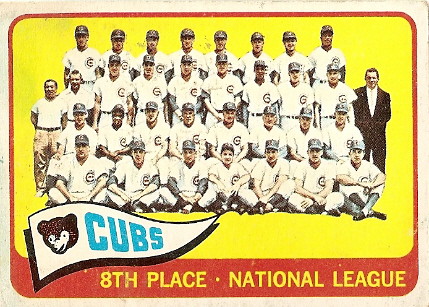
#91 Chicago Cubs Team Card

Here's another of the cards I received from reader Ed. This is my first team card for the 1965 Topps set, and it's a beauty. Sure, the team itself was a bottom feeder; their 76-86 won-lost record wasn't terrible, but this was the season in which an amazing pennant race saw the top five teams finish within five games of each other. But those classic Cubbie unis still look sharp, as does the old-school Cub head logo in the pennant. As the son of an art teacher, I'd be remiss if I didn't mention the excellent use of primary colors on this card. The club was managed by Bob Kennedy, who played on the first Orioles team in 1954. His son Terry was a catcher for the O's in the late 1980s. Kennedy was the Cubs' first conventional manager after the "College of Coaches" debacle in the early Sixties.

The card (and the team) features 33-year-old first baseman Ernie Banks (23 HR, 95 RBI), left fielder Billy Williams (.312, 33 HR, 98 RBI), and third baseman Ron Santo (.313, 30 HR, 114 RBI). The first two are Hall of Famers, while Santo's worthiness is still hotly debated. Speaking of Hall of Famers, a struggling young outfielder named Lou Brock was traded to the Cardinals in June for pitcher Ernie Broglio. Hindsight has proven that deal to be a big win for the Redbirds, of course. The pitching staff was led by veteran Larry Jackson, who won a career-best 24 games to lead the National League and sported a 3.14 ERA. Jackson finished second in ML Cy Young voting (back in the days when one award was given for the entire major leagues) to the Angels' Dean Chance, who won 20 games with a miniscule 1.65 ERA.

In looking at the 1964 Cubs roster, my favorite quirk is that there were two Burdettes on the pitching staff - former Braves star Lew and reliever Freddie - who do not seem to have been related to each other.