Sunday, May 04, 2008

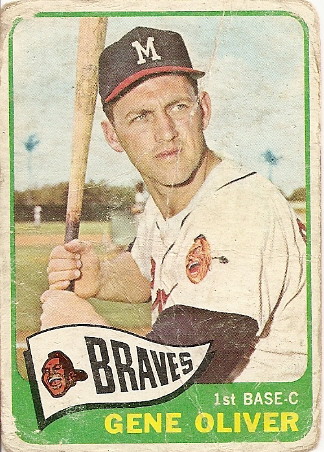
#106 Gene Oliver


This is another card that I was sent by reader Ed. As you can see, it has withstood the test of time, even though it's been battle-tested more than most of the other cards in my growing collection. Gene Oliver had a pretty interesting career. He was signed by the Cardinals in 1956 out of Northwestern University, where he had been a scholarship athlete in football. Gene was primarily a catcher, but also was a decent first baseman and serviceable outfielder. His longball power was his calling card, as he slugged 151 home runs in five-and-a-half minor league seasons. He led his league in deep flies three times, as you will see below on his card back. (Thanks to reader Mr. Schwartz for the excellent suggestion to scan the backs as well. I've been remiss in not sharing these great cartoons and stats with you; the minor league numbers especially are not available online.)
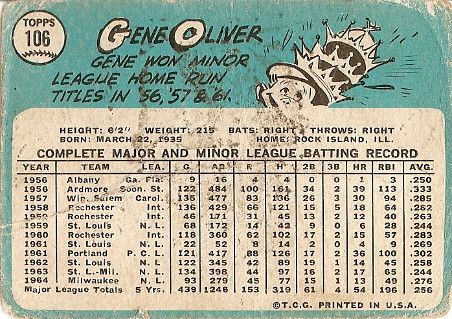
As you can see, Gene still showed some pop by the time he finally got playing time in the majors; he didn't stick around for a full season until he was 27. But 1965 would be a career year for Oliver, as he hit .270 with 21 home runs. He was one of six Braves to go deep 20 times or more , joining Hank Aaron, Eddie Matthews, Joe Torre, Felipe Alou, and Mack Jones. He struggled following the team's move to Atlanta, but did become the first player to hit 3 round-trippers in a single game at Fulton County Stadium as part of a 4-for-4, 7 RBI performance. The following season, he was traded to the Phillies for the one and only Bob Uecker. It was actually a fitting trade, as Oliver reportedly was a ukulele player and kept his teammates loose with his sense of humor.

Perhaps Gene's most impressive legacy as a big leaguer is his .409 career batting average against Dodgers great Sandy Koufax. He is the only man to top .400 against Koufax in more than 50 career at-bats. Gene Oliver passed away in March of 2007 after undergoing lung surgery. He was 71 at the time.

Thursday, April 24, 2008

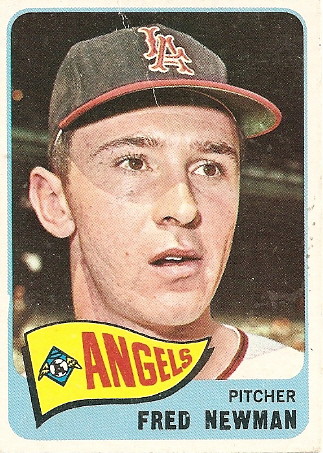
#101 Fred Newman

Card number three from reader Ed is another Angel. Has any team had a greater identity crisis than the Los Angeles/California/Anaheim/Los Angeles of Anaheim Angels? All of the commotion about the team's hometown is only further complicated by the fact that they played their home games in 1961 at Wrigley Field! (Obviously, it was another stadium in L. A. that shared a name with the Cubs' home field.)

Signed out of nearby Brookline High School as an amateur free agent by the Red Sox, Fred Newman was taken by the Los Angeles Angels in the expansion draft less than a year later. Fred is looking rather baby-faced in this photo, most likely because he was twenty-two in 1964. Newman's best pitch may have been his sinker, and he was known for his excellent control, which helped him win 13 games in 1964, his first full season in the majors. He sported a 2.75 ERA and allowed less than a hit per inning. He was just as good the following year, allowing just .86 hits per inning and posting a 2.93 ERA. The finest game of his career may have been a 5-0 victory over the Twins on June 30, 1965, in which he allowed just two hits and one walk while going the distance. However, the Angels' quiet bats handed him several tough-luck losses, and he finished with a 14-16 record.
Unfortunately, arm troubles brought Fred's promising young career to a premature end two years and 24 games later. His life game to a similarly premature conclusion, as he died in a car accident in 1987 at the age of 45.

Sunday, April 20, 2008

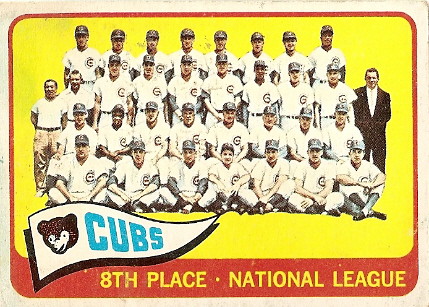
#91 Chicago Cubs Team Card

Here's another of the cards I received from reader Ed. This is my first team card for the 1965 Topps set, and it's a beauty. Sure, the team itself was a bottom feeder; their 76-86 won-lost record wasn't terrible, but this was the season in which an amazing pennant race saw the top five teams finish within five games of each other. But those classic Cubbie unis still look sharp, as does the old-school Cub head logo in the pennant. As the son of an art teacher, I'd be remiss if I didn't mention the excellent use of primary colors on this card. The club was managed by Bob Kennedy, who played on the first Orioles team in 1954. His son Terry was a catcher for the O's in the late 1980s. Kennedy was the Cubs' first conventional manager after the "College of Coaches" debacle in the early Sixties.

The card (and the team) features 33-year-old first baseman Ernie Banks (23 HR, 95 RBI), left fielder Billy Williams (.312, 33 HR, 98 RBI), and third baseman Ron Santo (.313, 30 HR, 114 RBI). The first two are Hall of Famers, while Santo's worthiness is still hotly debated. Speaking of Hall of Famers, a struggling young outfielder named Lou Brock was traded to the Cardinals in June for pitcher Ernie Broglio. Hindsight has proven that deal to be a big win for the Redbirds, of course. The pitching staff was led by veteran Larry Jackson, who won a career-best 24 games to lead the National League and sported a 3.14 ERA. Jackson finished second in ML Cy Young voting (back in the days when one award was given for the entire major leagues) to the Angels' Dean Chance, who won 20 games with a miniscule 1.65 ERA.

In looking at the 1964 Cubs roster, my favorite quirk is that there were two Burdettes on the pitching staff - former Braves star Lew and reliever Freddie - who do not seem to have been related to each other.

Wednesday, April 16, 2008

#38 Jim King

This is the first of nine cards that I recently received from reader Ed. Jim King was actually one of the original new Washington Senators...that is to say, when DC received a new expansion team before the 1961 season, they drafted him from the Cleveland Indians. King is shown here taking a mighty cut, which was his calling card as a player. He had his best seasons in Washington, clubbing a personal-best 24 home runs in 1963 and following up with another 18 in 1964. For his career, he reached double digits in roundtrippers eight times. Though he didn't hit for average (.240 career), his penchant for extra base hits and his good batting eye (363 walks and 401 strikeouts) made him a valuable contributor: his career OPS+ was 104, placing him just above the league average. In 1967, which proved to be his final season in the bigs, he was traded from the White Sox to the Indians for another slugger at the end of the line: outfielder Rocky Colavito.

Wednesday, March 26, 2008

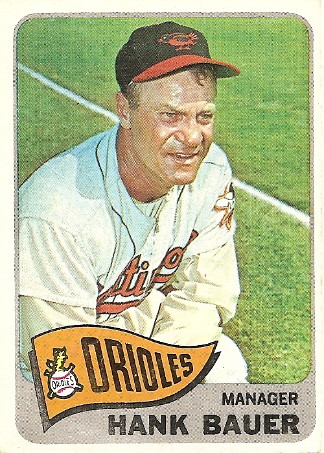
#323 Hank Bauer

See, I told you I'd be back! I received this beauty from reader Tim in NO, who was kind enough to send me a box full of Orioles cards that I needed. I've coveted this Hank Bauer card since the day I first saw it while clicking around on The Baseball Card Project. Bauer had a classic, weathered face to match his gruff bulldog persona, and yet most pictures I've seen of him showcase his wide, endearing smile. That's the case here, and it's even better because the loose strands of hair poking out from under his cap combine with the glistening forehead to make it look like he's just had a rough night out.

Hank Bauer was a regular in the Yankee outfield for eleven years, winning seven World Series in nine postseasons. His best performance came in his last Fall Classic, the 1958 showdown with the Milwaukee Braves. In that series, Bauer hit four home runs in seven games for a .710 slugging percentage. His longevity in the New York lineup is even more impressive when you consider the fact that he didn't play a full season in the majors until he was 26. Hank lost his early playing years to World War II, where he served as a U.S. Marine from 1942-1945, earning two Purple Hearts and two Bronze Stars. His second Purple Heart came in the Battle of Okinawa, when he commanded a platoon of 64 men. Bauer was one of only six who survived, being sent home after he was hit in the thigh with shrapnel.

Hank Bauer was also the manager that took the Orioles to the promised land, bridging the gap between the strong foundation that Paul Richards built and the prolonged greatness of the Earl Weaver era. In Bauer's first year at the helm (1964), the Baby Birds gave the Yankees a run for their money, spending 92 days in first place and holding the top spot as late as September 18. Ultimately they faded just a bit, finishing two games behind New York with a then-O's record 97 wins. 1965 brought another third-place finish and 94 more wins, but 1966 would be Baltimore's year. Bolstered by the addition of slugger Frank Robinson, Bauer's charges again won 97 games. This time it was good enough to take them to the World Series, where they swept the more-heralded Dodgers in four straight games, shutting them out over the last 33 innings. Hank was named Manager of the Year for his efforts, but the glory was short-lived. After an injury-plagued O's team stumbled to a fifth-place finish in 1967 and started slow the following year, he was replaced by Earl Weaver, who'd just been added to the coaching staff at the beginning of the season. The rest, as they say, is history.

Thursday, March 20, 2008

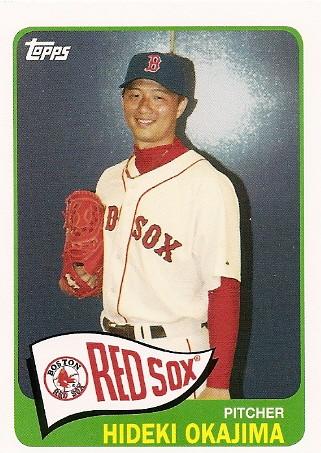
Long-Overdue Update

I'm still around! Things have been slow on the 1965 Topps front, which has obviously affected the frequency of my updates here. But I've been busy in all other aspects of my baseball card mania, at the very least. I picked up a jumbo hobby box of 2008 Topps right after its release, and was able to complete Series One. I really do love the design, as well as a couple of the more well-conceived inserts. The best of the bunch is Trading Card History, which features current players on various vintage card designs throughout history. There's an equal mix of early (1880s-1930s) tobacco and gum card designs and previous Topps designs. I was fortunate enough to pull the Hideki Okajima card patterned after the 1965 Topps set, which I couldn't resist posting here; consider him the long-lost 599th 1965 Topps card.

Speaking of 2008 Topps, I've continued to update my trade and want lists. I've gotten a lot closer to completing some pesky old sets with the help of my readers/trading partners. 1987 Topps is now my first hand-completed set, in fact! 1989 Topps may be the second; all I need is one lousy checklist. I've also added want lists for 1989 Upper Deck, 1990 Topps, 2006 Topps, and the 2008 Topps inserts I'm trying to complete - Campaign '08, 50th Anniversary All Star Rookies, and Trading Card History. The big addition to my trade list is the other 2008 inserts I've pulled - Year in Review, Own the Game, and the Mickey Mantle stuff. Ideally I'd like to get 2008 inserts in return for 2008 inserts, even-up. I'm also working my way through a box of 2008 Topps Heritage. I'm going to need a lot of help completing that one, so I'll put up a want list (and a list of my Heritage doubles) by next week.

Hopefully I'll have some new posts in the near future. I know for a fact that at least one more 1965 Topps card is headed my way, and I've gotten an email from another reader indicating that a few more might soon follow. If things reach a standstill again the way they did over the past month, I was also considering buying up some singles on eBay. I know it runs counter to the original concept of this blog, but I want to keep the content coming on a more consistent basis. Besides, if nothing else, the trade/donation concept did give me a nice little headstart in compiling this great set. If you feel strongly one way or the other about this, let me know. Thanks!

Tuesday, March 04, 2008

1959

1959 Topps (128): 8, 9, 10, 14, 18, 20, 24, 26, 28, 30, 34, 36, 37, 38, 45, 46, 50, 51, 57, 61, 62, 68, 72, 76, 77, 79, 86, 90, 91, 93, 102, 106, 110, 111, 129, 149, 150, 151, 163, 166, 167, 168, 171, 180, 185, 188, 190, 202, 205, 212, 291, 297, 298, 301, 305, 308, 316, 320, 335, 338, 339, 343, 350, 352, 355, 358, 360, 380, 385, 387, 389, 397, 402, 419, 430, 435, 443, 450, 461, 463, 464, 467, 472, 478, 485, 489, 495, 497, 508, 509, 510, 512, 513, 514, 515, 522, 525, 526, 527, 528, 532, 533, 534, 536, 537, 538, 541, 542, 543, 545, 546, 547, 548, 549, 550, 554, 555, 556, 559, 560, 561, 562, 563, 564, 565, 566, 569, 570, 572

Tuesday, February 19, 2008

Donation from Bob, Part Two: McNally and Powell

As promised, we resume with the second pair of 1965 Topps cards I received in a bundle of vintage Orioles from reader Bob. They're good ones too, bringing some real star power to my collection!

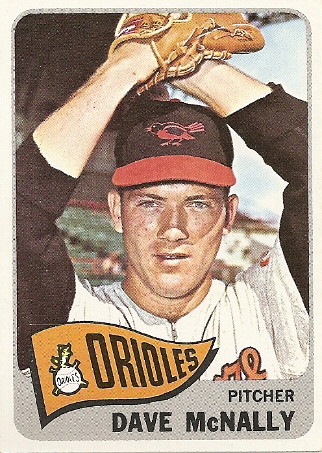
#249 Dave McNally

First up is a talented young lefty by the name of Dave McNally. He'd just finished his second full season in the major leagues, and was already showing signs of greatness. He'd dropped his ERA nearly a full run from 1963 to 1964 (4.58 to 3.67), and although he had yet to post a winning record, his three shutouts were third on the team in 1964 behind Milt Pappas and Robin Roberts; pretty good company, if you ask me. Better times were on the horizon for Dave, as he'd break out in 1965 with an 11-6 record and a 2.85 ERA for the Birds. In another year's time, he'd be on the mound for the team's first World Championship, slamming the door on the Dodgers with a 1-0 masterpiece in the clinching Game Four.

From 1968-1971, McNally won 87 games and lost only 31. He excelled in the postseason to the tune of a 2.49 ERA and 6 complete games in 14 starts. His grand slam in Game Three of the 1970 World Series remains the only granny hit by a pitcher in the history of the Fall Classic. Dave's place in Orioles lore is secure; his 181 wins rank him second in team history, as do his 33 shutouts. He places second in career strikeouts and complete games. He also made baseball history by winning a grievance against the Montreal Expos in 1975; he and Dodgers pitcher Andy Messersmith became baseball's first free agents.

#560 Boog Powell


This is a gem of a card featuring one of the most popular players in O's history. You might notice that it lists Boog's position as "Outfield". Indeed, he came to the Orioles as a slightly trimmer left fielder. In 1965, he would split his time between the infield and the outfield before settling at first base in 1966 and staying there. I also love this card because it showcases the classic road jersey with "Baltimore" emblazoned in orange script. The disappearance of this design in the 1970s, and the decision to stay away from it in recent years, is a major bone of contention for the majority of the Charm City faithful. The cartoonish bird head logo on the left sleeve is a precursor to the Woody Woodpeckerish emblem that would make its appearance the following year.
You might have also noticed the #8 on Boog's jersey, which another great player would make famous in the coming decades. Orioles uniform numbers are sort of my thing, but this one has escaped me so far. I've found records indicating that he wore #30 as a rookie in 1961, #16 for his sophomore season in 1962, and switched to his familiar #26 from 1963 onward. That would seem to indicate that this is a Spring Training photo, and may even be a few years old. Baseball-Alamanac.com suggests that he wore #8 and #26 in 1964, but why would he have switched back and forth, having already worn #26 the previous year? If anyone has more info, let me know.
I've also written about my Dad's recent encounter with Boog over at my Orioles Card O' the Day blog.

Wednesday, February 13, 2008

Donation from Bob, Part One: 1964 AL RBI Leaders and Charlie Lau

Today's entry was made possible by a very generous donation from reader Bob, who found my card blogs through my NumerOlogy website. (Psst, check it out if you haven't already.) He found my Topps Orioles Needs list in the sidebar and very generously sent me his duplicate Orioles cards from 1957 through 1983, a few hundred in total! Fortunately, there were four 1965 cards in the box he sent, so I'll be writing them up two at a time in the next two entries. Thanks again, Bob!


#5 AL RBI Leaders: Brooks Robinson, Dick Stuart, Mickey Mantle, and Harmon Killebrew
Wow, check out this murderers' row! Three Hall of Famers, plus "Dr. Strangeglove", one of the best nicknames in baseball history. 1964 was of course Brooks Robinson's MVP season, when he led the league in RBI (118) and placed second in batting average (.317) and tenth in home runs (28). It was the first of three straight top-three finishes for Brooks in MVP voting. You can read about my own personal encounter with him right here. As for the Mick, it's nice to finally have a vintage card featuring his likeness; I've really been getting burned out on Topps' flogging of #7 in their modern sets. Harmon Killebrew was in the prime of his career at this time; he had just hit 49 home runs, a high-water mark for him. "Killer" hit 40 home runs in five of his first six full seasons, in fact.
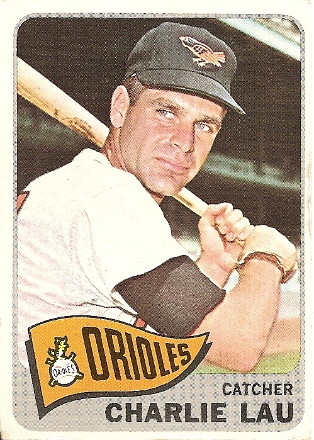
#94 Charlie Lau Check out that withering glare! I would not want to mess with Charlie. He was a reliable backup catcher for parts of eleven seasons, and did his best work with the bat in 1962 during his first stint in Baltimore. That year, Lau hit career peaks in the Triple Crown categories (.294, 6 HR, 37 RBI in 81 games). Most fans know Charlie best for his post-playing career as a hitting coach. His one-handed follow-through technique allowed maximum arm extension, enabling hitters to spray the ball all over the field. He became something of a guru, writing the book How to Hit .300 and working with the Orioles, Athletics, Royals, Yankees, and White Sox over parts of three decades. His most famous students include George Brett, Hal McRae, and Carlton Fisk. Other players (such as Frank Thomas) still use his methods today, nearly twenty-five years after he died of cancer.
Two more 1965 Orioles to come soon!

Friday, February 08, 2008

My Prize from Cardboard Junkie: Rigney, Narum, Boyer World Series

Okay, my latest round of UPS stalking tells me that my package containing a jumbo box of 2008 Topps Series 1 and a jumbo box of 2006 Topps Series 2 (I threw that one in to reach the threshold for free shipping) is likely to arrive today, so I'd better knock this post out while I still have a chance. As the title suggests, these three cards arrived last week from Dave the Cardboard Junkie. I'd won my choice of several fabulous prizes for spotting one of the rogue 2006 Topps '52 Rookies in his 2007 pack rips on A Pack a Day. When offered, I will never turn down 10 Vintage Topps cards. In addition to some very cool Orioles, including a 1958 Gene Woodling, a 1970 ALCS recap card, and a fantastic 1973 Jim Palmer Boyhood Photo, there were the following:
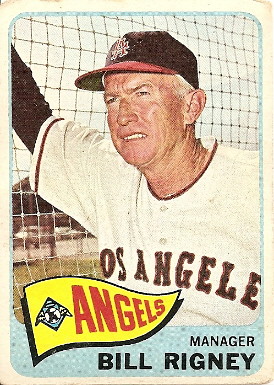
Bill is both my first manager and my first Angels card in the set. As you can see, the team was still known as the Los Angeles Angels, before they became the California Angels, then the Anaheim Angels, and most recently the insipid Los Angeles Angels of Anaheim. Just pick a name and stick with it! That uniform looks pretty sharp, though. Bill suffers from Sparky Anderson disease, in which the rigors of managing ages the subject terribly. Though I'd have pegged him as sixty-five years old at a glance, "The Cricket" was all of forty-six at the time of this photo. Yikes.
Bill served in the Coast Guard during World War II, which may have contributed to his late arrival in the big leagues as a player; he was 28 when he got his start with the Giants as an infielder. He hung around for eight seasons, hitting .259 overall and gaining an All-Star berth in 1948. Three years after his retirement, he became manager of his old team; in fact, he was the last manager of the New York Giants. Rigney was named Manager of the Year in 1962, when he guided the second-year Angels squad to 86 wins and a third-place finish in the American League.

Hey, check it out, a former Oriole! Les actually went by "Buster" for most of his career, and broke in with the Birds in 1963, tossing nine nondescript innings in relief. However, he also hit a home run in his first major league at-bat, a two-run shot off of the legendarily ugly Don Mossi in what would be an 8-5 triumph for the O's.

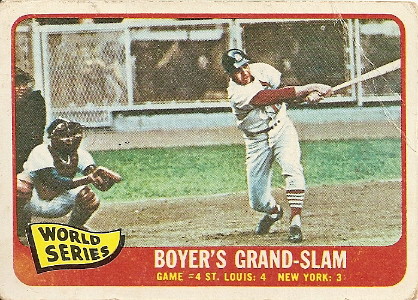
#135 World Series Game 4: Ken Boyer's Grand Slam

Hey, a World Series card! This is an amazing action shot of a great player; Ken was a five-time Gold Glover and a seven-time All Star while manning the Hot Corner for the Cards. This grand slam was one of Boyer's only big moments with the bat in a thrilling seven-game victory for St. Louis over the Yankees. However, it was a fitting cap to a season in which he won the NL MVP (.295, 24 HR, league-leading 119 RBI). I love Clete's striped stirrups; I think Anthony Reyes is the only current Cardinals player who shows off his stripes on a regular basis. Ken was the lucky one out of the baseball-playing Boyer brothers; you might remember his brother Clete as a solid third baseman for the Yankees, but older brother Cloyd pitched for the Cardinals as well. Clete is bad enough, but who in their right mind names a boy "Cloyd"? Did his father mean to say "Lloyd", but he coughed and the hospital secretary wrote it on the birth certificate like that?

I'll be back soon; another reader is generously sending me a few 1965 Orioles for my collection!