Showing posts with label angels. Show all posts

Wednesday, April 20, 2011

#46 Bob Lee

#46 Bob Lee
Observations:

1. The photographer was really intent on capturing Bob Lee's chest hair.
2. Bob wears/wore a Rawlings glove.
3. I'm a big fan of the "Los Angeles" road jersey. I think all teams should wear their city name on the grays, and I was thrilled when my Orioles went back to "Baltimore" on their away threads a few years ago.
4. Bob Lee's name is a nonsense adverb.

Fun facts about Bob Lee:

-A native of Ottumwa, IA, Bob signed with the Pirates in 1956, several months before his 19th birthday.

-His progress through the minors was slow; he didn't reach A-ball until 1960, his fifth pro season.

-In 1963, he spent much of the year with the New York-Penn League (Class A) Batavia Pirates, going 20-2 with a 1.70 ERA and 0.99 WHIP. Late that summer, Pittsburgh dealt him to the Angels.

-Known as either "Moose" or "Horse" due to his 6'3", 230-pound frame, Bob broke camp with the Angels in 1964. The 26-year-old rookie had a great year out of the L.A. bullpen, going 6-5 with a 1.51 ERA and a team-leading 19 saves. He also struck out 111 batters in 137 innings.

-Though he made his mark in relief, he started five games for Los Angeles in his first big league season. The first start was an April 25, 1964 gem against Cleveland; he allowed one run and struck out eight in ten innings but did not earn a decision as the Indians won in the eleventh. His first career win came in his next start, as he one-hit the Senators for seven innings in a 5-1 Angels victory. However, Lee totaled 9.2 innings over his next 3 starts while allowing 11 runs, convincing the team to keep him in the 'pen.

-He was the Halos' lone All-Star in 1965, when he vultured 9 wins in relief to go along with 23 saves and a 1.92 ERA.

-Though his 2.74 ERA and 16 saves were both the best marks on the team for the third year running, Lee's strikeout rate dropped precipitously in 1966 (4.1 K/9 IP). It would prove to be his last effective season.

-He split the 1967 season between the Dodgers and Reds, compiling a 4.55 ERA in 31 appearances and saving only 2 games.

-The end of the road came in 1968, when he walked more batters than he fanned and put up a 5.15 ERA in 44 games for Cincinnati. In 5 seasons, he was 25-23 with a 2.71 ERA and 63 saves.

-Lee later opened a barber shop near Anaheim Stadium, home to the Angels.
#46 Bob Lee (back)

Monday, April 04, 2011

#26 Bobby Knoop

#26 Bobby Knoop
Here are the fruits of a short and sweet trade with MattR of A Giant Blog and Project Baseball 1976. He sent me Bobby Knoop and #27 Dick Bertell (to be posted tomorrow) as well as a couple of 1967 Topps Orioles that I needed. In return, I cobbled together some various and sundry Giants cards from his want list. Thanks Matt!

I always thought that Bobby Knoop's name was pretty odd. I assumed it was pronounced "Nupe" (rhymes with loop) on account of the double-o. But analysts and announcers seem to pronounce it "Nopp" (rhymes with cop). Oh well.

Fun facts about Bobby Knoop:

-Bobby was born in Sioux City, IA but attended high school in Montebello, CA before signing with the Braves in 1956.

-He was stuck in the minors for eight years before the Angels claimed him in the Rule 5 draft, ensuring him a spot on the major league roster in 1964. Though he batted just .216 with a .289 on-base percentage, 7 home runs, and 38 RBI, he saw action in all 162 games as a 25-year-old rookie.

-Knoop achieved personal bests in 1965 with a .269 average and 24 doubles.

-His most productive season was 1966, when he socked 17 home runs, drove in a team-high 72 runs, and led the American League with 11 triples. He was named to his only All-Star team.

-Bobby was a gifted defensive second baseman, nicknamed "Nureyev" by sportswriters who compared his dexterity and grace to the Russian ballet dancer. He partnered with shortstop Jim Fregosi to give the Angels a successful double-play combo and won three straight Gold Gloves (1966-1968).

-He was traded to the White Sox in May 1969 when his offense began to slip. However, he remained a top defender during his two seasons in Chicago.

-Though he hit just seven home runs in 1969, two came in a May 30 loss to the Senators.

-Knoop finished his career with the Royals, where he backed up Cookie Rojas in 1971-1972. In parts of 9 big league seasons he batted .236 with 56 home runs and 331 RBI.

-Loved to face: Camilo Pascual (.415/.442/.683 in 43 plate appearances). Hated to face: Steve Barber (.065/.137/.065 in 51 PA).

-He spent nearly a quarter-century coaching for the White Sox, Angels, and Blue Jays. Today he is an assistant coach at Seton Catholic High in Arizona.
#26 Bobby Knoop (back)

Friday, March 04, 2011

#140 Dean Chance

#140 Dean Chance
I firmly believe that names are important. A guy with a name like "Dean Chance" just seems to have a much better chance of being a successful baseball player than "Micah Hoffpauir", don't you think?

Fun facts about Dean Chance:

-A native of Wooster, OH, Dean signed with the Orioles in 1959 out of high school.

-After going 22-12 with a 3.07 ERA in his first two pro seasons, he was chosen by the Senators in the expansion draft. They immediately traded him to their first-year counterparts (the Angels) for Joe Hicks, an outfielder who would hit .217 for Washington. Chance debuted with Los Angeles in September 1961, but was hit hard.

-The Halos kept him on the big league roster for the entire 1962 campaign, and he saw action in 50 games (24 starts). Dean led the club with a 14-10 mark and a 2.96 ERA, and his 8 saves were one off of the team lead. He received a single vote out of the 20 cast for A.L. Rookie of the Year. The winner was New York's Tom Tresh (.286/.359/.441, 20 HR, 93 RBI). If this vote played out today, bloggers and analysts would be howling over the four votes given to Angels catcher Buck Rodgers (.258/.309/.372, 6 HR, 61 RBI).

-Poor run support doomed Chance to a 13-18 record despite his 3.19 ERA in his sophomore season. But he took matters into his own hands in 1964 with league-leading totals in ERA (1.65), complete games (15), shutouts (11), innings pitched (278.1), and home runs per nine innings (0.2/9). Incredibly, he surrendered just seven home runs all season; you could certainly forgive him for being taken deep once each by Norm Cash, Mickey Mantle, and Brooks Robinson. Dean also went 20-9 to top the A.L. in wins, and earned an All-Star nod and the Cy Young Award. The latter was no mean feat, as only one award was given for the entire major leagues that year. He left the Cubs' Larry Jackson (24-11, 3.14 ERA) and the Dodgers' Sandy Koufax (19-5, 1.74) in his wake.

-The effectively wild right-hander never quite matched that dominant 1964 effort, but remained effective for two more years in Los Angeles before being traded to the Twins for Pete Cimino, Jimmie Hall, and Don Mincher. Dean was an All-Star in his Minnesota debut in 1967, as he went 20-14 with a 2.73 ERA and topped the A.L. with 18 complete games. He was named Comeback Player of the Year, but his season ended in disappointment. His 5-3 loss to the Red Sox in the final game decided the American League pennant.

-On August 25, 1967, he no-hit the Indians in the nightcap of a doubleheader. It was a 2-1 squeaker, with the Tribe manufacturing a first-inning run on two walks, an error by third baseman Cesar Tovar, and a wild pitch. Tovar scored the winning run in the sixth inning when Cleveland starter Sonny Siebert balked with runners on the corners!

-His last strong year came in 1968, when he set a career high with 234 strikeouts and turned in 15 complete games and a 2.53 ERA. His 16-16 record was hampered by poor Twins hitting; 17 times in his 39 starts the offense gave him less than three runs of support.

-After a sore shoulder held him to 15 starts in 1969, Dean changed teams frequently. He split an ineffective 1970 season between the Indians and Mets, and tossed only 89.2 innings for the Tigers in 1971. They released him in October and he called it a career.

-In parts of 11 seasons, he was 128-115 with 23 saves and a 2.92 ERA. His career rate of 0.44 HR/9 IP is the lowest in Angels franchise history, and only Andy Messersmith (2.78 ERA) had a lower earned run average in his Angels tenure than Chance's 2.83.

-In 1969, Dean became a boxing promoter and manager. He founded the International Boxing Association in the 1990s and is president of IBA to this day. It's a professional sanctioning body, and its titles are viewed as a stepping-stone to greater honors. Notable former IBA champs include Oscar de la Hoya, Roy Jones, Jr., James Toney, George Foreman, Arturo Gatti, Sugar Shane Mosley, and Antonio Tarver....not to mention Eric "Butterbean" Esch!

#140 Dean Chance (back)

Tuesday, February 22, 2011

#486 Angels Rookie Stars: Tom Egan and Pat Rogan

#486 Angels Rookie Stars: Tom Egan and Pat Rogan
There's a creepy ethereal quality to the background of Pat Rogan's picture. It looks like the wainscoting of the heavens.

Fun facts about Tom Egan:

-A native of Los Angeles, Tom signed with the Angels as a teenager in 1964.

-He debuted with the Halos in May 1965, just short of his 19th birthday. He played sparingly, but hit .263 in 38 at-bats.

-Tom didn't spend a full season in the majors until 1969. Backing up Joe Azcue, he batted just .142 with 5 home runs. However, two of his homers came off of Hall of Famer Catfish Hunter.

-He threw out 43.6% of attempted base stealers in 1969, fifth-best in the American League.

-Had a career day on September 20, 1970, with four hits in five at-bats (including two doubles) as the Angels walloped the White Sox 9-2.

-Egan was traded to the White Sox after the 1970 season. The following year, he played in a career-high 85 games and had a .239 average, a .320 on-base percentage, 10 home runs, and 34 RBI.

-After dipping back below the Mendoza line in 1972, the catcher spent all of 1973 at Chicago's AAA Iowa affiliate. This allowed the Angels to bring him back via the Rule 5 draft.

-On September 28, 1974, he had the thrill of catching Nolan Ryan's third no-hitter, a 4-0 victory over the Twins.

-Tom's final season was1975, when he hit .229 in 28 games. In parts of 10 big league seasons, he had an average of .200 on the nose with 22 home runs and 91 RBI.

-He became a minor league manager at the tender age of 30, spending two unsuccessful seasons at his post in the low minors of the Mets organization.

Fun facts about Pat Rogan:

-Right away, I have to tell you to bear with me. Pat never made it to the big leagues, so there's not much information available.

-Pat was born on November 29, 1943 and appears to have been signed by the Angels circa 1962.

-At age 18, he held his own at Class C San Jose with a 12-9 record, 8 complete games, and a 3.92 ERA.

-The Angels may have pushed him too far too soon, as he scuffled at AAA Hawaii in 1964 (9-11, 4.53)  and was even worse the following year at AA El Paso (5-10, 5.53).

-Back down at Class A San Jose, Rogan had a good 1966: 10-4, 2.84 ERA.

-Set a career high in 1967 with 13 wins while pitching for San Jose and El Paso.

-He was out of organized baseball after splitting the 1968 season among California's top three farm teams and combining to go 10-7 with a 3.08 ERA. Just 24 at the time, Pat finished with a minor league record of 66-57 and a 3.98 ERA in 7 seasons.
#486 Angels Rookie Stars: Tom Egan and Pat Rogan (back)

Wednesday, February 09, 2011

#374 Angels Rookie Stars: Jose Cardenal and Dick Simpson

#374 Angels Rookies: Jose Cardenal and Dick Simpson
You're not fooling anyone, Jose Cardenal. We all know that's a Giants uniform. Why do you think Dick Simpson is smirking at you?

Fun facts about Jose Cardenal:

-A native of Matanzas, Cuba, Jose signed with the Giants in 1960 when he was only 16.

-He moved quickly through the San Francisco farm system, hitting .312 with 36 home runs and 35 steals at AA El Paso in 1963. The Giants gave him a few brief looks in 1963 and 1964, but he managed a single hit in 20 at-bats.

-The Angels acquired Cardenal and made him their starting center fielder in 1965. Though his on-base skills were lacking (.250 AVG/.287 OBP), he was a rangy and strong-armed defender. His 37 steals were the second-highest total in the American League behind his cousin, Bert Campaneris of the A's.

-From 1967-1972, Jose played for five teams in a six-year span: the Angels, Indians, Cardinals (yep, Cardenal was a Cardinal), Brewers, and Cubs.

-He tied a major league record by executing two unassisted double plays as an outfielder in 1968. The first was on June 8, and the second was on July 16.

-With the Cubs, the quirky outfielder enjoyed a productive prime. While playing primarily on the corners (where he was said to have chewed on the ivy that hung on Wrigley Field's wall), he batted .296 with a .363 on-base percentage and 129 steals in a 6-year span.

-In 1975, Jose batted a career-high and team-leading .317 with a .397 on-base percentage. He also paced the Cubs with 30 doubles and 34 steals.

-On May 2, 1976, Cardenal was instrumental in a 14-inning 6-5 Cubs win over the Giants. Playing the whole game, he went 6-for-7 with a home run, a double, a stolen base, and 4 RBI. His single off of Gary Lavelle plated the winning run in the final inning.

-He spent the final three seasons of his career as a part-timer for the Phillies, Mets, and Royals and retired with a .275 average, 138 home runs, 775 RBI, and 329 steals in parts of 18 seasons.

-He spent a decade as a big league coach with the Reds, Cardinals, Yankees, and Devil Rays, and later worked as a senior advisor to the Nationals' general manager.

Fun facts about Dick Simpson:

-Dick was born in Washington, DC and attended high school in California before signing with the Angels in 1961.

-He was only 19 when he made his big league debut on September 21, 1962 with an RBI pinch single off of Mudcat Grant of the Indians.

-Simpson never did break into the Angels' lineup, totaling 35 major league games before being traded to the Orioles for first baseman Norm Siebern in December 1965. Just a week later, he was flipped to the Reds along with Milt Pappas and Jack Baldschun in the famous trade that brought Frank Robinson to Baltimore.

-Though he appeared in 92 games with the Reds in 1966, Dick totaled just 99 plate appearances and started 16 games. He batted .238 with a .333 on-base percentage, 4 home runs, and 14 RBI.

-After batting .259 in a scant 54 at-bats in 1967, he split the following season between the Cardinals and Astros. In a career-high 267 plate appearances, he managed a paltry .197 average and .292 on-base percentage with 6 home runs and 19 RBI.

-1969 proved to be Simpson's final season in the majors, as he combined to hit .194 in 32 games with the Yankees and Pilots.

-His last home run as a big leaguer was on June 9, 1969. He took Detroit's Mickey Lolich deep as the first batter of the game. Lolich went on to strike out 16 Seattle hitters and did not allow another run, but departed after nine innings with the game tied. The Pilots won 3-2 in 10 innings.

-In parts of 7 seasons, he batted .207 with 15 home runs and 56 RBI. Though he was considered one of the fastest players of his era, he stole only 10 bases in 20 career attempts.

-He briefly played in the minors for the Giants and Padres in 1970-1971.

-Dick is currently thought to be living in Venice, CA.
#374 Angels Rookies: Jose Cardenal and Dick Simpson (back)

Wednesday, January 19, 2011

#569 Gino Cimoli

#569 Gino Cimoli
Wow, Gino Cimoli is impeccably coiffed. His pompadour has a pompadour.

Fun facts about Gino Cimoli:

-Gino was born in San Francisco and signed with the Dodgers as a teenager in 1949.

-Despite hitting .292 in the minors, he did not get a crack at the big leagues until 1956. That year, the 26-year-old was used primarily as a defensive replacement in the outfield. He batted only 38 times in 73 games, scraping out four hits and a walk (.111 AVG, .135 OBP).

-1957 saw Gino flourish in a starting role, batting a career-high .293 with 10 home runs and 57 RBI. He was named to his only All-Star team.

-His first two home runs as a Dodger were both notable. On April 16, 1957, he handed future Hall of Famer Robin Roberts a 12-inning complete game loss with a solo shot. On May 6 of that year, he hit his only walkoff homer to give Brooklyn a 14-inning win over the Braves. The latter home run gave young reliever Sandy Koufax his fifth career win.

-After being dealt to the Cardinals, he hit .279 with a personal-best 72 RBI in 1959, his lone season with the club. His 40 doubles were fourth-most in the National League, and he placed eighth with 7 triples.

-Cimoli served as the fourth outfielder for the 1960 Pirates, but started five of the seven World Series games after Bob Skinner hurt his thumb. He filled in admirably, scoring four runs and batting .250 in the Fall Classic. His pinch single in the deciding game sparked a five-run Pittsburgh rally and set the stage for Bill Mazeroski's dramatic home run in the ninth inning.

-He played sparingly for the Pirates and Braves the following year, but found himself back in the starting lineup after being drafted by the Athletics. In 1962, he led the American League with 15 triples. Though the rest of his offensive numbers dipped in 1963, he banged out another 11 triples to place fourth in the league.

-Gino's decline came on abruptly. He saw action in just 42 games in 1964, batting .119 with the A's and Orioles before being demoted to AAA Rochester. The Angels barely used him the next year before releasing him in May. In parts of ten seasons, he hit .265 with 44 home runs and 321 RBI.

-In his post-baseball career, Cimoli became a UPS driver. In 1990, the company honored him for 21 years of service without a single traffic accident. He was light-heartedly referred to as "the Cal Ripken of UPS".

-Today, the 81-year-old still calls San Francisco his home.
#569 Gino Cimoli (back)

Monday, January 10, 2011

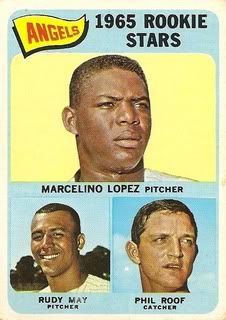
#537 Angels Rookie Stars: Marcelino Lopez, Rudy May, and Phil Roof

#537 Angels' Rookie Stars: Marcelino Lopez, Rudy May, and Phil Roof
It's disorienting to see Rudy "The Dude" May without his famous oversized glasses. Also, I wonder if Rudy and Phil were jealous of Marcelino for nabbing the top half of the card all for himself.

Fun facts about Marcelino Lopez:

-A native of Havana, Cuba, Marcelino was barely 16 when the Phillies signed him in 1959.

-His record in the minors was uneven, but the Phils placed him on their major league roster in April 1963. The 19-year-old only totaled six innings in four appearances, but did earn his first win on April 20 by limiting the Cardinals to two runs in five innings.

-Acquired for Vic Power after the 1964 season, Lopez threw 215.1 innings for the Angels as a rookie in 1965. He went 14-13 (putting him one off of Dean Chance's team-leading win total) with a 2.93 ERA. He narrowly lost the Rookie of the Year vote to Baltimore's Curt Blefary, but did make the Topps All-Star Rookie Team.

-Marcelino did not fare so well in his sophomore season. His ERA jumped by a full run and his record was a woeful 7-14. He also led the A.L. with nine hit batsmen.

-However, he did pitch the game of his life on September 23, 1966. Facing the soon-to-be World Champion Orioles, he allowed three hits and two walks while striking out a dozen O's batters. It was the third and final shutout of Lopez's career. Even though a glimpse at the box score indicates that Hank Bauer was resting his starters, that shouldn't take away from a great performance.

-He was traded to the pitching-rich Orioles in June 1967 and appeared in four games for them that year, apparently suffering from a sore arm. The club kept him in the minors for the entire 1968 season and some of the next year as well.

-Lopez served as a long reliever in the Baltimore 'pen for much of 1969, winding up with a 4.41 ERA in 69.1 innings. His performance was uneven, but highlights included a win against his old club on June 10. The Cuban replaced O's starter Tom Phoebus in the fourth inning and held the Angels hitless for the rest of the game, walking a pair and striking out four in five and one-third innings. The Birds had assaulted Halos starter Rudy May (how 'bout that?) and reliever Bob Priddy for 11 runs in the first 3 innings, and Marcelino reaped the benefits.

-He had a much better season in 1970, compiling a 2.08 ERA in 25 games. The southpaw even saw action in Game Two of the World Series, relieving Moe Drabowsky with two on and one out in the seventh inning and the O's clinging to a 6-5 lead. He got Bobby Tolan to foul out to Brooks Robinson and was relieved by Dick Hall, who closed out the inning and finished the game. In his only Fall Classic action, Lopez faced one batter and earned a hold!

-Marcelino finished his big league career with a mediocre season in Milwaukee and a four-game cup of coffee in 1972 with the Indians. In parts of eight seasons he was 31-40 with a 3.62 ERA and a pair of saves.

-Lopez passed away in 2001 in Hialeah, FL. He was 68 years old.

Fun facts about Rudy May:

-Rudy was born in Coffeyville, KS, and signed with the Twins in 1962 at age 18.

-He had the rare distinction of changing organizations three times before his 21st birthday. The White Sox acquired him in the minor league draft in late 1963 and traded him to the Phillies the following October. Two months later, he was dealt to the Angels for Bo Belinsky.

-May debuted with the Halos on April 18, 1965 and immediately attracted notice. He held the Tigers hitless until Jake Wood doubled with one out in the eighth. Wood scored the tying run on a George Smith error, ad May was lifted after nine innings of one-hit, ten-strikeout ball with the game still tied. There would be more growing pains that year; his ERA was a manageable 3.92, but he battled control problems (78 BB/76 K) and posted a 4-9 record.

-Rudy did not re-emerge in the majors until 1969, when he put up a 10-13 record in 43 games (25 starts) with a 3.44 ERA.

-He spent the next four seasons as a full-time starter, peaking in 1972 with a 12-11 mark (his only winning season in California) and a 2.94 ERA with a career-high 169 strikeouts.

-Despite fashioning a 28-inning scoreless streak from April 17-May 9, 1973 was a tough year for him (7-17, 4.38 ERA). Rudy was traded to the Yankees the next May. He pitched effectively for them for parts of three seasons, including a 14-12 season with a 3.06 ERA and personal-best 13 complete games in 1975.

-May was traded to the Orioles in the massive 10-player deal in June 1976 that also brought Tippy Martinez, Rick Dempsey, and Scott McGregor to Baltimore. In a season and a half with the O's, the lefty was 29-21 with a 3.68 ERA.

-He spent the 1978 and 1979 seasons in Montreal. In the latter year, the Expos shifted him to the bullpen with great results (10-3, 2.31 ERA).

-The Yankees reacquired Rudy in 1980, and he had his best all-around season. Despite starting in only 17 of his 31 appearances, he went 15-5 and led the league in ERA (2.46), WHIP (1.04), and strikeout-to-walk ratio (3.41: 133 K, 39 BB). He also pitched in six postseason games for New York in 1980-1981, most notably an eight-inning complete game 3-2 loss to the Royals in Game Two of the 1980 ALCS.

-Rudy retired in 1983 following a 16-year major league career. He was 152-156 with 12 saves and a 3.46 ERA.

Fun facts about Phil Roof:

-A native of Paducah, KY, Phil signed with the Braves as a teenager in 1959.

-He comes from a big baseball family. Younger brother Gene was an outfielder with the Cardinals and Expos in the early 1980s, and cousin Eddie Haas briefly played outfield for the Cubs and Braves between 1957 and 1960, and managed Atlanta in 1985. Three other brothers played in the minors, as have three nephews!

-Roof spent six seasons in the Milwaukee farm system, appearing in one major league game each in 1961 and 1964.

-In 1965, Phil embarked on a long career as a light-hitting part-time catcher, appearing in 52 games for the Angels and Indians and batting a scant .162 with three RBI. He stuck around for years thanks to a reputation for handling young pitchers well.

-He spent the next four seasons with the Athletics and actually started the majority of the team's games behind the plate. In 1965 he reached career highs in games (127), hits (77), doubles (14), home runs (7), and RBI (44).

-Roof moved on to the Brewers for a season and a half before landing in Minnesota, where he remained for parts of six seasons. In limited play in 1975 (142 plate appearances in 63 games), the veteran had by far his best rates: .302 AVG/.353 OBP/.484 SLG. He also matched his personal-best total of seven home runs.

-On May 30, 1972, he powered the Twins to a 3-2 win over the Royals with the only two-homer game of his career.

-After short cameos with the White Sox and Blue Jays, Phil retired in 1977. He left behind a .215 average with 43 home runs and 210 RBI in a career that spanned 15 big league seasons.

-He managed for 16 seasons in the Twins organization, including 11 years with their AAA affiliates in Portland, Salt Lake City, and Rochester. Overall his record was 1165-1116 at the time of his retirement in 2005.

-Roof also served as a bullpen coach in the majors for the Padres, Mariners, and Cubs.
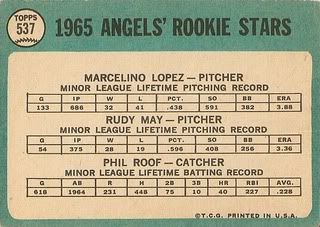
#537 Angels' Rookie Stars: Marcelino Lopez, Rudy May, and Phil Roof (back)

Monday, November 01, 2010

#422 Aubrey Gatewood

#422 Aubrey Gatewood
Aubrey Gatewood is one of only three men in major league history named "Aubrey". The first was Aubrey Epps, a catcher who played a single game for the Pirates in 1935, and the other is Aubrey Huff, the power-hitting first baseman whose home run last night provided the Giants with the winning runs in Game Four of the World Series.

Fun facts about Aubrey Gatewood:

-A native of Little Rock, AR, Aubrey attended Arkansas State University before signing with the Tigers in 1959.

-The Angels claimed him in the expansion draft, and three years later gave him a look in the majors. In his debut on September 11, 1963, he earned the victory with a complete game four-hitter as L.A. beat the Red Sox 4-1.

-He held his own in two more starts and a relief appearance to finish September with a 1.50 ERA, but poor run support kept him from any more wins.

-Gatweood spent the second half of the 1964 season back with the Angels and looked strong in relief but often struggled in starts. He had a 2.24 ERA overall in 60.1 innings.

-The Halos kept Aubrey mostly in the bullpen in 1965, and he was solid again with a 3.42 ERA.In a troubling sign, he walked as many as he struck out (37 each).

-After developing arm troubles, Gatewood learned to throw a knuckleball. But the results were inconsistent, and he languished in the minors for the next four-and-a-half years. During that time he became the property of the Reds, then the Orioles, and finally the Braves.

-Atlanta promoted him to the majors in June of 1970, nearly five years after he'd last thrown a big league pitch. He had two effective relief outings before a disastrous attempt at mop-up work on July 8. With the Braves trailing the Giants 6-0 in the fifth inning, he allowed a runner that he'd inherited from Phil Niekro to score, and a run of his own as well. With two on and two out, he looked to have escaped further damage when he coaxed a ground ball from Willie Mays. But shortstop Sonny Jackson booted it and both runners scored. Willie McCovey received an intentional pass, and Dick Dietz walked to load the bases for Jim Hart. Hart cleared the bases with a triple, and Gatewood was yanked with the Braves in a 13-0 hole. He'd allowed six runs in one-third of an inning, but only one of them was earned. Nonetheless, it was the last game he ever pitched in the majors.

-In parts of four MLB seasons, he was 8-9 with a 2.78 ERA. His complete game in his debut was the only one of his career. He pitched in the minors through the 1971 season.

-Norm Cash was 0-for-7 off of Aubrey in his career. Boog Powell was 2-for-12 with a double, and Luis Aparicio was 1-for-11.
#422 Aubrey Gatewood (back)

Friday, September 03, 2010

#358 Albie Pearson

#358 Albie Pearson
Albie Pearson was a seriously tiny dude: 5'5", 140 pounds. For a little perspective, CC Sabathia is listed as 6'7" and 290 pounds! He's two Albies!

Fun facts about Albie Pearson:

-Born in Alhambra, CA, Albie signed with the Red Sox in 1953.

-After five years in the Boston chain, he was traded to the Senators and made the big league squad at age 23 in 1958.

-As Washington's everyday center fielder, he led the club with 25 doubles and seven steals (they didn't do much running!) and batted .275 with a .354 on-base percentage. He walked twice as often as he struck out and was named A.L. Rookie of the Year.

-Albie suffered from a sophomore AND junior slump, as he batted only .223 with seven doubles and 14 RBI in 350 trips to the plate for the Senators and Orioles in 1959-1960. The O's even shipped him out to their minor league club in Miami.

-The diminutive outfielder hit only one home run during his stint in Baltimore. It was a two-out, eighth-inning grand slam off of New York's Jim Coates. Unfortunately, it only closed the O's deficit to 12-5 in a game they ultimately lost 15-9 (teammate Billy Klaus hit ANOTHER grand slam in the ninth!).

-Chosen by the Angels in the expansion draft, Pearson got untracked, hitting a team-best .288 with a .420 on-base percentage (thanks to 96 walks). He paced the team with 92 runs and 11 steals.

-After topping the American League with 115 runs scored in 1962, Albie was an All-Star the following year. His average was a personal-best .304 (fourth in the league), he walked 90-plus times for the third straight year, and added 26 doubles.

-Derailed by back spasms, he slumped to .223 in 1964 before rallying for one last hurrah the year after (.278 AVG, .370 OBP, 12-of-13 SB). He made it into just three games before the Angels released him in July of 1966.

-In eight-plus seasons, Albie hit .270 with a .369 on-base percentage, 28 home runs, and 214 RBI. He was 77-for-110 as a base stealer.

-Pearson is an ordained minister who has founded an organization to train fellow pastors and ministers. He and his wife have also founded a youth organization to keep kids drug-free, and in 2002 they dedicated Father's Heart Ranch in Desert Hot Springs, CA. It is an 11-acre home for abused, neglected, and abandoned boys.
#358 Albie Pearson (back)

Wednesday, August 25, 2010

#342 Bob Rodgers

#342 Bob Rodgers
Those are some pearly whites that Bob (aka Buck) Rodgers is flashing! I hope his dentist had this card framed in his office.

Fun facts about Bob Rodgers:

-A native of Delaware, OH, Bob signed with the Tigers right out of high school in 1956.

-After five years in the Detroit organization, Bob was claimed by the Angels in the 1960 expansion draft. He made his major league debut in September of 1961, hitting .321 in 16 games.

-His first career home run came on September 29, 1961 off of Cleveland's Barry Latman. It was a third-inning grand slam that gave the Angels a 6-4 lead and capped the scoring for both clubs.

-He became Los Angeles' starting catcher in 1962 and hit .258 with 34 doubles (fifth-best in the A.L.), 61 RBI and a league-leading 34 baserunners caught stealing. His 45.9% caught stealing rate was second in the league; he would gun down 43% of would-be thieves for his career. The switch-hitting backstop also set a rookie record with 155 games caught. He was named to the Topps All-Star Rookie team and placed second in Rookie of the Year voting behind Tom Tresh of the Yankees.

-On May 5, 1962, he caught Bo Belinsky's no-hitter against the Orioles and went 1-for-3 at the plate with a double.

-Rodgers remained the Halos' primary catcher for seven years on the strength of his defense. He never approached the offensive production of his rookie year.

-He appeared in only 18 games in 1969, his career coming to a close at age 30 due to wear and tear. In parts of nine seasons he hit .232 with 31 homers and 288 RBI.

-Buck got into coaching as soon as his playing days were over, serving on the staffs of the Twins (1970-1974), Giants (1976), and Brewers (1978-1980). He also managed in the minors for the Angels (1975, 1977) and Expos (1984).

-While coaching the Brewers, he was promoted to interim manager after skipper George Bamberger suffered a heart attack in the spring. Bamberger returned for a portion of the season before stepping down and handing the reins back to Rodgers in September. The following year, Milwaukee went 62-47, including 31-22 in the second half of the strike-shortened season to advance to the divisional playoffs. There they lost a heartbreaking series to the first-half East champion Yankees, three games to two. In 1982, the Brew Crew won the East and the A.L. pennant, but did it without Buck, who was replaced by Harvey Kuenn after a 23-24 start.

-In 1985 he took over the Expos and piloted some competitive clubs, averaging nearly 84 wins over six full seasons as manager. Montreal peaked with a 91-71 record in 1987, good for third place in the N.L. East and four games back of the division champion Cardinals. In 1991, he was fired because of a 20-29 start and succeeded by Tom Runnells. The Angels hired him that August, but he completed just one full season as California's manager. In May 1992, a team bus crashed on the way from New York to Baltimore and he sustained the most serious injuries of the dozen Angels personnel who were impacted - a broken rib, broken knee, and broken elbow. He missed half of the season. In 1993, the Halos lost 91 games, shortening his leash. After another slow start in 1994 (16-24) he was let go, bringing an end to a 13-year managerial career in which he went 784-774, a .503 win percentage.
#342 Bob Rodgers (back)

Tuesday, August 10, 2010

#324 Bobby Locke

#324 Bobby Locke
Here's a different sight in this set: a full-body airbrushing. If you know your 1960s uniforms, the pinstripes and the big red "TV numbers" on the sleeve were worn by the Indians from 1958-1962. Bobby Locke pitched in Cleveland from 1958-1961, and the only team he wore #29 with was the Tribe, so this photo is at least three years old. I call shenanigans, Topps!

Fun facts about Bobby Locke:

-A native of Rowes Run, PA, Bobby signed with the Indians in 1953 at age 19. He sometimes was called Larry, as his birth name was Lawrence Donald Locke.

-Though he won 56 games in his first four years in pro ball, he didn't make it to the majors until 1959, when he was 25. His minor league stats show that he did not play at all in 1957 and 1958.

-He was hit hard in his major league debut, but all was not lost. He received a no-decision and hit his only career home run, a three-run shot off of opposing pitcher Frank Sullivan.

-Pitched in 24 games as a rookie, primarily in relief, going 3-2 with two saves and a 3.13 ERA.

-Tossed the only two shutouts of his career in 1960: a six-hitter against Detroit on June 5 and a four-hitter against Chicago on September 25.

-Between November 27, 1961 and April 28 of the following year he was passed around by four teams: the Indians, the Cubs (whom he never played a game with), the Cardinals, and the Phillies.

-Did not exceed 20 innings pitched in the major leagues in any season between 1962 and 1967; spent all of 1966 in the minors, in fact.

-His MLB career ended ignominiously, as he racked up a 6.44 ERA in 29 games with the Angels in 1968 and blew a save in his final appearance by allowing a game-tying single to Leon Wagner, the only batter he faced. Tom Burgmeier replaced him and eventually allowed his runner to score as the White Sox prevailed 7-6.

-Locke pitched at AAA Hawaii and Syracuse in 1969 before finally hanging up his spikes. In parts of nine major league seasons he was 16-15 with a 4.02 ERA and ten saves (two saves total in each of five separate seasons, oddly enough).

-According to Baseball Library, he worked as a hairdresser.
#324 Bobby Locke (back)

Monday, July 26, 2010

#307 Barry Latman

#307 Barry Latman
Barry has a somewhat pained expression on his face. I actually like the fact that cards like this exist. It would be boring if all posed card photos featured players smiling brightly. Sometimes a guy just has to grimace, or glower, or just stare off into the distance.

Fun facts about Barry Latman:

-A Los Angeleno by birth, Barry attended the University of Southern California before signing with the White Sox in 1955.

-He debuted with Chicago in September 1957 at age 21 and earned his first career win on the 15th with two innings of scoreless relief against the Senators.

-Spent only the final two months of the 1958 season in the majors but turned heads, allowing four earned runs in 47.2 innings (0.76 ERA). Did not permit a run in his final 18 innings of work, including a three-hit, nine-strikeout shutout of the Athletics in his season finale.

-Was a swingman, never receiving more than 21 starts in a single year but starting in 39% of his total appearances.

-After an 8-5 record and 3.75 ERA in his first full season (1959), Barry was traded to the Indians for pitcher Herb Score.

-Was an All-Star in 1961, setting or tying career highs in wins (13-5 record), shutouts (two), and saves (five).

-Had a rocky three-year stretch from 1962-1964, posting a 21-35 record with a 4.32 ERA for Cleveland and the Angels.

-Actually wound up back in AAA during the 1965 season; despite a 2.84 ERA in 18 relief appearances for the Halos, he allowed baserunners at a career-worst 1.5 per inning rate.

-Finished his career with the Astros, pitching to a strong 2.71 ERA in 1966 before backsliding in his final year in the bigs. In parts of 11 seasons he was 59-68 with 16 saves and a 3.91 ERA.

-If Wikipedia is to be believed, Barry currently lives in Puerto Vallarta, Mexico with his wife Patti.
#307 Barry Latman (back)

Sunday, April 25, 2010

#242 George Brunet

#242 George Brunet
George Brunet looks like a guy that knew how to have fun. With his sweat-slicked hair (complete with cowlick), sideways leer, and whatever that is that's sticking out from his jersey (a wayward shirt tag?), this might be the most visually intriguing portrait in this set.

Fun facts about George Brunet:

-Born in Houghton, MI, way up at the tip of the Upper Peninsula, George began pitching professionally in independent ball in 1953. He was 18 at the time. Two years later, he signed with the Athletics.

-While pitching for AA Little Rock in 1957, he was a bit lacking in run support. From June 21 to August 3, his teammates failed to score a single run while he was on the mound: a 52 and 1/3 inning drought. He lost eight straight starts but led the league in strikeouts with 235.

-Brunet debuted with the A's in 1956, but did not exceed 60 innings in a major league season until 1965. By that time, he was with the Angels, his fifth team of nine total.

-He was a decent starter for the Halos for four and a half seasons, compiling a 3.13 ERA (peaking at 2.56 in 1965) yet twice leading the league in losses.

-While with the Seattle Pilots in 1969, George alleged told teammate Jim Bouton that he never wore underwear because he didn't want to have to worry about losing it.

-He last pitched in the bigs in 1971 with the Cardinals. In parts of 15 seasons, he won 69 games and lost 93 with a 3.62 ERA.

-The lefthander returned to the minors from 1971-1973, wrapping up a minor league career in which he appeared for 16 different clubs in 15 seasons. He is believed to hold the minor league record with 3,175 strikeouts.

-At age 38, George moved to Mexico and began pitching for the club in Coza Rica. He plied his trade in the Mexican League all the way up to 1989, when he was 54 years old! He holds the Mexican League record with 55 shutouts, and he played professionally for 37 years, which it's safe to say is another record.

-George stayed in Coza Rica to teach the game to others, right up until a heart attack ended his life in 1991.

-In 1999, Brunet was posthumously elected to the Salon de la Fama, the Mexican baseball Hall of Fame.
#242 George Brunet (back)

Thursday, April 08, 2010

#229 Lou Clinton

#229 Lou Clinton
Fun facts about Lou Clinton:

-Born in Ponca City, OK, Lou signed with the Red Sox at age 17 in 1955.

-Started regularly in right field for Boston in 1960, his rookie season, but hit only .228.

-On August 9, 1960, he gave an unfortunate assist to a home run by Cleveland's Vic Power. The ball hit off the top of the fence and caromed back to Lou, who inadvertently kicked it over the wall before it touched the ground!

-After spending much of 1961 in the minors, he returned to Fenway in 1962 and was much improved. He reached career highs in average (.294), doubles (24), and triples (10 - 2nd in the A.L.). He also hit 18 homers and drove in 75.

-July 13, 1962 was a day to remember for Lou. He hit for the cycle against the Athletics and went 5-7 with a walk, four runs scored, and four RBI, culminating in a game-winning RBI single in the 15th inning! Although the teams played six extra innings, he didn't need them - he clinched the cycle with a single in the ninth.

-Finished second on the Red Sox with 22 home runs and 77 RBI in 1963, though his average plunged to .232.

-His production dropped along with his batting average the following season, and he was traded to the Angels. He stayed in L.A. for little over a year before being selected on waivers by the A's. He played a single game in Kansas City before the waiver claim was voided and he was returned to the Angels. The Indians then put in a waiver claim for him, and he lasted a full dozen games in Cleveland before being traded the following January. Makes your head spin.

-Clinton hit .220 as a reserve for the Yankees in 1966, and appeared in six games the following year before finishing his pro career at AAA San Diego. He hit .247 in parts of eight big league seasons with 65 home runs and 269 RBI.

-He moved to Wichita, KS after his retirement and owned and operated a business called Clinton Productions Corp.

-Lou passed away in 1997 at age 60.
#229 Lou Clinton (back)

Wednesday, December 02, 2009

#210 Jim Fregosi

#210 Jim Fregosi
One idea that I've kicked around for this blog but never followed through was to post scans of other cards of the featured players. As my collection (particularly the vintage part of it) grows, it would be neat to show these players on different teams. You could see them when they were fresh-faced rookies or grizzled veterans or even as managers decades later. For instance, here's a 1992 Topps card depicting Jim Fregosi as the skipper of the Phillies.
Jim Fregosi 1992 Topps #669

Fun facts about Jim Fregosi:

-The San Franciscan signed with the Red Sox right out of high school in 1960, but was claimed by the Angels in the expansion draft the following draft.

-After debuting with the Halos in late 1961, the youngster worked his way into the everyday lineup midway through the following season, batting .291 in 58 games.

-Jim broke out in 1963 (.287 with 50 extra-base hits), but may have been at his best the next year (.833 OPS, 18 HR, 72 RBI), when he made the first of six All-Star teams.

-Hit for the cycle twice: July 28, 1964 (the first cycle in Angels history and the only one at Dodger Stadium until Orlando Hudson in 2009) and May 20, 1968.

-Other accolades for Fregosi included a Gold Glove in 1967, a league-leading 13 triples in 1968, and career highs of 33 doubles, 22 home runs, and 82 RBI in 1970.

-After a tumor in his foot abbreviated his 1971 season, the Angels bit the bullet and traded their all-time leader in practically every offensive category. They received four players from the Mets, including a wild young pitcher named Nolan Ryan. You may have heard about this trade.

-Injuries hampered Jim's playing career throughout the 1970s. After averaging 156 games a year from 1963-1970, he failed to top 107 in any season for the rest of his career. He spent only a year and a half with the Mets, but became a valuable part-time player for the Rangers for parts of five seasons.

-He ended his career with a brief stint with the Pirates, who granted him his release in 1978 when the Angels expressed interest in hiring him as their manager. In parts of 18 seasons, he hit .265 with 264 doubles, 78 triples, 151 home runs, and 706 RBI.

-Fregosi was indeed hired to helm the Halos at age 36, and led the club to an A. L. West title in his first full year before they bowed to a strong Baltimore team in the ALCS. He skippered the Angels until mid-1981, and later managed the White Sox (1986-1988), Phillies (1991-1996), and Blue Jays (1999-2000). The 1993 Phils went to the World Series, where they fell in six games to the defending champion Toronto club. Overall, he won 1,028 games and lost 1,095.

-Jim is currently a Special Assistant to Atlanta Braves general manager Frank Wren.
#210 Jim Fregosi (back)

Friday, November 27, 2009

#11 1964 AL Strikeouts Leaders: Al Downing, Camilo Pascual, and Dean Chance

#11 AL Strikeout Leaders
Now that we're all doped up on turkey, stuffing, and pumpkin pie, let's take a peek at some more standout pitching performances from around the American League in 1964, whaddaya say?

The photographer seems to have surprised Al Downing; maybe he had just arrived from the future to foretell of Hank Aaron's 715th home run. In just his second full season, the 23-year-old Yankee led the loop with 217 strikeouts...and 120 walks. Both were career highs.

That looks like Camilo Pascual's Myspace photo; how's that for outdated-yet-before-its-time humor? Much to the Cuban righthander's chagrin, he fell just four K's short of leading the AL for the fourth straight season. His personal-best total came in 1961, when he whiffed 221 batters.

What a surprise - it's Dean Chance on a pitching leaders card! His 207 punchouts left him just shy of a pitching Triple Crown, as he topped the A.L. in wins (20) and ERA (1.65). He would top 200 K's twice more, including a high of 234 in 1968.

As an interesting side note, Sam McDowell was far and away the league leader in strikeouts per nine innings, with 9.2. Downing was #2 at 8.0. But "Sudden Sam" only tossed 173.1 innings in 1964, leaving him eighth in total whiffs at 178.
#11 AL Strikeout Leaders (back)

Thursday, November 26, 2009

#9 1964 AL Wins Leaders: Chance, Peters, Bunker, Pizarro, and Wickersham

#9 AL Wins Leaders
Happy Thanksgiving, folks! I'm thankful for this nifty card, one of a couple dozen that I received in a trade from Steve, a diehard Cubs fan who has a blog of his very own. Give it a look, why not?

The labeling on this card is pretty murky. On the front it just says, "Pitching Leaders". Way to narrow it down, Topps. The back gives the more specific (and delightfully quirky) "Victory Leaders". These men are victors! They exult in the lamentations of their conquered foes' women! Huzzah!

Whereas some of the league leaders cards feature multiple Hall of Famers in one fell swoop, not one of the five men pictured here has gotten the call to Cooperstown. Of the quintet, Juan Pizarro was the winningest over the course of his career with 131 W's. But in 1964, they were five of the finest pitchers in the American League. Let's break it down.

Dean Chance was the standard bearer with 20 wins and nine losses, as well as a miniscule 1.65 ERA. He was the runaway Cy Young Award winner, back when there was just one winner for all of MLB. Tying him in the win department was Gary Peters of the White Sox, who was followed closely by teammate Pizarro with 19. Also clocking in with one win for each of his 19 years was Rookie of the Year runner-up Wally Bunker, who's giving a Brady Bunch-esque sideways glance to Juan. Then there's Dave Wickersham, who also fell a game short of the big 2-0. Dave never topped a dozen wins in any other season, incidentally.

I love the detail that they put into the leaderboards in this set. Assuming that I can count this late at night, the top 54 winners in the A.L. are listed here. This may very well be the only time that Bob Heffner and John O'Donoghue were ever mentioned in the same space as Robin Roberts and Mickey Lolich. You'll also notice the misspelling of Jim Kaat's last name as "Katt", which recurs on his own card. No respect.
#9 AL Wins Leaders (back)

Saturday, November 21, 2009

#595 Don Lee

#595 Don Lee
This is one of the best looks we've had at the old "LA" insignia on the Angels' caps, back in the days when they actually did play in Los Angeles. It's a great-looking logo. I kind of like that the bottom of the "L" doesn't also serve as the middle bar of the "A". This distinguishes it from the Dodgers cap logo.

Fun facts about Don Lee:

-His father, Thornton Lee, pitched for the Indians, White Sox, and Giants from 1933 to 1948. He won 22 games and lead the A.L. with a 2.37 ERA and 30 complete games in 1941.

-Don grew up in Arizona (birthplace: Globe, AZ) and pitched at the University of Arizona before signing with the Tigers in 1956.
Link
-Debuted with Detroit in 1957, but appeared in just 12 games over two seasons.

-After spending most of 1958 and all of 1959 in the minors, he changed teams twice in the offseason, being traded to the Braves and then drafted by the Senators.

-On September 2, 1960, Lee pitched a complete game against Boston, earning a 5-1 win. The only run he allowed came on a Ted Williams home run. Williams, who would retire weeks later, had also hit a home run against Lee's father as a rookie. The Splendid Splinter became the first player in history to homer against a father-son duo.

-After back-to-back solid years as a swingman (3.44 and 3.52 ERAs), he split 1962 between the Twins and Angels and had a career year. Starting 31 games, he reached personal highs in wins (11), complete games (5), and strikeouts (1.02). He also had a 3.46 ERA.

-All four of his career shutouts came in a two year span (1962-1963), highlighted by a three-hitter against the Twins on April 17, 1963. Between the fourth and ninth innings, the righthander retired fifteen batters in a row.

-1963 was a bit of a step back for Don (8-11, 3.68), but 1964 was better. In 89.1 innings - mostly in relief - he fashioned a 2.72 ERA and whiffed 73 batters.

-Elbow and knee woes shortened his career, as he struggled in limited appearances for the Angels, Astros, and Cubs over the last two years of his major league career.

-In parts of nine seasons, Lee went 40-44 with a 3.61 ERA and 11 saves.
#595 Don Lee (back)

Wednesday, November 11, 2009

#464 Ron Piche

#464 Ron Piche
If you're especially sharp-eyed, you should be able to see that Ron Piche is wearing a Braves jersey. Topps got a little sloppy with their photo cropping, it seems.

Fun facts about Ron Piche:

-Hailing from Verdun in the Canadian province of Quebec, Ron signed with the Braves in 1955.

-Steadily climbed the minor-league ladder, posting double digits in wins in each of his first four years and compiling earned run averages under 3.00 at every stop.

-Debuted in Milwaukee in 1960, appearing in 37 games (all in relief) and pitching to a 3.56 ERA. His nine saves were one off of the team lead.

-Spent significant portions of the 1961 and 1962 seasons in his native Canada. Unfortunately, he was there on business, pitching for the Braves' AAA teams in Vancouver and Toronto. He was more than up to the challenge, going a combined 23-11.

-Returned to the majors for a full year in 1963 and was again an effective reliever, with a 3.40 ERA.

-Made the most of a full season at AAA Toronto in 1964, leading the International League in win percentage (14-3, .824) and putting up a 2.98 ERA.

-Was traded to the Angels in 1965, but suffered his worst season, with a 6.86 ERA in just 14 games.

-Bounced around several other organizations (Twins, Cardinals, Cubs, Expos) during the final five years of his career, with a 20-game stint in St. Louis in 1966 (4.26 ERA, 2 SV) serving as his last exposure to big league batters. In six major league seasons, Ron was 10-16 with a 4.19 ERA and 12 saves.

-Bill Mazeroski had his number. Not known for his power, the slick-fielding Pirates second baseman hit four home runs in 14 career at-bats against Piche, racking up a 1.214 slugging percentage!

-He coached for the Expos' big league club in 1976, but also spent many years with the organization as a minor league instructor and a community relations man.
#464 Ron Piche (back)

Sunday, August 30, 2009

#172 Jim Piersall

#172 Jim Piersall
Wow, I took a look at Jimmy Piersall's body of work both on and off the field and it's going to be tough to do him justice. Let's give it a shot!

Fun facts about Jim Piersall:

-Born in Waterbury, CT, Jim signed with the Red Sox in 1948 and received some substantial playing time with the club in 1952 but was optioned to AA Birmingham after getting into fights with teammate Mickey McDermott and Yankee infielder Billy Martin, as well as a separate incident in which he spanked the four-year old son of teammate Vern Stephens.

-The young outfielder was suspended from Birmingham after a series of four ejections. The last of these occurred after he had sprayed home plate with a water pistol to commemorate Milt Bolling's home run. Piersall was the next batter, and struck out. He had then moved up to the grandstand and heckled the umpire. Soon after the suspension, Jim entered treatment at the Westborough State Hospital in Massachusetts for nervous exhaustion (he was later diagnosed with bipolar disorder) and missed the rest of the season.

-Bounced back to spend all of 1953 as a starter for Boston, highlighted by the first 6-hit performance in team history on June 10, 1953.

-Was a two-time All-Star (1954: .285 AVG, 24 doubles; 1956: .293, 91 runs, league-best 40 doubles, 14 home runs, 87 RBI).

-Had a reputation as a smooth and speedy center fielder, earning Gold Gloves in 1958 and 1961 (he also hit .322 in the latter season).

-The 1957 film Fear Strikes Out starred Anthony Perkins as Piersall and concerned his battle with a mental disorder. The player himself was no fan of the movie, feeling that it placed too much blame upon his demanding father and that Perkins "threw a baseball like a girl and danced around in the outfield like a ballerina".

-His behavior continued to be erratic throughout his career. Some incidents were benign: stepping up to bat in a Beatles wig and playing air guitar with his bat, leading his own cheers in the outfield in between plays, and "talking" to Babe Ruth among the center field monuments in Yankee Stadium. Others were more troublesome: he was ejected six times in one season and in an incident in September 1961, he was attacked on the field at Yankee Stadium by two fans and defended himself by punching one and kicking the other.

-On June 23, 1963, he hit his 100th career home run and celebrated by rounding the bases backward (home to third to second to first). He was with the Mets at the time.

-Retired in 1967 as a .272 hitter in parts of 17 seasons, with 104 home runs and 591 RBI.

-Piersall kept busy after he was through playing by working in the A's front office (1972), coaching with the Rangers (1975), and announcing TV and radio games for Texas (1974) and the White Sox (1977-1981). The Pale Hose eventually fired him for his public criticisms of the team, prompting him to pen a book entitled The Truth Hurts. Later, he would also serve as a minor league instructor for the Cubs.
#172 Jim Piersall (back)