Friday, September 05, 2008

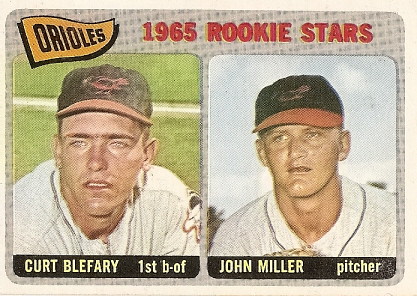
#49 Orioles 1965 Rookie Stars: Curt Blefary and John Miller

Orioles 1965 Rookie Stars by you.
This is the first of two cards that I received back in June (yep, I'm that far behind) from Butch, a distant relative by marriage who is himself a big sports fan and has the most amazing collection I've ever seen in person. He was generous enough to help me fill some holes in my Orioles inventory, and in the case of the card above, it serves a purpose for this blog as well!

This is my first two-player Rookie Stars card from this set, a format that Topps used from 1964 through 1971. Prior to this, they'd used a four-player design, with players from multiple teams on one card. In 1972, they switched to three players, all on the same team. A few teams still had two per card, though.

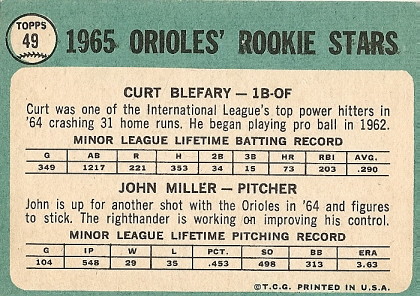
As for the "star" designation, Topps was batting .500 on this card. Curt Blefary would win the 1965 Rookie of the Year award in the American League while splitting time between the corner outfield sports in Baltimore. He beat out Angels pitcher (and future O's teammate) Marcelino Lopez for the honor by slugging 22 home runs, the first of three consecutive years of 20+ roundtrippers. Though he batted only .260, Curt's on-base percentage was a whopping .381 thanks to his 88 walks. He proved to be a patient and discerning hitter, finishing his eight-year career with more walks than strikeouts.

Though Blefary put together three solid years with the Birds, there were cracks in the foundation. After logging time in the outfield and at first base early in his career, Hank Bauer and Earl Weaver stuck him at catcher for 40 games in 1968. He was behind the plate for Tom Phoebus' no-hitter against the Red Sox, but he wasn't thrilled with his status as a defensive nomad. In a year dominated by pitchers, trying to learn a demanding new position certainly didn't help Curt. His .200 batting average was a career low, and his RBI total was half of what it had been the previous year (though he did log 100 less at-bats). It would prove to be his final year in Baltimore, as he was sent to Houston as the centerpiece of a deal that brought Mike Cuellar to Birdland. The trade was great for the O's, but not so much for Blefary. He spent one year as an Astro before being flipped to the Yankees for Joe Pepitone. Injuries and ineffectiveness soon hastened the end of the Brooklyn native's career; he didn't hit above .221 in his final three seasons (1970-1972), as he bounced from the Bronx to Oakland to San Diego.

After a long illness, Curt Blefary passed away at the age of 57 in January of 2001. His wife honored his wishes by having his ashes scattered on the site of Memorial Stadium in Baltimore. Though much of the old structure had been demolished by then, the Babe Ruth Museum supplied the home plate used during the 1991 farewell season at the park for a ceremony on May 24, 2001.

Fun fact: Former O's teammate Frank Robinson often made Blefary the butt of his jokes. It was Robby who coined the nickname "Clank" for Curt, based on the robotic futility of his defensive play. When the team bus drove past a landfill, Frank reportedly urged the driver to stop, "so Blefary can get a new glove". A few years later, when the Birds were steamrolling the competition in the A.L., then-Yankee Blefary told a reporter that "they're not Superman". Frank, Moe Drabowsky, and others conspired to greet their ex-teammate on the field prior to New York's next visit to Baltimore, at which time they unbuttoned their jerseys to reveal blue t-shirts with the Superman emblem on their chests.

As for John Miller...he's not even the most well-known John (or Jon) Miller in Orioles history. He was a hometown boy, at least. Miller got a few peeks at the big leagues before turning in a pretty good rookie campaign in 1965. In sixteen starts from late June through October, he went 6-4 with a 3.18 ERA. Unfortunately, he faltered the following season, posting a losing record (4-8) with a 4.74 ERA while splitting time between the bullpen and the rotation. After just two relief appearances in 1967, his contract was purchased by the Mets. For whatever reason, he never made it back to the majors. According to the Baseball-Reference Bullpen, he served as a firefighter after his baseball career ended.

Fun fact: Miller gave up only twenty home runs in 227 innings in his career. However, seven of those longballs were hit by Washington Senators - that's over one-third of his total! The next-highest team total was three by the Indians.
Orioles 1965 Rookie Stars (back) by you.

Sunday, August 24, 2008

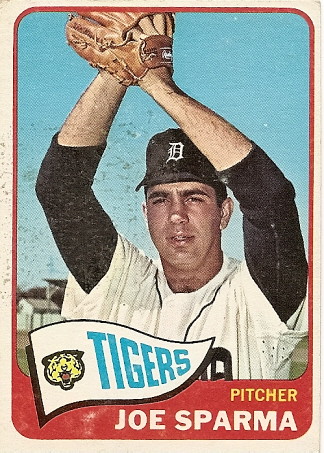
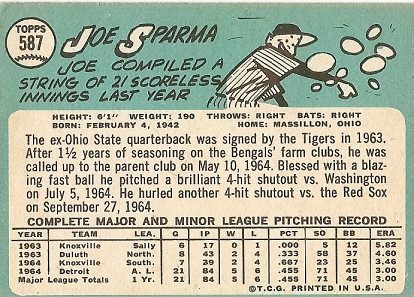
#587 Joe Sparma

Having returned from vacation and other distractions, I can finally bring you the third and final card from my trade with Bobby. Righthanded pitcher Joe Sparma has one of the more fascinating stories I've encountered in writing this blog. He first gained notoriety as the star quarterback for coach Woody Hayes' Ohio State University Buckeyes in the early Sixties. Teaming with receiver and future NFL great Paul Warfield, Sparma delivered a Big Ten championship in 1961 (8-0-1), highlighted by a 474-yard performance in a 50-20 win over Michigan. But the quarterback didn't see eye-to-eye with Hayes, and quit the team after three years to play professional baseball.

This card is Sparma's rookie issue from Topps; he had signed with the Tigers in 1963, earning a $32,ooo bonus. 1965 would be his first full season in the bigs, and an early thrill came when he started against the Yankees on Mickey Mantle Day in New York. When #7 stepped to the plate for the first time, Joe stepped off of the mound to shake Mantle's hand and tell him how much he admired him. He then proceeded to strike out the Mick, who lamented to catcher Bill Freehan that Detroit manager Mayo Smith didn't start a soft-tosser to let the Yankee star look like a hero.

After a career year in 1967 (16-9, 3.76 ERA, 5 shutouts), Sparma clashed with Mayo Smith, and was eventually demoted to the bullpen in the midst of the 1968 season. (I'm noticing a trend here.) He'd complained to reporters after being removed from a game, claiming that Smith didn't respect or trust him. The skipper's diplomatic response was that he "didn't want to get into a spitting contest with a skunk". After sitting for the first two weeks of September, Joe finally got another start and clinched the American League pennant by tossing a complete-game, five-hit effort to beat the Yankees. In the World Series, Smith seemed to hold on to the grudge, using the pitcher just once in relief in a thrilling seven-game battle with the Cardinals. Though the Tigers were victorious, the bad blood remained. Eventually the Tigers dealt Sparma to the Expos, where he lasted just nine games (0-4, 7.06 ERA) before calling it quits in 1970. He was only twenty-eight.

Joe Sparma suffered a heart attack in 1986 and passed away prematurely (age forty-four) due to complications from triple-bypass surgery.

Fun fact: According to former Sparma roommate (and battery mate) Bill Freehan, Sparma had ESP. Occasionally he would wake up on a day that he was scheduled to pitch and tell Freehan that he had a good feeling. Whenever he said this, the Tigers would win. Once he predicted that infielder Dick McAuliffe would have a 3-for-5 day at the plate. After starting out 3-for-4, McAuliffe struck out in his fifth at-bat and blamed Sparma for jinxing his final plate appearance! Talk about being ungrateful.

Sunday, August 03, 2008

#455 Norm Siebern

Norm Siebern by you.
Hey, it's another Oriole! This card was also part of my trade with Bobby. It's kind of funny to see an O's player wearing #4, which of course has been retired for Hall of Fame manager Earl Weaver since he called it quits in 1986. Norm was just one of six players to sport the number in Baltimore, the most renowned of which was slugging first baseman "Diamond" Jim Gentile, who the Birds traded to Kansas City to acquire Siebern! Of course, being traded for heavy hitters was nothing new for Norm; earlier in his career, the Yankees had sent him to the A's for Roger Maris.

Norm Siebern was a pretty good hitter, grabbing attention during his three straight All-Star seasons (1962-1964). His final season as an All-Star was his first in Baltimore, when he hit just .245 but still had an above-average OPS+ on the strength of 106 walks (compared to only 117 hits). His most impressive season with the bat was probably 1962, when he hit .308 with 25 home runs, 117 RBI, and 110 walks for a putrid Kansas City Athletics team that lost 90 games. He was the only one of Charlie Finley's men to drive in 100 runs, and the only one to score 100 times himself. But Norm was no slouch with the leather either, winning a Gold Glove as a left fielder during his first full season (1958).

Fun fact: In the aforementioned Maris trade, one of other players the Yankees swapped to the A's was Hank Bauer, who would become Norm's manager in both K.C. and Baltimore.
Norm Siebern (back) by you.

Wednesday, July 30, 2008

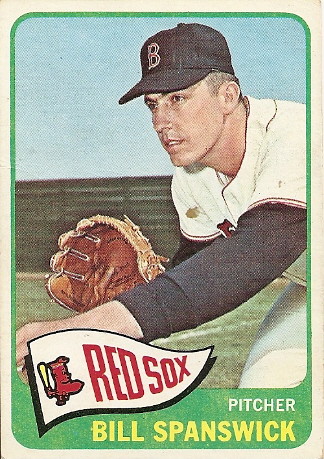
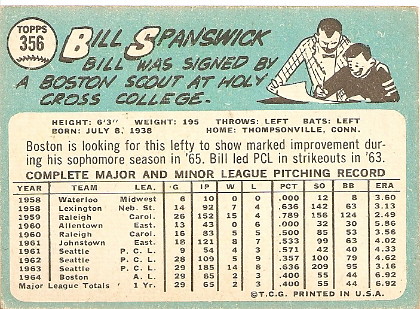
#356 Bill Spanswick

Before I get started on the first of three cards I acquired in a trade with reader Bobby, I'd like to bring your attention to a couple of links that "The Commish" dug up on Ken Retzer, the subject of our last card. Great stuff, including Ken's meeting with John F. Kennedy and his claim to fame: he caught the first pitch of the 10,000th game in MLB history! Thanks, Bob.

Alright, from Bob back to Bobby, who proposed a 3-for-3 trade. I sent him three Orioles: a 1991 Donruss #23 Gregg Olson (Diamond King), a 1989 Donruss #44 Pete Harnisch (Rated Rookie), and a 1984 Topps #240 Eddie Murray. First we're going to deal with Bill Spanswick, who has an excellent Dickensian sort of name. If he had been born in Nineteenth Century London, he might have been a cockney bootblack or a pickpocketing tramp, but it was his good fortune to be born in 1938 in Springfield, Massachusetts (home of the Basketball Hall of Fame and birthplace of Dr. Seuss and Kurt Russell).
spanswick by you.
Bill was a one-year wonder, and that's being kind. His 6.89 ERA in 65 and one-third innings in Boston leave little doubt as to why the 1964 season was his first AND last in the majors. Perhaps he should have given things a try at another position, though: he swatted 4 hits in 14 at-bats that year, driving in two and walking twice for a .286 batting average and a .375 on-base percentage.

Spanswick may have spent six seasons down in the minor leagues before getting the call to Fenway Park, but he had some share of glory in those years. He led his league in strikeouts at least twice (Nebraska State League in 1958 and Pacific Coast League in 1963). With Lexington in 1958, he struck out 22 batters in a one-hitter, and later topped that total with a 24-K, 14-inning effort!

Fun fact: Bill got his second (and final) win without breaking much of a sweat. In Game One of a doubleheader against the Indians, starter Jack Lamabe gave up a two-out double in the seventh inning to Dick Howser, scoring Al Smith with the go-ahead run. Spanswick came in to relieve Lamabe, and got Vic Davalillo to ground the ball back to him for the final out of the frame. Russ Nixon singled to lead off the home half of the seventh. With Spanswick due up, manager Johnny Pesky sent Chuck Schilling to pinch-hit. Schilling bunted the runner to second, and two batters later Felix Mantilla put the Red Sox ahead with a two-run home run. Dick Radatz shut the door with two hitless innings and added an RBI single to boot!
spansback by you.

Wednesday, June 18, 2008

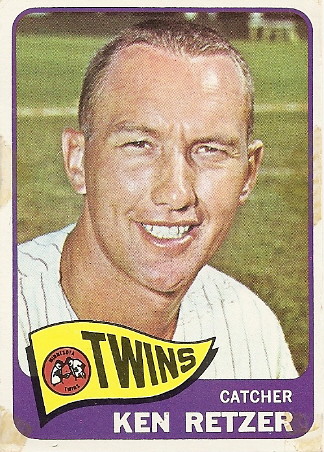
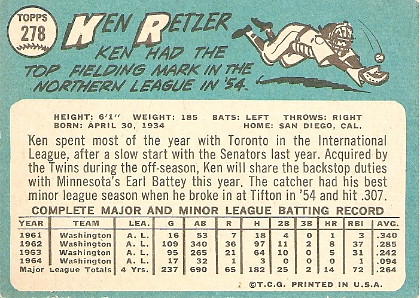
#278 Ken Retzer


Here's the grand finale of the group of cards I received from Ed, so big thanks to him once again. Ken Retzer is a guy who paid his dues. After being signed by the Indians as an amateur free agent in 1954, the catcher toured the minor leagues until 1961, when he debuted with the Senators as a 27-year-old rookie. He hit .340 in his initial exposure to American League pitching, but from there it was a case of diminishing returns, as his batting average dropped each of the next three years. He bottomed out in 1964 at .094 before being shipped to the Twins in the winter. This was Ken's last baseball card, as he never played a single game in Minnesota. It would seem that he was sent back to the minors; the Twins sent him to Houston in April of 1966 and the Astros flipped him to Cleveland early the next year, bringing him full circle in pro baseball.

In his short time in the bigs, Ken apparently let his arm do most of the talking, throwing out 38.1% of would-be base stealers (48 of 126). He was also a tough strikeout, going down without contact only 50 times in 690 total at-bats, or once every 13.8 times at the dish.

Fun fact: Ken Retzer had Milt Pappas' number, homering four times in sixteen at-bats against the former Orioles' All-Star. That's once every four times to the plate, compared to a 49.2 AB/HR ratio for his entire career.

Tuesday, June 10, 2008

#268 Ken McBride

I just got three more cards from one of my readers, so let's wrap up the batch from Ed. This is the second-to-last card of that bunch, and you'll duck if you know what's good for you. Ken McBride led the American League in hit batsmen twice in his career, and plunked somebody once every 16.2 innings on average. Ouch! Fortunately, he also finished near the top of some more flattering lists.

The former Red Sox signee got his start in the big leagues with the other Sox. Since I'm always looking for a Baltimore connection, I have to mention that McBride debuted in Memorial Stadium, taking a hard-luck 3-2 loss for Chicago. He allowed three runs to the Birds in seven and one-third innings, but only one was earned and the deciding runs were allowed by his bullpen. Then again, if Ken hadn't walked seven batters (including a young Brooks Robinson twice), the outcome may not have been in doubt.

Ken never really got a long look on the South Side, but his career took off after the Angels selected him in 1960's expansion draft. He was an All-Star in each of the team's first three seasons; though he only played in the 1963 game, he did get the start that year. He allowed three runs in three innings, but did drive in the AL's first run with a single off of Jim O'Toole in the second frame. You can see some of his stats below; he finished in the top ten of the junior circuit in winning percentage (1962), WHIP (1963), K's and K/9 IP (1961), complete games (1961, 1963), shutouts (1962), and adjusted ERA (1961).

As you can see, his performance fell of dramatically in 1964, and unfortunately this would be his last card. He appeared in just eight games for the Halos in 1965, going 0-3 with a 6.14 ERA. Ken had always had a bit of a control problem, finishing in the top ten in walks allowed three times in four years in addition to his aforementioned tendency to hit batters. Maybe his wildness hastened his demise.

I just started adding Fun Facts recently, and I think I'm going to make it a habit. I'm also going to start tagging posts to indicate which team the featured player represents. I'll do it retroactively as well.

Fun Fact: Ken McBride was an August kind of guy. His first ML game, his last game, and his birthday all occurred in the first half of August.

Saturday, June 07, 2008

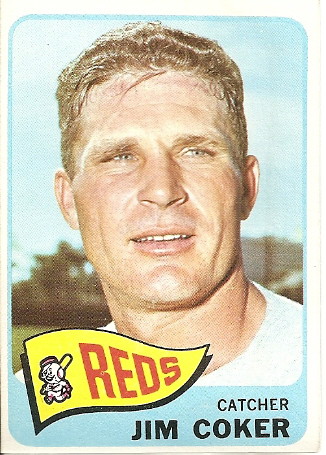
#192 Jim Coker


Slowly but surely, I'm plugging along with the bunch of cards that I received from Ed a while back. We've got another of Topps' Hatless Wonders, but my favorite part of this card is Mr. Redlegs, a fine logo if ever there was one. When it comes to baseball mascots, I say the more maniacal, the better.

As for Jim Coker, he was the fringiest of fringe players: his major league career consisted of 233 games spread out over nine seasons. As you can see below, he made it onto a card in 1965 despite playing in just 11 games the previous year. Then again, someone at Topps may have had a soft spot for Jimmie, as he's billed on baseball-reference.com. He made their All-Rookie team in 1960 on the strength of a .214 average, 6 home runs, and 34 RBI, not eye-popping numbers by any standard.

As you can see, he showed much more promise with the bat in the minor leagues, and it's not fair to judge him on his MLB stats, considering that the aforementioned 1960 season was the only true shot he had. You may notice that his first stop in pro baseball was Mattoon, Illinois, which is also the hometown of Deadspin editor Will Leitch. Another Jim Coker fun fact: he spent one month as Oriole, in a manner of speaking. In November 1962, Baltimore purchased him from the Phillies, only to send him to the Giants with pitchers Jack Fisher and Billy Hoeft on December 15. In return, the Birds received pitchers Stu Miller and Mike McCormick and slugging catcher John "Horse" Orsino. That deal worked out pretty well for the O's!

Tuesday, May 20, 2008

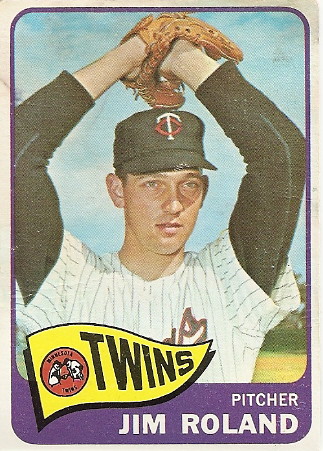
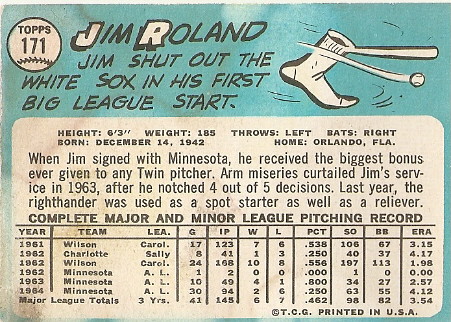
#171 Jim Roland


Coming 'atcha with another card from reader Ed. There's not a lot of information on Wikipedia or Baseball Reference, so Jim Roland's stats will tell the story. Though the card back below mentions his impressive first start with the Twins, a three-hit, nine-walk effort, he made a career out of solid bullpen work. Only 29 of Jim's 216 appearances came as a starter. Pitching most of his career with Minnesota and Oakland, he crafted a 3.22 ERA that was above league average. It's amazing that he gave up such a relatively low amount of runs, because those nine walks in his starting debut were indicative of his tendencies. He struck out 272 and walked 229 in 450 and one-third innings, a K/BB ratio of just 1.18. His saving grace was a decent hit rate; until his final season, he never gave up more hits than innings pitched.

FUN FACT: Jim Roland had exactly one run batted in over 84 at bats during his career. It was a walk-off walk: bases loaded, two outs, bottom of the fourteenth inning against the Tigers. Detroit had intentionally walked Johnny Roseboro to get to Roland, a career .071 hitter. Way to make it count, Jim!

Friday, May 09, 2008

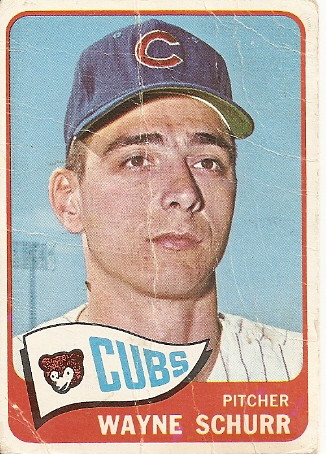
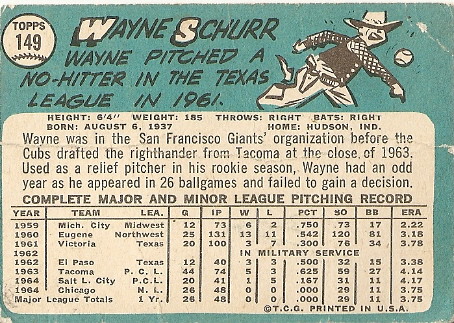
#149 Wayne Schurr


The next card from reader Ed was this creased masterpiece of Cubs rookie righty Wayne Schurr. You may be surprised to learn that this was Wayne's only baseball card; after a decent debut with the North Siders in 1964 (he actually pitched 48 and one-third innings, contrary to the stats on his card back, which makes his ERA 3.72 - the league average was 3.71), he never pitched in the majors again. Even stranger, he started that lone season with the Cubs, and was optioned to Salt Lake City in late July. The last traces of him that I found were a transaction in December 1966, when Chicago sent him to the Angels as part of a four-player deal.

But don't cry for Wayne. An autographed copy of this card can be found on eBay, where bidding has reached $8.16. Not too shabby for a one-year wonder. Or you can get a graded card (9 Mint!) for the Buy It Now price of $65. Since I have nothing else to add, check out the great caricature of Wayne as a cowboy pitcher on the card back below.

Sunday, May 04, 2008

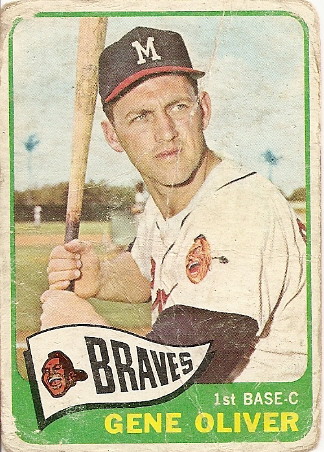
#106 Gene Oliver


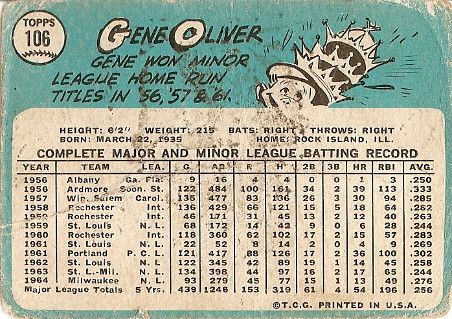
This is another card that I was sent by reader Ed. As you can see, it has withstood the test of time, even though it's been battle-tested more than most of the other cards in my growing collection. Gene Oliver had a pretty interesting career. He was signed by the Cardinals in 1956 out of Northwestern University, where he had been a scholarship athlete in football. Gene was primarily a catcher, but also was a decent first baseman and serviceable outfielder. His longball power was his calling card, as he slugged 151 home runs in five-and-a-half minor league seasons. He led his league in deep flies three times, as you will see below on his card back. (Thanks to reader Mr. Schwartz for the excellent suggestion to scan the backs as well. I've been remiss in not sharing these great cartoons and stats with you; the minor league numbers especially are not available online.)

As you can see, Gene still showed some pop by the time he finally got playing time in the majors; he didn't stick around for a full season until he was 27. But 1965 would be a career year for Oliver, as he hit .270 with 21 home runs. He was one of six Braves to go deep 20 times or more , joining Hank Aaron, Eddie Matthews, Joe Torre, Felipe Alou, and Mack Jones. He struggled following the team's move to Atlanta, but did become the first player to hit 3 round-trippers in a single game at Fulton County Stadium as part of a 4-for-4, 7 RBI performance. The following season, he was traded to the Phillies for the one and only Bob Uecker. It was actually a fitting trade, as Oliver reportedly was a ukulele player and kept his teammates loose with his sense of humor.

Perhaps Gene's most impressive legacy as a big leaguer is his .409 career batting average against Dodgers great Sandy Koufax. He is the only man to top .400 against Koufax in more than 50 career at-bats. Gene Oliver passed away in March of 2007 after undergoing lung surgery. He was 71 at the time.