Saturday, January 17, 2009

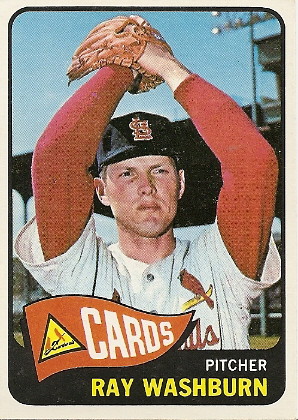
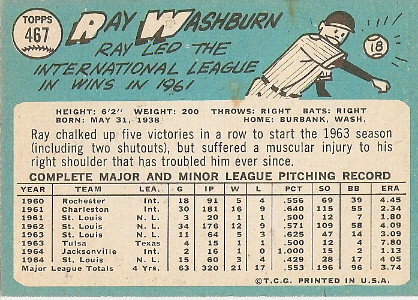
#467 Ray Washburn

Ray Washburn by you.
I haven't really discussed it yet, but there's something charming about the familiar shortening of "Cards" on the 1965 Topps set. This isn't the only year that the nickname appears on Topps cards, but it is the first; they would be the "Cards" from 1965 through 1971. It looks much cleaner on the pennant design than a smashed-up "Cardinals" would have.

A righty from Pasco, Washington, Ray Washburn played collegiately at Whitworth College before signing with St. Louis for a $50,000 bonus in 1960. He made his debut with the club late the next year after winning 16 games at Charleston. In his official rookie year of 1962, he pitched well, going 12-9 with a 4.10 ERA that was actually lower than the league average. Ray got off to an excellent start in 1963, compiling a 3.08 ERA before a torn shoulder muscle ended his season in June. He wouldn't be fully healthy for two more years afterward, missing out on the Cardinals' 1964 World Series triumph and posting a 9-11 record and a 3.62 ERA as a swingman the following year.

Washburn finally put together strong back-to-back seasons in 1966 and 1967, going 11-9 with a 3.76 ERA and 10-7 with a 3.53 ERA. He still had his share of hard luck, missing a month in the latter season with a broken thumb, courtesy of a line drive up the middle by Johnny Roseboro. All is well that ends well, however. Ray finally got a taste of World Series action, making two scoreless relief appearances in the Cards' seven-game victory over the Red Sox. There would be a return trip to the Fall Classic in 1968, thanks in part to the righty's career year: 14-8, 8 complete games, a 2.26 ERA (eighth-best in the N.L.), and a 1.10 WHIP. The cherry on top was a 2-0, no-hit victory over the Giants on September 18. It came just one day after Gaylord Perry no-hit Bob Gibson and the Cardinals, marking the first time in major league history that back-to-back no-hitters were pitched in the same series. In the World Series, Ray beat the Tigers in Game Three but was routed in Game Six, and St. Louis fell in seven.

Ray spent much of the second half of 1969 in the bullpen, and his record was a hard-luck 3-8 when you consider his 3.06 ERA. Nevertheless, the Redbirds set him loose the next year, trading him to Cincinnati for George Culver. Incidentally, Culver had also no-hit the Giants in 1968 - three days before Washburn equaled the feat! Ray had a brutal time of it with the Reds, giving up nearly seven runs per nine innings and over two baserunners per inning. All but three of his 35 games pitched were in relief. He again saw World Series action, but was merely a mop-up man in Cincinnati's Game Five loss, which clinched the Series for the Orioles. It was the last game of his career at age 32; he would be cut by the Angels the following Spring. Final-season struggles notwithstanding, his career record was a solid 72-64 with a 3.53 ERA. He struck out 700 batters in over 1200 innings, and whiffed nearly twice as many as he walked.

Attempting to move on with his life, Ray working at a sporing goods store in Seattle before spending a dozen years coaching at Bellevue Community College, and serving another dozen years as its athletic director before retiring. He still teaches phys ed part-time, and helps out with his daughter and son-in-law's orchards.

Fun fact: Not only did Ray throw the first pitch at Busch Stadium (II) in 1966, but he also pitched in relief in the first game at Cincinnati's Riverfront Stadium in 1970!
Ray Washburn (back) by you.

Wednesday, January 14, 2009

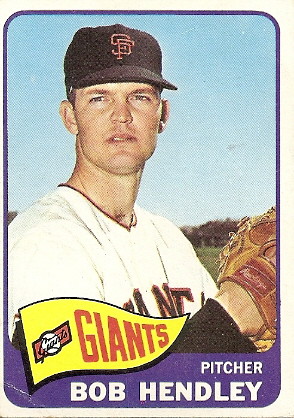
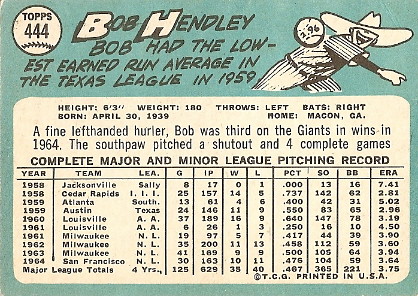
#444 Bob Hendley

Bob Hendley by you.
Check out the product placement on this card! Pitcher Bob Hendley is flashing his Rawlings leather for all of the world to see. I hope he at least got a few free gloves out of them. Incidentally, I took a close look at Donn Clendenon's glove as I was scanning his card yesterday, and he had a Spalding. There was also a facsimile signature on the heel, but I just couldn't make it out. This concludes today's edition of GloveChat.

Hailing from Macon, Georgia, Bob Hendley signed with the Milwaukee Braves in 1958 as a fireballer, but an elbow injury in 1960 cost him much of his velocity. He made it to The Show in 1961, having to rely on deception to stay ahead of hitters. The 22-year-old went 5-7 with a 3.90 ERA as a rookie and became a full-time member of the starting rotation the following year. That sophomore campaign would be his best, as he threw exactly 200 innings and won 11 games against 13 losses with 7 complete games and a 3.60 ERA that was slightly better than league average. After splitting time between the bullpen and the rotation in 1963 (9-9, 3.93), the lefty was dealt to the Giants in a seven-player trade that brought Felipe Alou to Milwaukee.

In his only full season in San Francisco, Bob was a ten-game winner with a 3.64 ERA. After a brutal start to 1965 (21 ER in 15 IP), he was traded to the Cubs and got back on track somewhat. He only started 10 of his 18 games with Chicago, but two consecutive starts in September proved to be very memorable. On September 9 at Dodger Stadium, he mowed down the opposition, allowing just one hit and one walk. Unfortunately, the batter he walked (Lou Johnson) was sacrificed to second, stole third, and scored on catcher Chris Krug's wild throw. Meanwhile, opposing pitcher Sandy Koufax pitched a perfect game and Hendley took a 1-0 loss. Time of game: 1 hour, 43 minutes. But five days later there was a rematch at Wrigley Field and Bob got his revenge, twirling a four-hitter to beat Koufax 2-1. In a two-game span, the southpaw lowered his ERA by two full runs!

The Cubs slotted Hendley in the bullpen for much of 1966, and he had his usual mediocre season (4-5, 7 saves, 3.91 ERA). He split the next year, his last in the majors, between Chicago and the Mets, going 5-3 with a 3.90 ERA. In seven seasons, he won 48, lost 52, and compiled a 3.97 ERA.
After retirement, Bob returned home to Georgia and coached high school baseball. He had the opportunity to coach his sons, Bart and Brett, as well as current major leaguer Russell Branyan. Both sons would go on to play collegiately, with Brett spending time in the Athletics organization afterward.

Fun fact: Bob must have seen Frank Howard in his nightmares! "Hondo" hit eight home runs and batted .366 against him.

Bob Hendley (back) by you.

Tuesday, January 13, 2009

#325 Donn Clendenon

Donn Clendenon by you.

I always thought that Donn Clendenon's first name was unusually spelled, and assumed it was just an idiosyncratic nickname. I have a friend named Donald, who used to go by Donn, but eventually dropped the extra "n". However, Clendenon's birth name is actually Donn. Go figure.
Though he was born in Neosho, Missouri, Clendenon grew up in Atlanta. He was a gifted scholar and athlete, graduating second in his high school class and earning twelve letters in baseball, football, and basketball at Morehouse College. Though he had a greater interest in the latter two sports and received offers to play for the Cleveland Browns, New York Knicks, and Harlem Globetrotters, Donn signed with the Pirates in 1957 for a $500 bonus. A primary factor in his decision was his respect for his stepfather Nish Williams, a former Negro League catcher and manager who had a real love for the game.

After a nine-game trial late in 1961, Donn was eased into the lineup the following year at first base and in right field. He hit .302 with 20 of his 67 hits going for extra bases, and swiped 16 bases. He received the single vote for N.L. Rookie of the Year that did not go to the winner, Cubs second baseman Ken Hubbs. But the young Pirate would become a steady and productive hitter for his club throughout the 1960s, increasing his RBI total each year from 1962 (28 in 222 AB) to 1966 (a career-high 98). He socked double-digit home runs for nine straight seasons, back when that meant something. In 1965 and 1966, the first baseman went even further, reaching double digits in doubles, triples, and home runs (32-14-14 and 22-10-28, respectively). As with most hitters, his production dropped at the end of the decade, but he was the leading RBI man for the Bucs in 1968 with 87.

At the end of that 1968 season, Clendenon found himself separated from the team that had brought him into pro baseball some twelve years earlier. The Montreal Expos claimed him in the expansion draft, but almost immediately traded him to Houston along with Jesus Alou in exchange for Rusty Staub. For whatever reason, Donn did not want to play for the Astros, and refused to report to the club. In a canny and significant move that foreshadowed Curt Flood's challenge of the reserve clause, he claimed that he had retired. Commissioner Bowie Kuhn intervened and ruled that the trade would stand, with Houston accepting two pitchers and $100,000 compensation in place of Clendenon. He began the season in Montreal, but was still traded later in the year to the Mets in a crucial acquisition for the future World Champs.

Donn gave his "Amazin'" new team an infusion of calm veteran presence and power hitting, clubbing a dozen home runs in 72 games. But he saved his best for the World Series, batting .357 and leading the Mets with three home runs and four RBI as the all-too-recent laughingstocks of baseball shocked the powerhouse Orioles and the rest of the world. He was named Series MVP.

Though New York slipped to third place in 1970, Donn had one of his best efforts, clocking in at .288 with 22 home runs and a team-high 97 RBI. But that was a last hurrah for the veteran, as he saw his playing time nearly halved the next year. After struggling in a reserve role with the 1972 Cardinals, Clendenon called it a career. He finished with a .274 career average in twelve seasons.

Not content to be defined as an ex-athlete, Donn found a new calling by earning a law degree from Duquesne University. He worked at law firms in Washington, D.C. and Chicago, and battled with drug addiction, eventually rehabilitating at a facility in Ogden, Utah. Afterward, he continued to practice law in Sioux Falls, South Dakota and became an addiction counselor. In September 2005, Clendenon passed away at age 70 after a lengthy battle with leukemia.

Fun fact: As of 2008, Donn is still the only graduate of Morehouse College to ever play in the major leagues.
Donn Clendenon (back) by you.

Monday, January 12, 2009

#279 Dick Tracewski

tracewski by you.
Minor league veteran Dick Tracewski appears to have been banished to the farthest field in the Dodgertown complex at Vero Beach. The dense forest looms in the background, and based on the apprehensive look on Dick's face, I don't think he's preparing to field a bad-hop grounder. My guess is that he's using his infielders' glove to ward off an onrushing Sasquatch. It's not worth it, Dick! Run! Run for freedom!

The pride and joy of Enyon, Pennsylvania, Dick Tracewski signed with the Dodgers fresh out of high school. The year was 1953, and his labyrinthine path to the majors was just beginning. As the blurb on the back of his card states, the infielder played for twelve different minor league clubs in the decade prior to his major league debut. It's funny that his .298 average and 14 triples for the 1957 Pueblo Dodgers are mentioned as a springboard to the bigs, considering that they came a full five years before he landed in L.A. To be fair, he did lose two subsequent seasons to military service.

Though he had to wait until he was 27 to play in Dodger Stadium, Dick did have the thrill of playing for two World Series winners in his four seasons in blue. He also hit .154 and .118 in the 1963 and 1965 Fall Classics, but who's counting? He split time amongst three infield positions (second and third base and shortstop), topping out at 106 games and 304 at-bats in 1964. He compensated for a lackluster bat with an able glove and strong throwing arm, and evidently the Tigers were impressed enough with his versatility to give up former 15-game winner Phil Regan in order to obtain him.

The trade was a steal for the Dodgers, as Regan went 14-1 with a 1.62 ERA in 1966, his first season with the team. Conversely, Tracewski hit below .200 in three of his four seasons in Detroit (the exception being a .280 mark in 107 at-bats in 1967). But the utilityman again made the most of his situation, as he played for yet another World Champion in 1968! The Tigers wisely limited him to two appearances in the Series: a defensive substitution late in Game 1 and a pinch-running cameo in Game 7. He scored an insurance run in a 4-1 win. Dick retired a year later with three World Series rings in an eight-year career, an unlikely outcome for a career .213 hitter with a gap of a decade between his initial signing and his MLB debut.

Apparently, Tracewski liked Detroit so much that he stayed around for a few more decades. After managing in their farm system in 1970 and 1971, he spent a team-record 24 seasons as a Tigers coach. He had two stints as interim manager, going 2-0 in 1979 prior to Sparky Anderson's arrival and filling in for Anderson for several weeks in 1989 while the skipper recovered from a bout of exhaustion.

Fun fact: On April 28, 1964, Dick went 3-for-4 with two triples in the Dodgers' 3-1 win over Houston. He scored the go-ahead run in the eighth inning, and was caught stealing home in the ninth!
tracewskib by you.

Sunday, January 11, 2009

#270 Milt Pappas

Wow, it's been a while since I got to write about an Oriole on this blog, and today it's one of the all-timers. Milt Pappas was born in Detroit as Miltiades Sergios Pappastediodis. If I were him, I probably would have wanted to shorten my name too!

As a high school phenom, young Milt was heavily scouted and pursued by his hometown Tigers. But it was an ex-Tiger pitcher, Hal Newhouser, who scouted the righty and was instrumental in his signing with the Orioles. Detroit was furious, convinced that the Birds had skirted the rules. They filed an unsuccessful greivance, but later caught the O's red-handed when manager Paul Richards tried to stash a healthy Pappas on the disabled list while having him travel and practice with the club.

The wily Richards made Pappas into his pet project, including placing him on a strict pitch count (which was unheard of at that time). The veterans on the team were rankled by this, and Milt's cocky attitude didn't help matters. But he was undeniably talented, all but bypassing the minor leagues and winning ten games in 1958, his first full season in Baltimore. He had excellent control, never walking more than 83 batters in a single year. He combined with Steve Barber, Jack Fisher, and Chuck Estrada to form the "Baby Birds" rotation, and twice led the team in victories. In eight seasons with the O's, he was a double-digit winner every year, and notched three All-Star selections: two in 1962 (12-10, 4.03), and another in 1965, which may have been his best campaign (13-9, 2.60). His 110 career wins as an Oriole still rank seventh in team history.

In December of 1965, Pappas gained notoriety in baseball role. The Orioles took advantage of Cincinnati's predilection for trading players before their decline rather than after. The Reds traded 30-year-old slugger Frank Robinson to the O's for Milt and two other players. Frank hit the ground running, winning the A.L. Triple Crown and leading his new club to their first World Series win over the Dodgers. Meanwhile, the Reds' supposed new ace lasted just two-plus years in his new digs, posting a career-worst 4.29 ERA in 1966 before rebounding to go 16-13, 3.35 the following year. However, Pappas' outspoken nature was what truly made him expendable. He feuded with fellow pitcher Joe Nuxhall, who claimed that the former was milking injuries. In turn, Milt complained that Nuxhall (after retiring to the broadcast booth) was flying first-class while the players were stuck in coach. He also criticized the Reds for failing to cancel a scheduled game on the day of Robert F. Kennedy's funeral. A slow start in 1968 (2-5, 5.60) was the final nail in the coffin, as Pappas was traded to the Braves.

Milt regained his form in Atlanta, winning ten games and putting up a strong 2.37 ERA. His final win of the year was his 150th. He was one of 16 modern-era pitchers to compile 150 victories prior to age 30; the only man on that list to make it to 300 wins was Greg Maddux. Pappas slumped to 6-10 in 1969, but did see postseason action for the only time in his career. Pitching in long relief, he surrendered three runs in two and one-third innings in the Braves' 11-6 loss in Game Two of the NLCS. Another poor start to the following season led to another change of zip code, with the Cubs purchasing his contract.

Again, Milt found equal parts glory and controversy in his new locale. He was a ten-game winner in his first half season in Chicago, and actually performed better in hitter-friendly Wrigley Field than he did on the road. In 1971, he won a career-high 17 games and tied a major league record with a nine-pitch, three-strikeout inning against the Phillies in September. He was even better the next year, going 17-7 with a 2.77 ERA. But on September 2, he threw the greatest game of his career, retiring the first 26 Padre batters he faced. San Diego's last hope was pinch hitter Larry Stahl, who took two straight pitches with a 2-2 count. Home plate umpire Bruce Froemming called both offerings balls, sending Stahl to first base and disrupting the perfect game. The pitches were both borderline sliders, and Pappas went ballistic, thinking that he was at least close enough to get the benefit of the doubt in that situation. He retired the next hitter to preserve his no-hitter, but has maintained a grudge against Froemming throughout the ensuing decades.

A year later, Milt concluded his career with a 7-12 season, bringing him to 209-164 with a 3.40 ERA. Despite intimations from teammates that Paul Richards' pitch limits conditioned Pappas to hit a mental wall late in games, he did complete 129 of his 465 starts. He also finished one win short of joining the short list of pitchers to rack up 100 victories in each league.

Fun fact: Milt had some power in his bat, amassing 20 career home runs, half of which gave him the lead!

Thursday, January 08, 2009

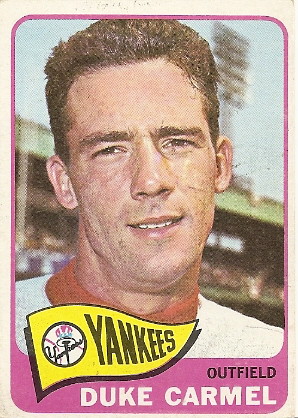
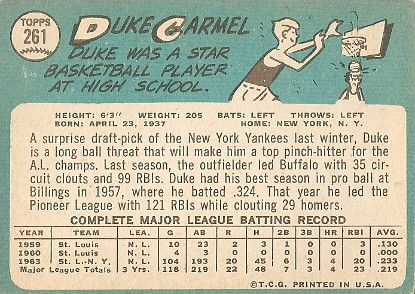
#261 Duke Carmel

CARMEL by you.
Contrary to popular belief, Duke Carmel was not a delicious candy bar. Nor was he one of the Yankees' all-time greats. What was he? A prodigious minor-league slugger who never quite broke through at the next level.
A native son of New York City, Leon James "Duke" Carmel signed with the Cardinals as an eighteen-year-old in 1955. He spent five seasons in the minors before getting a look in St. Louis, with his best effort being a .324, 29-home run, 121-RBI season at Billings in 1957. He did very little in his cups of coffee in 1959 (.130 in 10 games) and 1960 (0-for-3 in 4 games), and spent the next two years at AAA while being swapped back and forth from the St. Louis organization to the Dodgers, back to St. Louis, to the Indians, and back again (whew!). He had a good power stroke, but seldom hit for average. In 1963, he finally spent a full season in the majors, but still played sparingly. He received 53 plate appearances in 57 games with the Cards, batting .227 with a .358 on-base percentage and one home run. A midseason trade to the Mets gave him a small cult following; he hit .235 with 3 homers and 18 RBI while teaming with Duke Snider to give New York a rare pair of Dukes.

That offseason, the Yankees acquired Carmel and stashed him at AAA Buffalo, where he proceeded to hit 35 longballs, knock in 99 runs, and post a .404 on-base percentage. He went to Spring Training with the Bombers in 1965 amid much fanfare; in Ball Four, Jim Bouton sardonically notes that he was supposed to be "the next Joe DiMaggio". According to Bouton, he struggled in camp and Whitey Ford consoled him by suggesting that he just couldn't hit in South Florida. When he continued to play poorly in Tampa, Whitey amended his remarks: "You're just not a Florida hitter." Of course, Duke then faltered in a few more games further north, prompting the great Yankee pitcher to say, "It looks like you just can't hit south of the Mason-Dixon Line." Nor could he hit in the Bronx. The team put the 28-year-old on the Opening Day roster, and he went hitless in eight at-bats, striking out five times. That was the last that Duke Carmel would see of the major leagues. He spent three more years riding the buses before retiring.

After baseball, Duke settled in Coram, New Jersey and became a salesman for a liquor distributor. He also spent several years coaching amateur summer league baseball.

Fun fact: Dateline: April 16, 1963. Duke's first career home run was a pinch-hit, game-tying solo shot leading off the bottom of the ninth inning against Roy Face. He sparked a game-winning rally by the Cardinals, as Curt Flood followed with a double and scored on an error by Pirates second baseman Julio Gotay.
CARMELB by you.

Wednesday, January 07, 2009

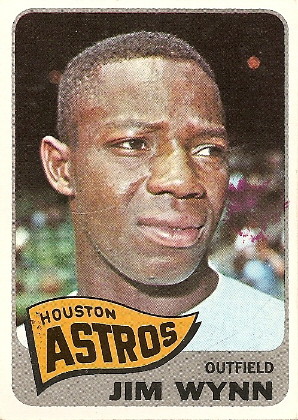
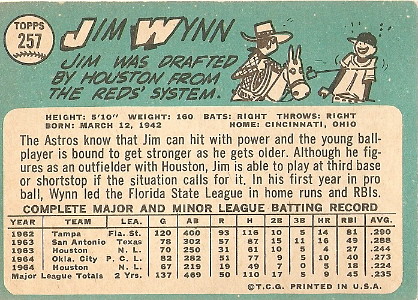
#257 Jim Wynn

WYNN by you.
You know, I'm really starting to feel sorry for all of these hatless Houstoners. A guy could get a nasty sunburn playing nine innings with no headwear, to say nothing of the glare problems. Jim Wynn in particular could use a hat to shade his eyes, since his future is so bright.

In 1962, the Reds signed 20-year-old Jimmy Wynn out of Central State University in Wilberforce, Ohio (about an hour's drive from his birthplace of Hamilton). He was signed as a shortstop, but would convert to a full-time outfielder within a few years. Before the ink was even dry on Jimmy's contract, the Astros snapped him up in the expansion draft. He spent roughly half of the 1963 and 1964 seasons in Houston before earning the starting center field job in '65. The youngster showed off his dazzling combination of speed (90 runs and a career-high 43 steals in 47 attempts!) and power (30 doubles and 22 home runs), and batted .275 with a strong .371 on-base average. Only 5'9" and 160 pounds, he was nicknamed "the Toy Cannon" by writer John Wilson.

After a down year in which he saw action in just 105 games, Wynn stormed back in 1967. His 37 home runs trailed only Hank Aaron's total of 39, and he drove in 107 runs while scoring 102 (the first of four 100-run seasons). The Astro slugger made his first All-Star team and finished eleventh in the MVP race despite playing for a ninth-place team. After a less-glamorous 26-HR, .376 OBP year, Jimmy turned heads again in 1969. He bashed 33 longballs, scored 113 times, and walked 148 times for an astounding .436 on-base percentage! His walk total was an N.L. record until Barry Bonds strolled on by in 1996. From 1970-1973, Jimmy vacillated between good and bad years, with the highlight being a personal-best 117 runs in 1972 and the low point being a .203 average in 102 games in 1971 (and even then, he took enough walks to post a .302 OBP). After he hit .220 with only 55 RBI in 1973, Houston traded the 31-year-old to the Dodgers, ending an eleven-year partnership.

Finally freed from the pitchers' paradise that was the Astrodome, Jimmy flourished. He scored 104 runs, walked 108 times, and hit 32 homers and drove in a career-high 108 runs in helping Los Angeles to the pennant. He was an All-Star, the N.L. Comeback Player of the Year, and a fifth-place finisher in MVP voting; the award went to teammate Steve Garvey. In postseason play, the veteran outfielder had only five hits in nine games, but walked thirteen times, leading to an unusual .192/.450 batting/on-base combo. The Dodgers stormed past the Pirates only to fall to the A's in the only postseason of Wynn's career. He earned a second straight All-Star selection in 1975 despite a dip in offensive production (aside from an impressive 110 walks). That November, the Dodgers flipped him to the Braves in a six-player deal that brought Dusty Baker to L.A.

In his lone season in Atlanta, Wynn walked more times than he hit safely, the second straight year he compiled this unusual stat line. Thanks to his 127 walks and 93 hits, he batted a paltry .207 yet had a robust .377 on-base average. In 1977, Jimmy played out the string in the American League, splitting a substandard 66 games between the Yankees and the Brewers. He retired with 291 home runs, 225 steals, a .250 average, and a .366 on-base percentage. There's no telling how much greater his numbers would be if he had played in a hitters' era, and/or in a more accommodating ballpark.

Currently, Jimmy works for the Astros as a community outreach executive, and provides post-game analysis of the team's broadcasts on Fox Sports Net Houston. The team retired his uniform number (24) in 2005, leading outfielder Jason Lane to switch from #24 to #16.

Fun fact: Wynn twice hit three home runs in a single game, seven years apart. The first such game was against the Giants in 1967, and the second was in 1974, victimizing the Padres.
WYNNB by you.

Tuesday, January 06, 2009

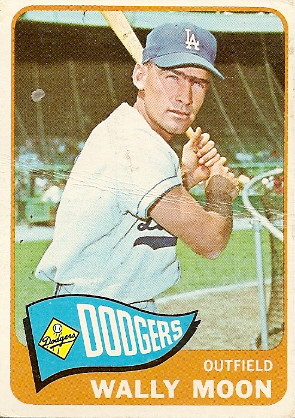
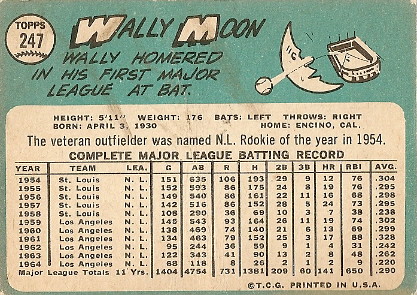
#247 Wally Moon

moon by you.
At long last, after more than a year of blogging, I get to discuss Wally Moon's unibrow. Actually, back up: Wally Moon's Unibrow. It deserves to be capitalized. It is the Alpha and the Omega of Unibrows, the One that all other singular eyebrows aspire to be. (Sorry, Frank Zupo; your sixteen-game career dims the glory of your admittedly impressive appearance.)

Wally Moon was more than just an eyebrow; he was one heck of a hitter. The Arkansas boy was a fine scholar-athlete: an All-Southwest Conference player at Texas A & M University, who later earned his Master's degree in education. He signed with the Cardinals in 1950, and played a limited minor league slate for two seasons while continuing his studies.

According to legend, Wally defied team management by reporting to major league camp in the spring of 1954, rather than minor league camp. He was permitted to stay, and replaced veteran Enos Slaughter in the St. Louis outfield. On Opening Day, the newcomer silence chants of "We Want Slaughter!" by socking a home run in his first at-bat. Moon didn't stop there, setting several offensive marks that would prove to be career highs: 106 runs, 193 hits, 29 doubles, 18 stolen bases. He hit .305 with 12 home runs and 76 RBI, and easily won N. L. Rookie of the Year honors over such stiff competition as Ernie Banks and Hank Aaron.

The young slugger showed his consistency by batting between .295 and .298 and scoring exactly 86 runs in each season from 1955-1957. He continued to hit for power, peaking with 24 homers in 1957, his first All-Star campaign. Moon slumped badly in 1958, playing only 108 games and chalking up a weak .238 average. In December, the Cards traded him to Los Angeles for future journeyman Gino Cimoli, a hasty move.

With an assist from ex-teammate Stan Musial, Wally adjusted quite well to the cavernous Los Angeles Coliseum. In 1959, he altered his swing to take advantage of the 251-foot left field line and posted double-digit doubles, triples (a league-leading 11), home runs, and steals for the second time in his career. His average jumped back up to .302, and the second-time All-Star finished fourth in an MVP race won by Chicago's Ernie Banks. Moon got the last laugh, as his Dodgers took the N. L. pennant and won the World Series. In postseason play, the left fielder hit .261 against the White Sox with a home run.

For an encore, Wally hit .299 in 1960 and won a Gold Glove; he was noted for his strong throwing arm. But the next year may have been his best as a hitter. He reached career highs in RBI (88), walks (89), batting average (.328), and on-base percentage (.434 - tops in the league). He ended up thirteenth in MVP voting, though winner Frank Robinson was way ahead of the pack. He also scored the last run ever at the Coliseum.

Perhaps it's only coincidence, but Moon declined after the Dodgers moved into their new stadium in 1962. He didn't top 343 at-bats in any of his four remaining seasons, and couldn't surpass a .262 average. He didn't even play in the 1963 World Series, won by L.A. His final two games were as a pinch-hitter in the 1965 World Series. He was retired in both at-bats, but Sandy Koufax's Game Seven shutout allowed Wally to end his career as a two-time champion. He also finished as a .289 career hitter with a strong .816 on base-plus-slugging average, due largely to a great 1.09 walk-to-strikeout ratio.

Wally coached with the expansion Padres club in 1969, and also served as athletic director and baseball coach at John Brown University in Alabama. In the late 1970s, he owned the Dodgers' minor-league team in San Antonio. He came back to coaching in 1986 with the AAA Springfield Cardinals, managed the Carolina League's Prince William Yankees the following year, and concluded his baseball career as a manager and special hitting instructor in the Orioles organization. In 1990 he guided the Frederick Keys to a Carolina League championship in their second year of existence. Since 1996, he and wife Bettye have been enjoying retirement in the Bryan-College Station area of Texas. You can get your Wally-related fix at his official website.

Fun fact: On April 23, 1954, Wally went 5-for-5 against the Milwaukee Braves. He walked once, tripled once, and stole a base. He also scored two runs in a 7-5 win for the Cardinals. Not bad for a guy who had been in the majors for all of ten days!
moonb by you.

Saturday, January 03, 2009

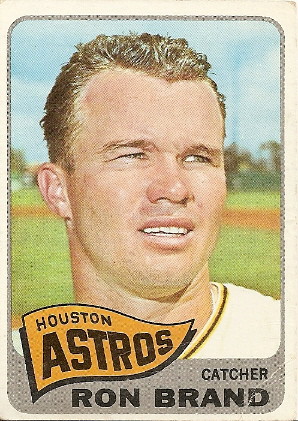
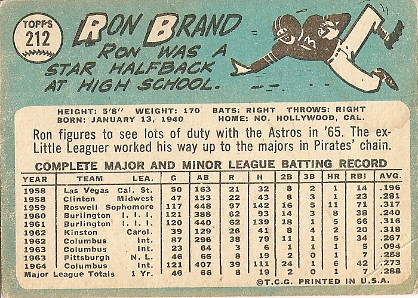
#212 Ron Brand

brand by you.
If Ron Brand's jersey piping looks a little black-and-gold, your eyes are not deceiving you. He was a Pirate before Houston nabbed him in the November 1964 Rule V draft. So it's another case of Topps sleight-of-hand.

Los Angeleno Ron Brand was signed by the Pirates after starring in baseball and football in high school. He paid his dues in the Pittsburgh system, waiting until his sixth professional season (1963) to get the call to the majors. In 66 at-bats he hit .288 and reached base at a .390 clip, but when 1964 rolled around, he was stuck back in the minors. Opportunity knocked that very offseason, when the Astros drafted Ron.

Brand made an early impact with his new team, tripling for the first hit by the home club in the exhibition opener at the new Astrodome. A triple might seem like a rare occurrence for a catcher, but he was quick enough to steal ten bases in 1965. Later in his career he would bat leadoff, something an Astros catcher would not do again until Craig Biggio came along in the early 1990s. In his first year in Houston, Ron played a career-high 117 games, which allowed him to post a personal-best 37 RBI. He also hit the final two home runs of his career; he'd go 0-for-six seasons after that. He settled into a part-time role for the rest of his Astros tenure (1966-1968), and proved valuable in unconventional ways. When the club acquired famed playboy pitcher Bo Belinsky prior to the 1967 season, they assigned Brand, a practicing Mormon, to be his roommate!

Ron spent the final three seasons of his career north of the border after the Expos tabbed him in the 1968 Expansion Draft. He topped 100 games once more (1969), reaching a high-water mark with 12 doubles that season and batting .258. In all, he batted .239 in 568 games spanning eight seasons.

Fun fact: Ron played a crucial role in Houston's first win as the Astros (they were of course known as the Colt .45s from 1962-1964). On April 14, 1965, Brand batted in the top of the seventh with the bases loaded and the Mets leading 2-1. According to this site, he bunted (a squeeze?) and the ball hugged the line, refusing to roll foul! His two-run single gave the Astros a 3-2 lead in a game that they would win, 7-6 in eleven innings.
brandb by you.

Friday, January 02, 2009

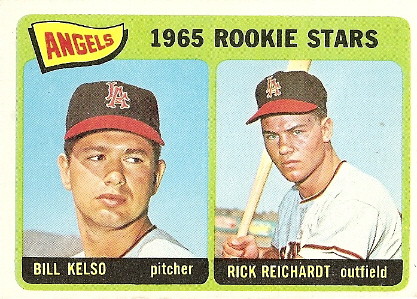
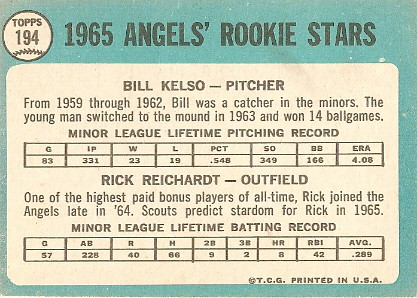
#194 Angels Rookie Stars: Bill Kelso and Rick Reichardt

halorooks by you.
The Angels batted .500 with this pair of prospects. Pitcher Bill Kelso was gone in three years, but outfielder Rick Reichardt became a power threat throughout the 1960s. There's not much to say about their photos, so I'll add that I like the dark wordmarks and piping with the red accents. It's a good look that the Angels briefly brought back in the mid-1990s. They would do well to revisit that style; I think their current unis are much too red.

After graduating from Whitworth College, a Presbyterian liberal arts college in Spokane, WA, Kelso signed with the Dodgers as a catcher. After a few seasons, he switched to the mound and switched L.A. teams, as the Angels claimed him in the Rule V draft. He showed promise in a summer 1964 callup, going 2-0 with a 2.28 ERA and shutting out the Twins in his only start. Despite the impressive debut, Bill didn't return to the majors until September 1966. Again he performed well, posting a 2.38 ERA in eleven and one-third innings of relief. The Halos finally gave him an honest shot the following year, and he responded. His 69 games pitched (all but one out of the bullpen) ranked third in the American League, and he went 5-3 with 11 saves and a 2.97 ERA. He was stingy with the longball, allowing six home runs in 112 innings. The Angels sold high, trading the righty to acquire former 22-game winner Sammy Ellis from the Reds. Kelso lasted only one season in Cincinnati, closing out his big league career with a 4.00 ERA in 35 games.

Fun fact: Seven of the sixteen home runs that Kelso allowed in his career were hit by Hall of Famers.

Rick Reichardt was the ultimate bonus baby, a handsome, strapping two-sport athlete at the University of Wisconsin. Eighteen major league teams vied for his service, and the $200,000 bonus that brought him to the Angels was the final straw in the push for an amateur draft. After brief exposures to the majors in both 1964 and 1965, he had a much-anticipated breakout year in 1966. In just 89 games, he hit .288 with 16 home runs and received minor consideration in the MVP vote. Unfortunately, his season was interrupted in July by an ailment that led to the removal of one of his kidneys. It's been suggested that this illness had a longer-lasting impact; Rick himself said that he "never had the resiliency after that". But in a pitching-first era, the young outfielder was still above average. He hit 17 home runs in 1967, and led the Angels with 21 longballs and 73 RBI the following year. Even his .255 average was 25 points above the overall league mark. His 13 homers and 68 runs driven in 1969 were also tops on the team.

In early 1970, the Angels ended their six-year association with Reichardt, trading him to the Senators with young infielder Aurelio Rodriguez in exchange for third baseman Ken McMullen. With more powerful hitters around him, such as Mike Epstein and Frank Howard, Rick didn't have the pressure of being the go-to guy, but his numbers stayed about the same (.253, 15 HR). After only one season in D.C., he was dealt to the White Sox. His first year in the Windy City was one of the best of his career (.278-19-62), but it was also his final season as a regular. He finished up with another year and a half in Chicago and a partial season in Kansas City. The Royals released him after one at-bat in April 1974. In parts of ten seasons, Reichardt hit .261 with 116 home runs.

In the thirty-five years since his retirement, Rick has worked in financial consulting, coached college baseball at the University of Wisconsin and the University of Florida, and at present works with Roland Hemond (special assistant to the president of the Arizona Diamondbacks) to counsel players about their education options.

Fun fact: With Walt Disney and Ronald Reagan in attendance, Rick hit the first-ever home run at Anaheim Stadium, a solo shot off of Tommy John.
halorooksb by you.