Tuesday, July 19, 2011

#115 Bobby Richardson

#115 Bobby Richardson
One pleasant surprise in the nearly four years that I've been doing this blog has been the boundless creativity of my readers. Greg Mader sent me a "pack" of five cards back in April, this Bobby Richardson card being one of them. There were three other 1965 cards (to be posted later this week), an autographed 1960 Topps of Walt "Moose" Dropo for my Orioles collection, and an individually-wrapped stick of gum! Much fresher than the chalky crap that usually comes with Topps cards, too. Thanks, Greg!

Fun facts about Bobby Richardson:

-A native of Sumter, SC, Bobby signed with the Yankees out of high school in 1953.

-He stormed through the minors, hitting .313 in four seasons and earning brief big league callups in 1955 and 1956.

-Became part of a second base platoon at age 21 in 1957, and made the All-Star team despite modest stats of .269/.281/.316 in 54 games in the first half.

-Richardson led all New York players with a .301 average in 1959.

-Had the unique honor of being named MVP of the 1960 World Series despite being on the losing team. He went 11-for-30 (.367) with 8 runs scored, 2 doubles, 2 triples, a home run, and a Series-record 12 RBI in the Fall Classic.

-Bobby won five consecutive Gold Gloves at the keystone from 1961 through 1965.

-He led the American League with 209 hits in 1962, finishing with 99 runs scored, 38 doubles, 8 home runs, 59 RBI, and a .302/.337/.406 batting line, all career highs. He was a surprising runner-up to teammate Mickey Mantle in MVP voting.

-On June 29, 1966, he went 5-for-5 with a home run and a double to help the Yankees eke out a 6-5 win over Boston.

-Bobby was only 30 when he retired at the end of the 1966 season to stay home with his family. He had intended to retire a year sooner, but Tony Kubek was forced to quit due to injuries, and the Yankees didn't want to lose both at once. Richardson finished his 12-year career as a 7-time All-Star, carrying a lifetime average of .266 with 34 home runs and 390 RBI.

-Richardson got into college athletics after retiring, coaching baseball at the University of South Carolina, Coastal Carolina College, and Liberty University between 1970 and 1990.

#115 Bobby Richardson (back)

Monday, July 18, 2011

#217 Walt Alston

#217 Walt Alston
Hey, it's another card I bought with my own hard-earned money! This one was actually an upgrade. Max sent me a well-used copy a few years back, mostly as a lark. As you can see, some bored young card owner made some cosmetic improvements to poor ol' Walt!

#217 Walt Alston Graffiti

So when I went to the Philly Card Show with Ed this past March, I found a boring ol' clean copy of the Alston card and picked it up for a scant dollar. Likewise, I got a new Vada Pinson to replace the previous one, which was missing half a face. Don't worry, I still have the original Tiptonized copies of both in my possession.

Fun facts about Walter Alston:

-Walter "Smokey" Alston was born in Venice, OH. He attended Miami University (Ohio), and worked as a teacher in the offseason. He signed with the Cardinals in 1935.

-After hitting .326 with 35 home runs at Class C Huntington, he got a September 1936 cup of coffee in the majors. Alston struck out against Lon Warneke of the Cubs in his only big league at-bat.

-In all, he played minor league ball for 13 seasons, never surpassing AA. Playing chiefly at first base, he was a career .295 hitter with 176 career homers.

-Walter started managing in the minors in 1940 while still an active player. He put in a total of 12 seasons as a skipper in the farm systems of the Cardinals and Dodgers, and had a 544-373 record (.593 win percentage) in 6 seasons at the AAA level for the Dodgers. There he managed future big league names like Tommy Lasorda, Jim Gilliam, and Johnny Podres.

-He replaced Chuck Dressen as the Dodger manager prior to the 1954 season. The club won 92 games in his debut year, the first of 10 seasons in which Alston led them to 90 or more wins.

-He helped deliver Brooklyn's first (and only) world championship in 1955, when the Bums finally knocked off the hated Yankees in a seven-game World Series.

-Walter stayed on as Dodger manager for an incredible 23 years, famously being retained on a series of one-year contracts. In his tenure, the team won seven National League pennants and four World Series (1955, 1959, 1963, and 1965). He was named Manager of the Year six times. He won 2,040 games and lost 1,613, a .558 winning percentage. He still ranks ninth all-time in managerial wins.

-When Alston retired, he handed the reins over to longtime player and coach Tommy Lasorda, who kept the post for another 20 years and won 1,599 games and a pair of championships himself.

-The Veterans Committee voted Walter into the Baseball Hall of Fame in 1983.

-He passed away in 1984 at age 72.
#217 Walt Alston (back)

Saturday, July 16, 2011

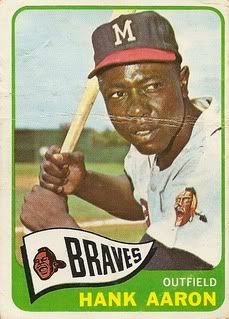
#170 Hank Aaron

#170 Hank Aaron
Are you ready for this bad boy? I've tried to complete most of this set by trade, but as we get down to the big-ticket cards I've got to be on the lookout for good deals. Ed was out at the Baseball Card Outlet nearby in Baltimore when he saw this Hank Aaron card on clearance for $15. That's right, 90% off book value just because of an eensy weensy crease. It took me about two seconds to ask him to be my proxy buyer. It's always good to have extra eyes and ears in the community.

Fun facts about Hank Aaron:

-Hank was born in Mobile, AL. As a teenager he played in the Negro Leagues with the Mobile Black Bears and Indianapolis Clowns. He signed with the Braves at age 18 in 1952, choosing them over the Giants because Boston offered $50 more per month.

-He broke in with the Braves in 1954 after regular left fielder Bobby Thomson fractured an ankle. The young outfielder adjusted well, and was hitting .280 with 27 doubles, 13 home runs, and 69 RBI when a fractured ankle ended his season on September 5. He still finished fourth in Rookie of the Year voting, with Wally Moon winning out over Ernie Banks, Gene Conley, and Hank.

-After leading the N.L. with 34 doubles, 200 hits, 340 total bases, and a .328 average in 1956, he won the MVP award in 1957. He topped the Senior Circuit that year with 118 runs scored, 44 homers, 132 RBI, and 369 total bases. He was also fourth in batting average at .322, as Stan Musial (.351) put some distance between the Hammer and the Triple Crown. He was also the driving offensive force behind Milwaukee's seven-game World Series victory over the Yankees: .393 AVG (11-for-28), .786 SLG, 3 HR, 7 RBI. Of course Lew Burdette gave up only two runs total in three complete-game victories and bested Hank for Series MVP.

-Hank also won three Gold Gloves in left field, 1958-1960, and is tied for the most years on the All-Star team. He took part in every Midsummer Classic for 21 straight years, 1955-1975.

-His younger brother Tommie played alongside him for parts of seven seasons in Milwaukee and Atlanta, beginning in 1962 and ending in 1971, but totaled just 13 home runs. In 1969, they became the first pair of brothers to team up in a League Championship Series.

-It's hard to summarize a career as outstanding as Hank's, but here are his three greatest seasons by OPS+ (with 100 being league-average), with league-leading totals in bold: 1959 (116 R, 223 H, 46 2B, 39 HR, 123 RBI, .355/.401/.636, 181 OPS+), 1963 (121 R, 44 HR, 130 RBI, 31 SB, .319/.391/.586, 179 OPS+), and 1971 (47 HR, 118 RBI, .327/.410/.669, 194 OPS+). That 1963 season was his closest miss in the Triple Crown race, as he was third in average behind Willie Davis (.326) and Roberto Clemente (.320). Incredibly, he finished third in MVP balloting in all three seasons.

-In 1970, Aaron became the first player in big league history with both 500 career home runs and 3,000 hits. He continued chasing history, enduring racist hate mail and death threats as he closed in on Babe Ruth's home run record in the early 1970s. He quietly endured these attacks and finally became the home rung king with #715, a two-run shot off of the Dodgers' Al Downing on April 8, 1974.

-His career came full circle with a November 1974 trade to the Milwaukee Brewers, with whom he finished his career with a two-year stint as a designated hitter. His career spanned 23 seasons, in which he hit .305/.374/.555 with 2,174 runs scored (4th all-time), 3,771 hits (3rd), 624 doubles (10th), 755 home runs (2nd to Barry Bonds' 762), 2,297 RBI (1st), and 6,856 total bases (1st).

-Home run minutiae: Hank hit 97 homers against the Reds, his most against any team. He victimized 310 different pitchers, with Don Drysdale (17 HR) his favorite target. He went deep in 31 different parks, and his highest total as a visitor was 50 HR at Wrigley Field. This one's my favorite: he hit 258 homers in the first three innings, 261 in the middle innings, and 236 from the seventh inning onward. That's pretty good distribution!

-He was of course a first-ballot Hall of Famer, garnering 97.8% percent of the vote. I'll withhold comment on the nincompoops that left him off of their ballot because "Babe Ruth/Honus Wagner/Walter Johnson/etc. didn't get 100%". The Braves and Brewers each retired his #44 and dedicate a statue in his likeness at their ballparks, and he has been a member of the Braves' front office for more than three decades. In 1999, MLB established the Hank Aaron Award, given annually to the top offensive player in each league. He has received the Presidential Citizens Medal and the Presidential Medal of Freedom. And, in a little touch that I enjoyed, he voiced both himself and his fictitious descendant Hank Aaron XXIV in a 2002 episode of Futurama.
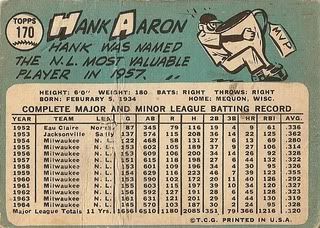
#170 Hank Aaron (back)

Thursday, July 14, 2011

#437 Chico Cardenas

#437 Chico Cardenas
And now we come to the end of another handful of cards provided by Ed. Thanks again, pal! Looking back at Chico Cardenas' uniform vest, those fat black stripes around the armholes seem kind of clunky up against the thin red pinstripes. But what do I know? You may have noticed a little handwritten augmentation on the front of the card. It's funny to imagine that "Good" is supposed to denote the condition of the card.

Fun facts about Chico Cardenas:

-A native of Matanzas, Cuba, Leo "Chico" Cardenas was acquired by the Reds after hitting .316 and slugging .551 for the Tucson Cowboys of the Class C Arizona-Mexico League at age 17 in 1956.

-He debuted with Cincinnati on July 25, 1960, going 2-for-4 with an RBI and a run scored in a 6-5 win over the Cubs. His leadoff single in the ninth inning sparked the game-winning two-run rally against Don Elston. The Reds made him their starting shortstop, a role he would maintain for nearly a decade.

-Cardenas appeared in just 74 games in 1961, but helped the Reds' pennant drive with a .308 average in 198 at-bats. He doubled once in three pinch-hit at-bats vs. the Yankees in the World Series.

-Though he made the All-Star team for the first of three straight seasons in 1964, it was statistically not one of his stronger seasons: .251 AVG, 32 doubles, 9 home runs, 69 RBI. The following year was his best all-around effort, though. In 1965, he batted .287 with a career-high .355 on-base percentage and socked 25 doubles, 11 triples, 11 home runs, and 57 RBI. He led the N.L. with 25 intentional walks, as he spent much of the year batting eighth in front of the pitcher. Chico also won the Gold Glove at shortstop, as is to be expected for a player nicknamed "Mr. Automatic" for his dependable defense.

-In 1966 his average slipped to .255, but he swatted a career-best 20 home runs. His 81 RBI tied him with Deron Johnson for the team lead.

-In a doubleheader vs. the Cubs on June 5, 1966, Chico went 6-for-8 with 4 home runs, a double, 4 runs scored, and 8 RBI. He was 3-for-4 with a pair of homers in each game, victimizing pitchers Bill Hands and Ernie Broglio twice each.

-Following a trade to the Twins in November 1968, Chico strung together three productive seasons in Minnesota. He was an All-Star for the fifth and final time in 1971, when he hit .264 with 18 homers and 75 RBI.

-An ugly batting line of .223/.272/.283 with the Angels in 1972 signaled the end of his days as a full-timer. He hung around as a reserve infielder for a few years with the Indians and Rangers before retiring in 1975.

-In parts of 16 seasons, Cardenas was a career .257 hitter with 118 home runs and 689 RBI.

-He still lives in Cincinnati, and was inducted into the Reds Hall of Fame in 1981.
#437 Chico Cardenas (back)

Wednesday, July 13, 2011

#408 Larry Sherry

#408 Larry Sherry
As far as rhyming baseball names go, Larry Sherry is funnier than Don Hahn, but not quite as funny as Greg Legg. Of course, your mileage may vary.

Fun facts about Larry Sherry:

-Larry was born in Los Angeles and signed with the Brooklyn Dodgers out of high school in 1953.

-He began the 1958 season, his sixth in pro ball, on the major league roster but was hit hard in five appearances and demoted. But he continued to tinker with a slider taught to him by his older brother Norm, a catcher in the Dodger organization.

-Sherry returned to the big leagues in July 1959, and became a surprise contributor down the stretch. His overall record that season was 7-2 with a 2.19 ERA and 3 saves. He seemed to improve as the year went along, with his ERA dropping from 3.62 in July to 1.85 in August and all the way down to 1.36 in September.

-Larry truly shined in a relief role in the 1959 World Series. The rookie appeared in four of the six games against the White Sox, earning saves in the first pair of Dodger wins and wins in the other two. He allowed a single earned run in 12.2 innings (0.71 ERA), yielding 8 hits and 2 walks. L.A. jumped out to an early 8-0 lead in Game Six, but manager Walter Alston didn't take any chances, yanking Johnny Podres after a fourth-inning homer by Ted Kluszewski narrowed the margin to 8-3. Sherry kept Chicago off of the scoreboard for the rest of the game, clinching the Series for the Dodgers and the MVP honors for himself.

-Big brother Norm joined him as a teammate in Los Angeles for parts of the 1959 through 1962 seasons, making them the first (and to date, only) battery of Jewish brothers in big league annals. On May 7, 1960, Norm even hit a walkoff homer against Ruben Gomez of the Phillies to deliver a win for his brother! Another brother, George, was a minor-league pitcher for the Pirates in 1951.

-Despite a middling 3.79 ERA in 1960, he posted a 14-10 record with 7 saves in 57 games (3 starts).

-Larry posted four seasons of double-digit saves in his career, including a career-high 20 with the Tigers in 1966 (third-most in the American League).

-He spent parts of six seasons as a Dodger, another three-plus in Detroit, and also had brief runs in Houston and with the Angels before retiring in 1968. In parts of 11 seasons he was 53-44 with 82 saves and a 3.67 ERA.

-Sherry served as a pitching coach for the Pirates (1977-1978) and Angels (1979-1980). He later became a minor league pitching instructor for the Dodgers.

-He was a golf enthusiast and lived for many years with his wife Sally in Mission Viejo, CA. He passed away at age 71 in 2006 after a long bout with cancer.
#408 Larry Sherry (back)

Tuesday, July 12, 2011

#370 Tommy Davis

#370 Tommy Davis
That's an interesting expression on Tommy Davis' face. He looks like he's halfway between a grin and a grimace, doesn't he?

Fun facts about Tommy Davis:

-A native of Brooklyn and a high school basketball teammate of NBA Hall of Famer Lenny Wilkens, Tommy was 17 when he signed with the hometown Dodgers in 1956 at the urging of star Jackie Robinson. Of course, the team moved across the country the following year, and Robinson retired rather than accept a trade to the rival Giants.

-After a one-game glimpse with Los Angeles in September 1959, he started about half of the team's games in the outfield in 1960. Despite his part-time status, he placed fourth on the club with 11 home runs and 44 RBI while batting .276.

-His career year came in 1962, when he led the National League with a .346 average, 230 hits, and 153 RBI. He is still the Dodgers' single-season RBI record holder. He also achieved personal bests with 120 runs scored, 9 triples, 27 home runs, and a .535 slugging percentage. He made the All-Star team for the first time, and finished third in MVP voting behind teammate Maury Wills and Willie Mays.

-On June 18, 1962, Tommy faced Bob Gibson with one out in the bottom of the ninth and the score tied 0-0. His walkoff home run was just the third hit that Gibson allowed that day, and it made a winner of Sandy Koufax, who yielded only five hits himself.

-Though his power figures dipped in 1963, Davis repeated as an All-Star and successfully defended his batting crown with a .326 mark. He also paced the Dodgers with 88 RBI, and batted .400 (6-for-15) with a pair of triples in the team's World Series sweep of the Yankees.

-A broken ankle cost Tommy most of the 1965 season and seemed to hinder his power for the duration of his career. He also became something of a journeyman, going from L.A. to the Mets, White Sox, Pilots, Astros, Athletics, Cubs, A's again, Cubs again, Orioles, Angels, and finally the Royals in the span of 11 years.

-Other than his time with the Dodgers, Davis' longest tenure with one team was his three-plus years with the Orioles (August 1972-October 1975). He was Baltimore's first designated hitter, and was a vital part of their A.L. East championships in 1973 (.306 with a team-high 89 RBI) and 1974 (.289, team-high 84 RBI). He later admitted that when he was DHing, he would retire to the clubhouse between at-bats to read or even to shave.

-Tommy excelled when called upon as a pinch hitter. He had a career .307 average (62-for-202) in those situations.

-He retired after the 1976 season as a career .294 hitter with 153 home runs and 1,052 RBI in parts of 18 seasons.

-Davis had a short turn as Mariners hitting coach under manager Maury Wills, and has also worked for the Dodgers as a minor league instructor and a community relations employee.
#370 Tommy Davis (back)

Monday, July 11, 2011

#145 Luis Tiant

#145 Luis Tiant
El Tiante! As you can see here, Luis has always been 50 years old. He was born with a stogie in his teeth.

Fun facts about Luis Tiant:

-Luis was born in Marianao, Cuba. He pitched in Mexico in his late teens and early twenties before signing with the Indians in 1962.

-His father, Luis Sr., was a star pitcher in the Negro Leagues and in his native Cuba in the 1930s and 1940s. Due to the ongoing conflict between the U.S. and Fidel Castro, the elder Tiant did not get to attend any of his son's pro games until the 1975 World Series.

-Luis debuted with Cleveland in grand fashion, striking out 11 Yankees in a 4-hit shutout on July 19, 1964. He would finish the season 10-4 with a 2.83 ERA and a WHIP of 1.11.

-In 1968, "The Year of the Pitcher", Tiant stood among the best. He went 21-9 with league-best marks of 9 shutouts (including 4 in a row, April 28-May 12), a 1.60 ERA, and 5.3 hits allowed per 9 innings. He made the first of three career trips to the All-Star Game and finished fifth in MVP voting.

-It was a far fall from 1968 to 1969, when he went 9-20 with a much higher 3.71 ERA. Amid concerns that he was pitching hurt, the Cuban fireballer was traded to the Twins. He missed a big chunk of the 1970 campaign, and was released by Minnesota the following spring.

-Catching on with the Red Sox during the 1971 season, Luis won just 1 of his 8 decisions in the majors. He then reinvented himself as a junkballer, relying on a variety of deception-based arm slots and an elaborate, back-to-the-plate windup to frustrate hitters. Working as a swingman for the 1972 Boston club, he went 15-6 with a league-low 1.91 ERA and got top-ten vote totals for both the Cy Young and the MVP.

-The tricky righthander had a notable stretch from 1973-1976, winning 20 games 3 times (81-52 overall) with a 3.31 ERA. He captured his third shutout crown in 1974, when he had 7 whitewashes among his career-best 22 wins.

-After going the distance in three of his four September 1975 starts, Luis had a memorable postseason. He allowed three hits and a single unearned run in a Game One ALCS victory over Oakland, then won two of his three starts against the Reds in the World Series. His five-hit shutout delivered a Game One victory for the Red Sox, and he gutted out a 5-4 complete game win in Game Four. Rain caused a postponement of Game Six, allowing him to take the ball again on five days' rest. He allowed six runs in seven innings, but an eighth-inning rally by Boston took him off the hook, setting the stage for Carlton Fisk's extra-inning heroics in one of the most talked-about games in history.

-He closed out his career with a two-year stint with the Yankees, followed by single seasons as a Pirate and an Angel. He retired in 1982 with a 19-year mark of 229-172, 49 shutouts, 15 saves, and a 3.30 ERA. He has the most major league wins of any Cuban-born pitcher.

-Tiant remained on the Hall of Fame ballot for the full 15 years before exhausting his eligibility. He drew 31% of the vote in 1988, his first year eligible, but his next-highest percentage was 18 in 2002, his last year. He played pro ball in Mexico in 1983-1984 and with the Gold Coast Suns and St. Lucie Legends of the Senior Professional Baseball League in 1989. He has worked for the Red Sox as a pitching advisor, and coached the Savannah College of Art and Design's baseball team from 1998-2001. He was inducted to the Hispanic Heritage Baseball Museum Hall of Fame in 2002.
#145 Luis Tiant (back)

Thursday, July 07, 2011

#35 Ed Charles

#35 Ed Charles
This card gives us a really close-up look at the Athletics' kelly green undershirt/gray vest/yellow insignia combination. It's easy to forget, given the explosion of gold and green polyester that the A's wore in the 1970s, but this early incarnation was a pretty sharp design.

Fun facts about Ed Charles:

-Ed was born in Daytona Beach, FL, and signed with the Braves as a teenager in 1952.

-His ascent to the major leagues was delayed by two years of military service and the presence of stalwart Milwaukee third baseman Eddie Mathews. After four consecutive seasons at AAA, he was finally freed up by a trade to the Athletics in December 1961.

-Installed as the regular third baseman in Kansas City in 1962, Ed hit .288 with 17 home runs and 74 RBI, was second on the club with a .454 slugging percentage, and stole a team-high 20 bases. He was named to the Topps All-Star Rookie Team.

-Charles was solid again in 1963, with a .267 average, 15 homers, 15 steals, and career highs of 28 doubles and 79 RBI. The following year he delivered 16 home runs and 63 RBI, but a backwards shift of the fences in K.C. sapped his power thereafter.

-He began writing poetry during his time in the minors, and was later dubbed "The Poet Laureate of Baseball".

-Ed was traded to the Mets early in the 1967 season, leaving the A's as the team's leader in games played (726) and total bases (1,065) during their short-lived Kansas City era.

-On May 20, 1968, he had a memorable game. His two solo home runs accounted for the only runs allowed by Pirates hurler Bob Veale. The second longball led off the bottom of the ninth inning and sealed a 2-1 walkoff win for the Mets. Overall, he was 3-for-3 with a walk on the day.

-Though he hit just .207 in 61 games for the Mets in his final season (1969), Charles did go out as a champion. He played in four of the five World Series games that year, singling and scoring the winning run off of Dave McNally in the ninth inning of Game Two.

-He retired with a .263 average, 86 home runs, and 421 RBI in 8 seasons.

-Among his later pursuits, Ed did some promotional work for Buddha Records (known for novelty releases and bubblegum pop), spent nine seasons as a scout and instructor with the Mets (notably signing reliever Neil Allen), and eventually settling into a life in New York's Washington Heights. There he has spent decades offering guidance to juvenile offenders while working with the Department of Juvenile Justice and Youth Options Unlimited.
#35 Ed Charles (back)

Wednesday, July 06, 2011

#12 NL Strikeout Leaders: Bob Veale, Bob Gibson, and Don Drysdale

#12 NL Strikeout Leaders: Bob Veale, Bob Gibson, and Don Drysdale
When I opened up my queue last night to see which card was next, there were only 16 left to write up. I can't tell you how energizing that is; I thought I would never catch up! The next six cards all came from recurring character Ed, who I can't possibly thank enough for his help with this set. This card in particular is a favorite, with two Hall of Famers being dwarfed by the looming figure of the becspectacled and bevested Bob Veale.

1964 was Bob Veale's first full season as a starter, and also marked his only strikeout crown. He whiffed 250 batters in 279.2 innings spread over 40 games (38 starts). He had only 5 games with double-digit K's, but did have a high-water mark of 16 in 12.1 shutout innings against the Reds on September 30. 8 days prior, he turned in his best 9-inning effort by fanning 15 Braves in a hard-luck 2-0 loss. The 1964 race to the top with Bob Gibson was neck and neck. On September 26, Veale's 5 K's in 5 IP left him with 229 total. "Hoot" had 232, and added 4 more in 8 innings on the 28th to give him some breathing room. But Veale's next start was the 16-K game, and Gibson nabbed 7 in his final start on October 2. Interestingly, both men pitched in relief on October 4: working on 3 days' rest, Veale whiffed 5 in 2 innings. Gibson had only a day of rest and added just a pair of strikeouts in 4 innings to finish with 245. Though the Pirates southpaw never topped the league in punchouts again, he established a career high in 1965 with 276, finishing well behind Sandy Koufax's record-shattering 382 K's. Veale is still 32nd-best all-time with 7.96 K/9 IP.

No need to cry for Bob Gibson, who had better years to come. 1964 marked his third straight year with 200+ strikeouts, and he too set a new career best the following year with 270. He too hit double digits in K's 5 times in 1964, topping out at 12 thrice. In his dominant Cy Young season of 1968, he captured his only strikeout title with 268 to go along with a league-best 1.12 ERA and 13 shutouts. He fanned 269 the next year and a career-high 274 the year after that, and retired in 1975 with 3,117 K's - 14th-best all-time.

Don Drysdale already had 3 strikeout crowns to his name by 1964. He got the honors in 1959 (242), 1960 (246), and 1962 (2.32). His 251 whiffs in 1963 were actually his personal best, but that year he trailed both teammate Koufax (306) and Cincinnati's Jim Maloney (265). In '64, he racked up 4 double-digit strikeout games, peaking with a dozen in a 9-inning win over the Cardinals on August 31. Despite a relatively short 13.5-season career, his total of 2,486 K's is still 30th-most in MLB history.

Going on down the line, Topps lists the 51 "top" strikeout men in the National League for 1964. By the time they get down to double digits near the top of the second column it starts getting silly, but it did allow them to squeeze in 43-year-old Warren Spahn at the very bottom. Besides, some 9-year-old who was president of the Don Nottebart Fan Club was probably thrilled to see his hero make it onto a league leaders card.
#12 NL Strikeout Leaders: Bob Veale, Bob Gibson, and Don Drysdale (back)

Tuesday, July 05, 2011

#468 Larry Brown

#468 Larry Brown
Well, I'm back from vacation. Did you miss me? No need to answer. This card wraps up the fiver from John Reid. Thanks again, John!

Fun facts about Larry Brown:

-Larry was born in Shinnston, WV and signed with the Indians at age 18 in 1958.

-His older brother Dick was a catcher for four American League clubs (primarily the Tigers and Orioles) from 1957-1965. His career was cut short by a brain tumor that ultimately claimed his life in 1970.

-Brown debuted with the Indians on July 6, 1963, collecting a single off of Al Downing and a walk in three trips to the plate.

-He saw action in 74 games as a rookie, batting .255 with 5 home runs and 18 RBI. One of his homers was a walkoff shot with two outs in the ninth inning against Detroit's Terry Fox.

-In 1964, Larry received 87 starts at second base for the Tribe and had career highs of 12 home runs and 40 RBI. However, he batted only .230 for the season.

-His best all-around season was 1965, when he matched his previous year's RBI total of 40 and added 52 runs scored and 22 doubles while batting .253. He also led American League shortstops with a .977 fielding percentage.

-A nasty collision with Indians outfielder Leon Wagner in 1966 left him with fractures to the skull, nose, and cheekbone. His power stroke seemed to be lessened after his recovery.

-In the late 1960s, he was Cleveland's everyday shortstop. During that time, he ranked among the league leaders for most at-bats between strikeouts. He whiffed once per every 10.8 trips to the plate in 1968, and once per 10.9 at-bats the next season.

-Larry spent time as a backup with the Athletics (1971-1972), Orioles (1973), and Rangers (1974). He finished his career with a .233 average, 47 home runs, and 254 RBI.

-Both his final career home run (May 13, 1973) and his final career hit (a single on September 22, 1974) came against pitcher Lindy McDaniel!
#468 Larry Brown (back)