Sunday, November 30, 2008

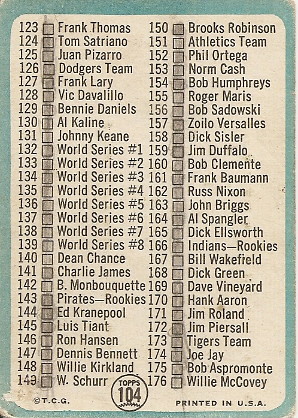
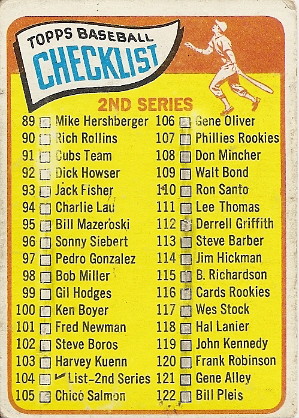
#104 Checklist 2nd Series

Checklist 2 by you.
Here's another breather in the form of a checklist. As you can see, someone filled in the boxes front and back in pencil, and then went back and erased the pencil...but only on the front. How odd. The featured stars in the second series are Hall of Famers Bill Mazeroski, Frank Robinson, Al Kaline, Brooks Robinson (at #150), Roberto (or "Bob") Clemente, Hank Aaron, and Willie McCovey. Talk about an impressive checklist! You've also got Gil Hodges, Ron Santo, Luis Tiant, and Roger Maris. The big Hero Number goes to National League MVP Ken Boyer at #100.

For those keeping tabs, I have now completed 39.8% of this second series (35 of 88). We are catching fire, and I will continue posting more cards at about the same pace established in the past few months!
Checklist 2 (back) by you.

Saturday, November 29, 2008

#97 Pedro Gonzalez

Pedro Gonzalez by you.
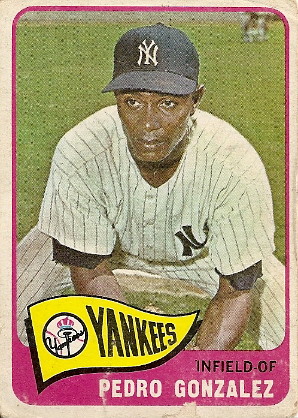
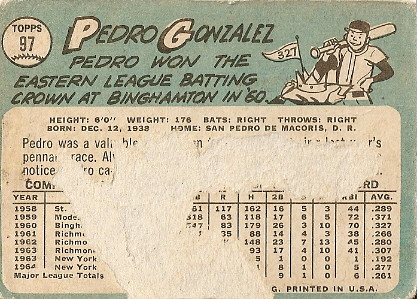
Utility player Pedro Gonzalez is in an abnormally deep crouch. It's probably for the best that we can't see his hands; this is a family blog. You may also notice that there's a chunk of paper missing from the back of the card down below. This is a common affliction for cards of a certain vintage. Back in the day, Ultra-Pro sheets and toploaders were unheard of. This poor card was probably pasted into a scrapbook somewhere, and then painfully extracted at a later date.

Pedro Gonzalez was one of the first major leaguers to hail from the Dominican Republic. He signed with the Yankees in 1958, at age 21. He was a strong hitter at every stop in the minor leagues, including an Eastern League-leading .327 average at Binghamton in 1960. After batting .307 at Richmond in 1963, he finally got the call to New York. Pedro struggled, hitting .192 in 14 games.

1964 proved to be Pedro's best season with the bat in the majors, as he batted .277. Splitting time at five positions, he committed only three errors in 66 games. He appeared in only one game in that Fall's World Series, popping out in his only at-bat. The following year, he appeared in seven games in pinstripes before being traded to the Indians for first baseman Ray Barker. He hit .254 overall with five home runs and 39 RBI. Cleveland used him almost exclusively at second base in his three years with the club; though he was slick defensively, he had little power and his average dipped to the .230 neighborhood in 1966-1967. The following season, he transitioned to managing in the Mexican League. He later spent a dozen years at the helm of the Braves' rookie-level Gulf Coast League team.

Fun fact: An Internet search turns up an incident in September 1965 as Gonzalez' lasting place in baseball. Incensed by two straight brushback pitches from Tigers pitcher Larry Sherry, Pedro charged toward the mound with his bat and took a few swings. He apparently hit Sherry on the arm before things were broken up. American League President Joe Cronin fined Pedro $500 and suspended him for the remainder of the season.
Pedro Gonzalez (back) by you.

Friday, November 28, 2008

#87 Nelson Mathews

Nelson Mathews by you.
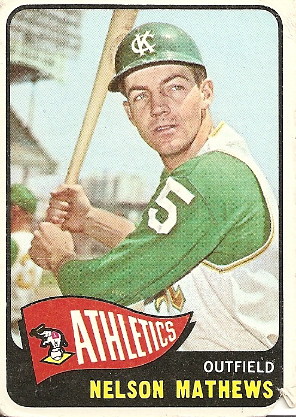
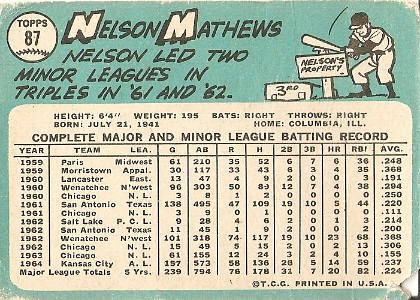
Outfielder Nelson Mathews is the first Athletics player I've posted in a while. He's posed while wearing a batting helmet, a rare sight in this set. The #5 on his sleeve is front and center, one of the more distinctive features of the unique A's uniforms. You can also see a teammate in the background. Based on the positioning of the number on the anonymous fellow's back, I'd say that it's in the thirties, rather than an outright #3.

A tall (6'4"), thin outfielder out of Columbia, Illinois, Nelson Mathews stayed close to home by signing with the Cubs for a $25,000 bonus in 1959. His offensive performance was uneven in four years of minor league play, though he did lead the Texas League in 1961 and the Northwest League in 1962 in triples. The latter year represented a breakout for the youngster, as he hit .368 with 54 extra-base hits for the Wenatchee (WA) Chiefs. Based on these numbers and a successful September with the big league club (.306 with 13 RBI in 15 games), he finally appeared to have spot on the Cubs roster after receiving the briefest of looks in 1960 and 1961.

Former Cubs first baseman and manager Charlie Grimm, who was a coach for the team during Mathews' time in Chicago, liked what he saw in the outfielder, likening his fielding to that of Yankees Hall of Famer Earle Combs. Unfortunately Nelson couldn't quite hit like Combs, at least not in 1963. Though he spent the whole season in the majors, the 21-year-old received just 155 at-bats, batting a paltry .155 (what an unwelcome coincidence!). The Cubs washed their hands of him that December, trading him to the Athletics for pitcher Fred Norman.

1964 would be Nelson's only season as a major league regular. He hit .239 with 14 home runs and 60 RBI. His 27 doubles were second-best on the team , trailing the duo of Wayne Causey and Rocky Colavito (tied with 31 each). He led the American League in the dubious category of strikeouts, whiffing 143 times. As Kansas City's everyday center fielder, he showcased the pluses and minuses of his range, leading the league in both putouts (381) and errors (13). In 1965, Mathews was supplanted in the starting lineup by veteran Jim Landis. Despite hitting .212 overall and only coming to bat 184 times, Nelson's seven triples placed seventh in the A.L., five behind co-leaders Bert Campaneris and Zoilo Versalles. At age twenty-three, when most players are just getting their start in the majors, Nelson Mathews was playing his final game.

Nelson's name would come up again thirty years later, when his son T. J. made his debut with the St. Louis Cardinals as a righthanded pitcher. He would go on to have an eight-year career, winning 32 games and saving 16 with a 3.82 ERA. He's best known as one of the three players traded from St. Louis to the A's for slugger Mark McGwire. He was coached in St. Louis by Dave Duncan, who in 1964 was briefly a teammate of Nelson Mathews!

Fun fact: Nelson's first big league home run was a first-inning grand slam off of Stan Williams, giving Cubs starter Bob Buhl all of the support he would need in a 5-0 win over the Dodgers.
Nelson Mathews (back) by you.

Wednesday, November 26, 2008

#85 Willie Smith

Willie Smith by you.
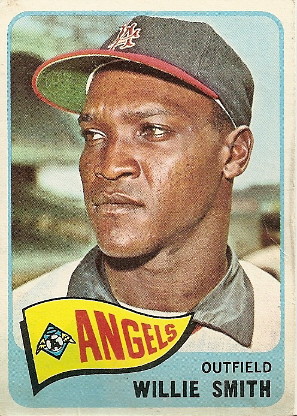
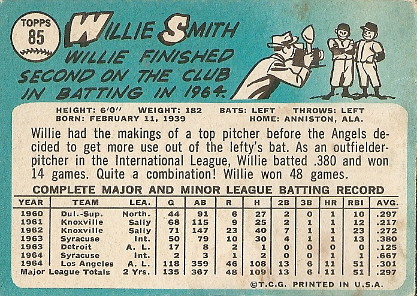
You are face-to-face with the lantern-jawed Willie Smith, a versatile athlete from Alabama. He originally signed with the Tigers in 1960, and split his time between the pitchers' mound and the outfield. He proved skilled at both, posting a 14-2 record and a 2.11 ERA at Syracuse in 1963. He also hit .380 in 79 at-bats, prompting Detroit to call the 24-year-old up in June and again in September. The following April, Willie was traded to the Angels for pitcher Julio Navarro. His new team used him as a pitcher and pinch hitter, and he compiled a 2.84 ERA in 31 and two-thirds innings, mostly in relief. But the Halos were so weak offensively (.242 team batting average) that by mid-June they switched Smith to the outfield. Although he was hitting in the .230s at that time, his bat caught fire with more regular playing time. He finished the season at .301 (only one other Angel topped .300) with 11 home runs and 51 RBI. He was also in the top ten in the league with six triples.

1965 saw "Wonderful Willie"'s average drop to .261, but he was still a reliable power source, climbing to fourth in the A.L. with nine triples to go along with career highs of 14 HR and 57 RBI. He was entering the dark ages as a hitter, however. The following season his playing time was more than halved as he hit .185 and homered once. It was back to the minors for much of 1967, when Smith's contract was purchased by Cleveland. After another poor start in 1968 (.143), the Indians traded the outfielder to the Cubs. In part-time duty with Chicago, he turned things around with a .275 batting mark and five longballs. 1968 also saw Willie make a few cameos on the mound. In seven and two-thirds innings, he allowed two hits, one walk, and no runs. Not bad for a guy who hadn't pitched in a major league in four years.

Smith started the 1969 season with a bang for the Cubbies. On Opening Day at Wrigley Field, he stepped to the plate in the bottom of the eleventh with one out and Randy Hundley on first base and walloped a walkoff two-run homer to erase a 6-5 Phillies lead. The Cubs were in first place and would stay there for 129 days, but ultimately blew a lead that was as large as nine games in mid-August. The Amazin' Mets chased the Bruins down and ultimately left them eight games back. Willie hit .246 with nine homers in his last semi-productive season. After hitting .216 in 1970, he finished his big league career the next year as a Red. Not ready to call it a career, the outfielder spent 1972 and 1973 in Japan, hitting .259 with 29 dingers for the Nankai Hawks. Following his playing days, Willie returned home to Anniston, Alabama and volunteered at youth baseball camps. He passed away nearly three years ago, reportedly due to a heart attack. He was 66 years old.

Fun fact: According to an obituary, Smith was the first of four Willies to hit an upper-deck home run at Atlanta-Fulton County Stadium. The others, of course, were Hall of Famers Stargell, Mays, and McCovey.

Willie Smith (back) by you.

Monday, November 24, 2008

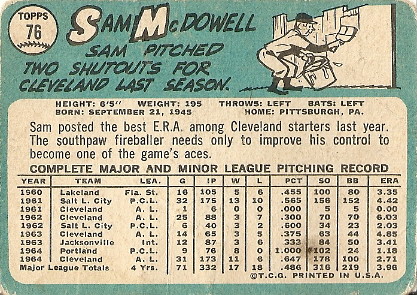
#76 Sam McDowell

Sam McDowell by you.
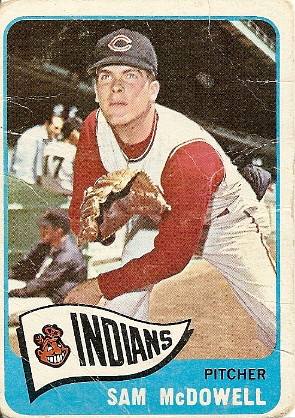
Check out the scowl on "Sudden" Sam McDowell's face as he unleashes an imaginary fastball toward some unlucky hitter! To the best of my recollection, this is also the first card from the set in which you can pretty clearly identify another player in the background. A quick check of the Indians' 1964 roster shows #17 as...Chico Salmon? That doesn't seem right. There's a chance that it could be a 1963 photo, in which case Mike de la Hoz was #17. That's more likely once you look at this suspiciously similar 1964 Topps card. But enough of that.

Towering over most of his peers at 6'5" and more than 200 pounds, Sam McDowell did most things hard and fast. Signed by the Tribe before his 18th birthday, the native of nearby Pittsburgh made his Indians debut in 1961, at the end of his second pro season. He struck out batters by the handful, but wallked nearly as many. That probably contributed to his tentative grasp on a roster spot; Sam did not spend a full season in the bigs until 1965. He started to put things together in 1964, when he went a combined 19-6 at Portland and Cleveland and posted a 2.70 ERA in the majors.

The following year was a memorable one for Sam. The 22-year-old was an All-Star (the first of six selections for him), going 17-11 with 14 complete games and a league-best 2.18 ERA. He also led the A.L. with an absurd 325 strikeouts (not to mention 132 walks and 17 wild pitches). Despite topping the Junior Circuit in K's again in 1966 (225) as well as shutouts (five), McDowell dropped to nine wins. After being unseated by Boston's Jim Lonborg for 1967's strikeout title (by a 246-236 margin), he returned to the top of the league in whiffs in 1968 (283) and 1969 (279). Sam also posted a miniscule 1.81 ERA in 1968, placing him as runner-up to teammate Luis Tiant. The southpaw's win totals were gradually climbing back to the heights of 1965, and he set a new career high with 18 victories in 1969. But the best was just around the corner.

1970 was McDowell's finest all-around year on the mound. He went 20-12 with 19 complete games, a 2.92 ERA, and 304 strikeouts. It was the fifth and last time he led the league in K's, with all five crowns coming in a six-year span. He was rewarded by The Sporting News, which named him Pitcher of the Year.

After following up with a down year by his own standards (13-17, 8 CG, 192 K, 3.40 ERA, 1.46 ERA), Sam found himself as one half of a challenge trade. He was sent to the Giants for fellow All-Star pitcher Gaylord Perry. The Indians would soon find that they had gotten the better of the deal; Perry won 72 games in three-and-a-half years in Cleveland and then netted them Jim Bibby, Rick Waits, Jackie Brown, and $100,000 in a trade with Texas. McDowell, sadly, was already running out of gas. He won just 11 games with an ERA near 4.50 before San Francisco cut their losses and sold him to the Yankees in June 1973. The lefty had a mediocre 29-game stint with the Yankees before coming home to Pittsburgh in 1975. Then 32 years of age, he posted a 2.86 ERA in 34 and two-thirds innings (mostly in relief) as a swan song to his career.

Sam McDowell was a force to be reckoned with in his prime, which helped him to 141 career wins and 103 complete games. He struck out 2,453 total batters, and his ratios of 8.86 K/9 IP and 7.03 H/9 IP are each still ninth-best all-time. Of course, a more disciplined approach may have lengthened both his peak and his career as a whole. He did top the league in walks allowed on five occasions, and in wild pitches thrice. It's also been said that his considerable appetite for alcohol hastened his decline. After his career ended, the drinking worsened, costing him his family. In the early eighties McDowell, deeply in debt, managed to rehabilitate. He repaid his creditors, earned a degree in sports psychology and addiction from the University of Pittsburgh, and found work as a counselor for the Rangers, Blue Jays, and eventually for the Major League Baseball Players' Alumni Association. He remarried in 2001 and started a retirement community in Florida for ex-players.

Fun fact: The character of Sam Malone, the alcoholic ex-Red Sox pitcher played by Ted Danson on the popular sitcom Cheers, was based on Sam McDowell.

Bonus fun fact: Sam played one-third of an inning at second base and two-thirds of an inning at first base in 1970, as manager Alvin Dark switched back and forth between the lefthander and righty Dean Chance. In the former instance, he even recorded a putout, taking a throw from third baseman Eddie Leon to force Frank Howard at second!
Sam McDowell (back) by you.

Sunday, November 23, 2008

#45 Roy McMillan

Roy McMillan by you.
Check out the designer frames on veteran shortstop Roy McMillan! Though you surely wouldn't hit a man with glasses, you're obviously not a National League pitcher. Roy placed in the top ten in hit-by-pitch five times in the N.L. in his 16-year career. That's gotta sting.

Texas-born Roy McMillan signed with the Reds in 1947 and served a four-year apprenticeship in the minors before debuting with Cincinnati at age 21. After struggling to hit in his first season (.211), the young shortstop showed improvement in 1952. He cracked 32 doubles (third-best in the N.L.), added seven home runs, and drove in 57. It would be a career trend for Roy: low batting average, but decent pop - particularly by shortstop standards. It would be his glove that made him a valuable starter, though. In 1954, he set a record (since broken) by turning 129 double plays. From 1957-1959, he won Gold Gloves in the first three years they were awarded. The late Fifties were kind to McMillan, as he also made back-to-back trips to the All-Star Game in 1956 and 1957. 1956 brought personal bests in RBI (62) and walks (76), and the following year he hit a career-high .272. The latter year he was caught in the crossfire of a controversy, as Reds fans stuffed the ballot box to place Roy and six teammates in the starting lineup of the Midsummer Classic. The league intervened, removing Wally Post from the team and Gus Bell from the starting lineup. McMillan and the other four Redlegs remained in the starting nine.

In December 1960, after a decade in Cincinnati, Roy was on the move. The Reds traded him to the Milwaukee Braves for Juan Pizarro and Joey Jay. His three-plus seasons up north were unremarkable, though he set a new personal best with 12 home runs in 1962. In May 1964, after getting into just eight games in the first month of the season, the shortstop again found a new zip code. He was dealt to the sorry Mets for pitcher Jay Hook and a player to be named later. The end was near for McMillan; in his three years in New York, he failed to post a slugging percentage or an on-base percentage above .300. For his career, he batted .243. Five years after his retirement, he was elected to the Reds' Hall of Fame.

Roy stayed in baseball after hanging up his glove, coaching and managing in the Mets' organization from 1967-1969 before returning to Milwaukee as a Brewers coach from 1970-1972. He served as interim manager for two games, splitting decisions while bridging the gap between Dave Bristol and Del Crandall. It was back to the Mets as a coach in 1974. The following year, team brass fired manager Yogi Berra with the club in third place at 56-53. Again, McMillan was installed at the helm. The Mets continued to tread water, going 26-27 under the interim skipper and staying put in third. He was not brought back for 1976, but did spend 1977-1980 managing in the Twins organization, winning a league championship with the A-level Visalia Oaks in 1978. Roy passed away in 1997, ten years after being selected to the Texas Baseball Hall of Fame.

Fun fact: Roy hit two home runs off of Joey Jay and one each off of Jay Hook and Juan Pizarro; he victimized all three pitchers that he was traded for at various points in his career.

Roy McMillan (back) by you.

Saturday, November 22, 2008

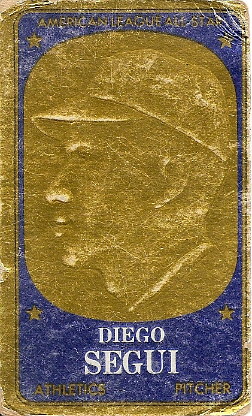
#24 Embossed: Diego Segui

SEGUIG by you.
Here's an interesting diversion from the base set. It also kicks off a batch of sixteen cards that I received from reader Ed, who gets his pick of my Orioles doubles just as soon as I have them all sorted. Younger collectors might not realize that Topps has been doing inserts for so long, but it's true. The card you see above is part of a one-per-pack insert set that comprised 72 cards in total. Each of the 20 MLB teams had three or four players in the set with the exception of the Senators (two) and the Indians (five).

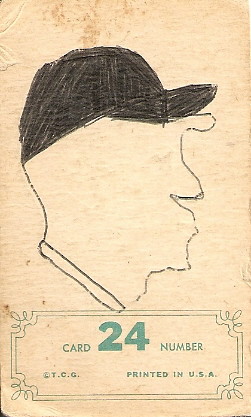
These are pretty gaudy by any standard, featuring a profile portrait of the player completely embossed in gold. The American Leaguers had blue borders, and the National Leaguers had red borders, which were a bit rougher on the eyes. Dayf, the Cardboard Junkie, recently picked up a Lee Maye Embossed to complete his Braves team set; you can see it here. The backs of the cards are nearly blank, save for the card number and copyright info in a box at the bottom.

Of course as you can see, my Embossed card does have an extra special touch on the back. Someone attempted to trace Diego's head from the front to the back, with...mixed results. He looks like some sort of half-moose hybrid. An odd detail I noticed on the front is just how prominent they depicted Segui's Adam's apple. That thing's just kind of hanging there. I'd go into more detail about his career, but his base card is sitting in the queue to be posted in the coming weeks and I don't want to use up my material.

So what do you think - should I try to complete this set along with the base cards? I'm definitely interested in collecting the four Orioles: Brooks Robinson, Milt Pappas, Boog Powell, and John Orsino.

SEGUIGB by you.

Thursday, November 20, 2008

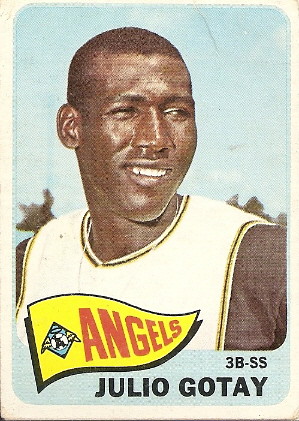
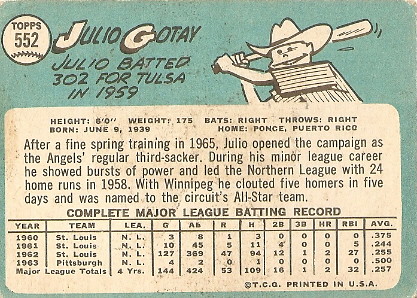
#552 Julio Gotay

Julio Gotay by you.
We can all thank our lucky stars that Julio Gotay didn't come along a few decades later than he did. As things stand, we've been spared the obnoxious spectacle of ESPN blowhard Chris Berman dubbing him Julio Gotay "It On the Mountain". But I digress. Gotay makes it back-to-back Halos this week; he's just been traded from the Pirates in early 1965, hence the bare head and the sleeveless jersey with the black and gold piping.
Like our last featured player (Vic Power), Julio was a native of Puerto Rico. Apparently he had a superstitious fear of crosses. After brief trials in 1960 and 1961, he became the Cardinals' starting shortstop in 1962. The 23-year-old hit an unproductive .255 - he had just fifteen extra-base hits in 369 at-bats and drove in 27 runs. In the offseason, he was dealt to Pittsburgh in the trade that brought All-Star shortstop Dick Groat to St. Louis.

The Pirates did not seem to have any real use for Gotay, giving him four at-bats in seven total games over a two-year span. Just before the card above was produced, they liberated the shortstop, trading him to the Angels for mediocre outfielder Bob Perry. Julio saw action in a whopping 40 games during his lone season in California, batting .247. Next it was off to Houston, where he would actually be a useful reserve for three seasons.

Julio had his best season with the bat in 1967, compiling a .282 average in 77 games as an Astro. He hit .248 and .259 in the two years that followed to finish his ten-year career with a .260 average, 6 home runs, and 70 RBI in 389 games.

On July 4, 2008, a few weeks after being hospitalized for treatment of prostate cancer, Julio died of respiratory failure. The Gotay family baseball legacy is carried on by infielder Ruben Gotay. Ruben is Julio's nephew, and has played for the Royals, Mets, and Braves in his four big league seasons.

Fun fact: Julio set an Astros record by hitting safely in eight straight at-bats from June 18-20, 1967. Filling in for Joe Morgan, who was on military leave, he doubled in his last at-bat against Phil Niekro on the 18th, went 5-for-5 on the 19th, including four safeties off of Bob Gibson an RBI single to send the game to extra innings, and a single and a double (following a hit-by-pitch) on the 20th. Not a bad way to start your week!
Julio Gotay (back) by you.

Wednesday, November 19, 2008

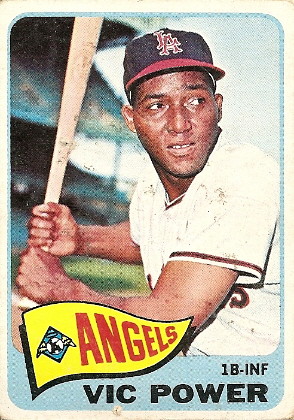
#442 Vic Power

Vic Power by you.
Ah, Vic Power, one of the greatest baseball names there ever was. Sure, his single-season high was 19 home runs, placing him behind such notable sluggers as Mike Bordick and Davey Johnson, but power is not just about four-base hits. It's a lifestyle. No one embodied that lifestyle, particularly on the diamond, like Vic Power. I like to think of his name as a rallying cry for Vics everywhere: "Vic POWER!".

Victor Pellot Pove grew up in Puerto Rico, and honed his skills playing for the San Juan Senators (or Senadores) in his early twenties. In 1949, he moved to mainland North America and played for a professional team in Quebec. Wikipedia (yeah, I know) suggests that French-Canadian fans snickered at Vic's name (he went by Pellot, his father's surname). There's no sourcing, of course, but my crack Internet research leads me to believe that "pelote", the French word for "ball", could have easily been a source of amusement for the terminally immature. So it was that he began going by his mother's maiden name, "Pove", which was roughly translated to the English "Power". Sheesh, talk about getting bogged down in linguistics.

Vic soon caught the eye of Yankees scouts, who signed him in 1951. The notoriously slow-to-integrate pinstripers seem to have been put off by the unapologetic nature and sharp wit of the young first baseman. During his first season in their organization, he reportedly entered a restaurant and was informed that they did not serve colored people. He replied, "That's OK, I don't eat colored people. I just want rice and beans." Despite hitting .331 with 109 RBI in the minors in 1952, Power was not invited to the major league camp the following Spring. The writing was on the wall, and indeed New York traded him to the Athletics as part of an eleven-player deal in December of 1953. A popular rumor has the Yanks deciding to dump Vic because he had been dating a white woman.

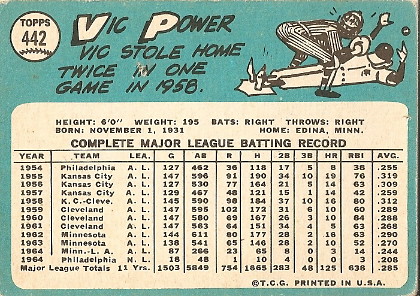
Whatever the circumstances, Power was finally a big leaguer in 1954, at age twenty-six. In the last season for the woeful A's in Philadelphia, he became the club's first Puerto Rican player. But it wasn't until they moved to Kansas City that the first baseman truly announced himself as a force. 1955 would hold up as the finest performance of Vic's career - he was an All-Star and a top-ten vote getter in the MVP race. He hit .319 with 61 extra-base hits and 76 RBI. Despite a dip in power the following season, his batting average stayed strong at .309 and he returned to the All-Star Game. Following a disappointing 1957, the A's shook things up in June 1958 by trading Power and Woodie Held to Cleveland for Roger Maris and two other players. The newest Indian responded by finishing the season at .312 overall with a personal-best 37 doubles and league-leading 10 triples. He also won his first Gold Glove.

Vic Power attracted lots of attention with his flashy play in the field. At the time, it was unheard of to catch the ball one-handed at first base, and it quickly became his calling card. Of course, now we take it for granted that this style of play increases flexibility and range, but Vic was instrumental in redefining his position. He was also an All-Star in two of his three full seasons with the Tribe, combining his doubles power with batting averages in the high .280s and continuing his slick work with the leather.

On the eve of the 1962 season, Power joined the Twins via another trade; pitcher Pedro Ramos was the outgoing Minnesota player. Again looking to make a good first impression, the first baseman was selected as the team's standout player of the year on the strength of a .290, 28 2B, 16 HR, 63 RBI stat line. After a decent encore in 1963, the 36-year-old showed his age the following year. In June, with his average at .222 and yet to hit a longball, Vic was traded to the Angels as part of a three-team deal. After batting .249 with 3 home runs in 68 games in L.A., he was shipped to the Phillies in September. You may be wondering why the card above has an Angels pennant and logo, in that case. As it so happens, the Halos reacquired Power in November, allowing Topps to use a photo of him that they'd ostensibly taken in the summer of '64. By that time, he was completely unable to live up to his name, stroking just nine extra-base hits in 197 at-bats in 1965. When the Angels released him the following April Fool's Day, it was a wrap for Vic Power. He carried a .284 batting average for his career.

The four-plus decades since Vic's career ended have cemented his legacy as one of the trailblazing Latin American players in Major League Baseball. He moved back to his native Puerto Rico and instructed future major leaguers such as Roberto Alomar, Jose Oquendo, Jerry Morales, Willie Montanez, and Jose Cruz, Sr. In 2005, just months after sharing memories of his career in the American documentary Beisbol, 78-year-old Vic Power succumbed to cancer.

Fun fact: Vic is one of 11 players to steal home plate twice in a game, having performed the feat on August 14, 1958. His first swipe gave the Indians a 9-7 lead in the eighth inning. After the Tigers tied the game in the ninth, Power stood on third in the bottom of the tenth with the bases loaded, two outs, and Rocky Colavito at bat. He took advantage of pitcher Frank Lary's struggles, breaking for home and catching him unaware with the game winner!
Vic Power (back) by you.

Sunday, November 16, 2008

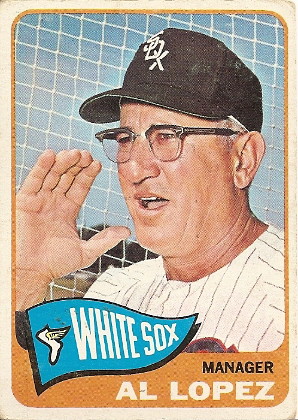
#414 Al Lopez

Al Lopez by you.
I am a big fan of this pose, which Topps photographers used to great effect for several managers (Sam Mele and Chuck Dressen among them) in this set. Really, it's surprising that no one thought of it sooner. Pitchers posed in their windup or follow-through. Batters posed in a batting stance. Fielders posed bent at the waist, glove out in front in anticipation of a grounder. So why shouldn't managers pose with a hand cupped to the mouth, shouting instructions to their charges?

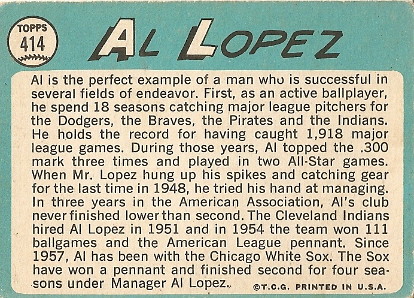
Al Lopez had as long and colorful a career in baseball as anyone. He broke into the major leagues as a 19-year-old catcher with the 1928 Brooklyn Dodgers, and played nineteen seasons, retiring from the 1947 Cleveland Indians. He set a record for games caught (1,918), which was broken four decades later by Bob Boone. In 1930, he hit the last-ever "bounce home run"; the following year, balls that touched the field of play and then bounced into the stands were scored as ground-rule doubles. He was a two-time All-Star, and twice hit over .300 in a full season.

Lopez found his true calling as a manager. From 1948-1950, he helmed the Indianapolis Indians, taking the Pirates' AA affiliate to the postseason in all three years and winning the Junior World Series in 1949. Cleveland hired him in 1951, and he was an instant hit, leading the Tribe to three straight 90-plus-win seasons. In each of those years, the club was the runner-up to the dynastic Yankees. But 1954 was a season for the ages. Led by a dominant starting rotation of Early Wynn, Mike Garcia, Bob Lemon, Art Houtteman, and Bob Feller, the Indians won a then-record 111 games (against just 43 losses) to interrupt New York's run of dominance. Regrettably, Cleveland ran into another New York team in the World Series. Willie Mays introduced himself to the world as the Giants swept the Indians in four straight. After two more second-place finishes behind the Yanks, it was time for Lopez to move on.

Al took over the White Sox in 1957, but found himself in a familiar position: looking up from second place at the pennant-winning Yankees. After more of the same the next year, he guided the Pale Hose to the top in 1959. The "Go-Go Sox" won 94 games but succumbed to the Koufax/Drysdale Dodgers in six games in the World Series. Chicago couldn't build any momentum in the ensuing years, finishing third, fourth, and fifth from 1960-1962. Led by young stars such as third baseman Pete Ward and pitcher Gary Peters, the White Sox vaulted back into contention in 1963, winning 94 but finishing 10 and 1/2 games back of (who else?) the Yankees. The next year the Sox were even better, notching 98 victories. Despite winning their last nine games, they finished a heartbreaking second, only one game behind the...Bronx Bombers. 95 more wins in 1965 were not enough to overcome the surging Twins, who won 102. Lopez walked away from managing, only to return for a brief and unsuccessful stint at the end of 1968 and beginning of 1969.

Al did have quite an impressive run as a manager, never finishing a full season with less than 85 wins. He won 1410 games and lost 1004, for a .584 winning percentage. His pennant-winning teams in 1954 and 1959 were the only clubs from 1949-1964 to interrupt a staggering string of Yankee league titles. On the strength of his managerial record, Lopez was enshrined in the Baseball Hall of Fame in 1977. He lived to the ripe old age of 97, passing away in 2005 shortly after his White Sox won their first World Series in nearly a century. He had been the last living player of the 1920s.

Fun fact: In 1954, Al Lopez Field was dedicated in the former catcher's hometown of Tampa. It was razed in 1989, and the spot where it once stood is now the south end zone of Raymond James Stadium, home of the NFL's Buccaneers.
Al Lopez (back) by you.