Wednesday, June 18, 2008

#278 Ken Retzer


Here's the grand finale of the group of cards I received from Ed, so big thanks to him once again. Ken Retzer is a guy who paid his dues. After being signed by the Indians as an amateur free agent in 1954, the catcher toured the minor leagues until 1961, when he debuted with the Senators as a 27-year-old rookie. He hit .340 in his initial exposure to American League pitching, but from there it was a case of diminishing returns, as his batting average dropped each of the next three years. He bottomed out in 1964 at .094 before being shipped to the Twins in the winter. This was Ken's last baseball card, as he never played a single game in Minnesota. It would seem that he was sent back to the minors; the Twins sent him to Houston in April of 1966 and the Astros flipped him to Cleveland early the next year, bringing him full circle in pro baseball.

In his short time in the bigs, Ken apparently let his arm do most of the talking, throwing out 38.1% of would-be base stealers (48 of 126). He was also a tough strikeout, going down without contact only 50 times in 690 total at-bats, or once every 13.8 times at the dish.

Fun fact: Ken Retzer had Milt Pappas' number, homering four times in sixteen at-bats against the former Orioles' All-Star. That's once every four times to the plate, compared to a 49.2 AB/HR ratio for his entire career.

Tuesday, June 10, 2008

#268 Ken McBride

I just got three more cards from one of my readers, so let's wrap up the batch from Ed. This is the second-to-last card of that bunch, and you'll duck if you know what's good for you. Ken McBride led the American League in hit batsmen twice in his career, and plunked somebody once every 16.2 innings on average. Ouch! Fortunately, he also finished near the top of some more flattering lists.

The former Red Sox signee got his start in the big leagues with the other Sox. Since I'm always looking for a Baltimore connection, I have to mention that McBride debuted in Memorial Stadium, taking a hard-luck 3-2 loss for Chicago. He allowed three runs to the Birds in seven and one-third innings, but only one was earned and the deciding runs were allowed by his bullpen. Then again, if Ken hadn't walked seven batters (including a young Brooks Robinson twice), the outcome may not have been in doubt.

Ken never really got a long look on the South Side, but his career took off after the Angels selected him in 1960's expansion draft. He was an All-Star in each of the team's first three seasons; though he only played in the 1963 game, he did get the start that year. He allowed three runs in three innings, but did drive in the AL's first run with a single off of Jim O'Toole in the second frame. You can see some of his stats below; he finished in the top ten of the junior circuit in winning percentage (1962), WHIP (1963), K's and K/9 IP (1961), complete games (1961, 1963), shutouts (1962), and adjusted ERA (1961).

As you can see, his performance fell of dramatically in 1964, and unfortunately this would be his last card. He appeared in just eight games for the Halos in 1965, going 0-3 with a 6.14 ERA. Ken had always had a bit of a control problem, finishing in the top ten in walks allowed three times in four years in addition to his aforementioned tendency to hit batters. Maybe his wildness hastened his demise.

I just started adding Fun Facts recently, and I think I'm going to make it a habit. I'm also going to start tagging posts to indicate which team the featured player represents. I'll do it retroactively as well.

Fun Fact: Ken McBride was an August kind of guy. His first ML game, his last game, and his birthday all occurred in the first half of August.

Saturday, June 07, 2008

#192 Jim Coker


Slowly but surely, I'm plugging along with the bunch of cards that I received from Ed a while back. We've got another of Topps' Hatless Wonders, but my favorite part of this card is Mr. Redlegs, a fine logo if ever there was one. When it comes to baseball mascots, I say the more maniacal, the better.

As for Jim Coker, he was the fringiest of fringe players: his major league career consisted of 233 games spread out over nine seasons. As you can see below, he made it onto a card in 1965 despite playing in just 11 games the previous year. Then again, someone at Topps may have had a soft spot for Jimmie, as he's billed on baseball-reference.com. He made their All-Rookie team in 1960 on the strength of a .214 average, 6 home runs, and 34 RBI, not eye-popping numbers by any standard.

As you can see, he showed much more promise with the bat in the minor leagues, and it's not fair to judge him on his MLB stats, considering that the aforementioned 1960 season was the only true shot he had. You may notice that his first stop in pro baseball was Mattoon, Illinois, which is also the hometown of Deadspin editor Will Leitch. Another Jim Coker fun fact: he spent one month as Oriole, in a manner of speaking. In November 1962, Baltimore purchased him from the Phillies, only to send him to the Giants with pitchers Jack Fisher and Billy Hoeft on December 15. In return, the Birds received pitchers Stu Miller and Mike McCormick and slugging catcher John "Horse" Orsino. That deal worked out pretty well for the O's!

Tuesday, May 20, 2008

#171 Jim Roland


Coming 'atcha with another card from reader Ed. There's not a lot of information on Wikipedia or Baseball Reference, so Jim Roland's stats will tell the story. Though the card back below mentions his impressive first start with the Twins, a three-hit, nine-walk effort, he made a career out of solid bullpen work. Only 29 of Jim's 216 appearances came as a starter. Pitching most of his career with Minnesota and Oakland, he crafted a 3.22 ERA that was above league average. It's amazing that he gave up such a relatively low amount of runs, because those nine walks in his starting debut were indicative of his tendencies. He struck out 272 and walked 229 in 450 and one-third innings, a K/BB ratio of just 1.18. His saving grace was a decent hit rate; until his final season, he never gave up more hits than innings pitched.

FUN FACT: Jim Roland had exactly one run batted in over 84 at bats during his career. It was a walk-off walk: bases loaded, two outs, bottom of the fourteenth inning against the Tigers. Detroit had intentionally walked Johnny Roseboro to get to Roland, a career .071 hitter. Way to make it count, Jim!

Friday, May 09, 2008

#149 Wayne Schurr


The next card from reader Ed was this creased masterpiece of Cubs rookie righty Wayne Schurr. You may be surprised to learn that this was Wayne's only baseball card; after a decent debut with the North Siders in 1964 (he actually pitched 48 and one-third innings, contrary to the stats on his card back, which makes his ERA 3.72 - the league average was 3.71), he never pitched in the majors again. Even stranger, he started that lone season with the Cubs, and was optioned to Salt Lake City in late July. The last traces of him that I found were a transaction in December 1966, when Chicago sent him to the Angels as part of a four-player deal.

But don't cry for Wayne. An autographed copy of this card can be found on eBay, where bidding has reached $8.16. Not too shabby for a one-year wonder. Or you can get a graded card (9 Mint!) for the Buy It Now price of $65. Since I have nothing else to add, check out the great caricature of Wayne as a cowboy pitcher on the card back below.

Sunday, May 04, 2008

#106 Gene Oliver


This is another card that I was sent by reader Ed. As you can see, it has withstood the test of time, even though it's been battle-tested more than most of the other cards in my growing collection. Gene Oliver had a pretty interesting career. He was signed by the Cardinals in 1956 out of Northwestern University, where he had been a scholarship athlete in football. Gene was primarily a catcher, but also was a decent first baseman and serviceable outfielder. His longball power was his calling card, as he slugged 151 home runs in five-and-a-half minor league seasons. He led his league in deep flies three times, as you will see below on his card back. (Thanks to reader Mr. Schwartz for the excellent suggestion to scan the backs as well. I've been remiss in not sharing these great cartoons and stats with you; the minor league numbers especially are not available online.)

As you can see, Gene still showed some pop by the time he finally got playing time in the majors; he didn't stick around for a full season until he was 27. But 1965 would be a career year for Oliver, as he hit .270 with 21 home runs. He was one of six Braves to go deep 20 times or more , joining Hank Aaron, Eddie Matthews, Joe Torre, Felipe Alou, and Mack Jones. He struggled following the team's move to Atlanta, but did become the first player to hit 3 round-trippers in a single game at Fulton County Stadium as part of a 4-for-4, 7 RBI performance. The following season, he was traded to the Phillies for the one and only Bob Uecker. It was actually a fitting trade, as Oliver reportedly was a ukulele player and kept his teammates loose with his sense of humor.

Perhaps Gene's most impressive legacy as a big leaguer is his .409 career batting average against Dodgers great Sandy Koufax. He is the only man to top .400 against Koufax in more than 50 career at-bats. Gene Oliver passed away in March of 2007 after undergoing lung surgery. He was 71 at the time.

Thursday, April 24, 2008

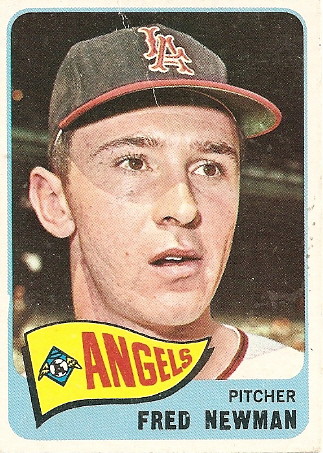
#101 Fred Newman

Card number three from reader Ed is another Angel. Has any team had a greater identity crisis than the Los Angeles/California/Anaheim/Los Angeles of Anaheim Angels? All of the commotion about the team's hometown is only further complicated by the fact that they played their home games in 1961 at Wrigley Field! (Obviously, it was another stadium in L. A. that shared a name with the Cubs' home field.)

Signed out of nearby Brookline High School as an amateur free agent by the Red Sox, Fred Newman was taken by the Los Angeles Angels in the expansion draft less than a year later. Fred is looking rather baby-faced in this photo, most likely because he was twenty-two in 1964. Newman's best pitch may have been his sinker, and he was known for his excellent control, which helped him win 13 games in 1964, his first full season in the majors. He sported a 2.75 ERA and allowed less than a hit per inning. He was just as good the following year, allowing just .86 hits per inning and posting a 2.93 ERA. The finest game of his career may have been a 5-0 victory over the Twins on June 30, 1965, in which he allowed just two hits and one walk while going the distance. However, the Angels' quiet bats handed him several tough-luck losses, and he finished with a 14-16 record.
Unfortunately, arm troubles brought Fred's promising young career to a premature end two years and 24 games later. His life game to a similarly premature conclusion, as he died in a car accident in 1987 at the age of 45.

Sunday, April 20, 2008

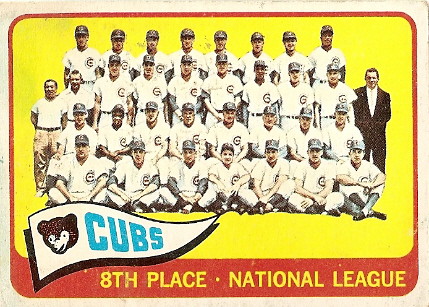
#91 Chicago Cubs Team Card

Here's another of the cards I received from reader Ed. This is my first team card for the 1965 Topps set, and it's a beauty. Sure, the team itself was a bottom feeder; their 76-86 won-lost record wasn't terrible, but this was the season in which an amazing pennant race saw the top five teams finish within five games of each other. But those classic Cubbie unis still look sharp, as does the old-school Cub head logo in the pennant. As the son of an art teacher, I'd be remiss if I didn't mention the excellent use of primary colors on this card. The club was managed by Bob Kennedy, who played on the first Orioles team in 1954. His son Terry was a catcher for the O's in the late 1980s. Kennedy was the Cubs' first conventional manager after the "College of Coaches" debacle in the early Sixties.

The card (and the team) features 33-year-old first baseman Ernie Banks (23 HR, 95 RBI), left fielder Billy Williams (.312, 33 HR, 98 RBI), and third baseman Ron Santo (.313, 30 HR, 114 RBI). The first two are Hall of Famers, while Santo's worthiness is still hotly debated. Speaking of Hall of Famers, a struggling young outfielder named Lou Brock was traded to the Cardinals in June for pitcher Ernie Broglio. Hindsight has proven that deal to be a big win for the Redbirds, of course. The pitching staff was led by veteran Larry Jackson, who won a career-best 24 games to lead the National League and sported a 3.14 ERA. Jackson finished second in ML Cy Young voting (back in the days when one award was given for the entire major leagues) to the Angels' Dean Chance, who won 20 games with a miniscule 1.65 ERA.

In looking at the 1964 Cubs roster, my favorite quirk is that there were two Burdettes on the pitching staff - former Braves star Lew and reliever Freddie - who do not seem to have been related to each other.

Wednesday, April 16, 2008

#38 Jim King

This is the first of nine cards that I recently received from reader Ed. Jim King was actually one of the original new Washington Senators...that is to say, when DC received a new expansion team before the 1961 season, they drafted him from the Cleveland Indians. King is shown here taking a mighty cut, which was his calling card as a player. He had his best seasons in Washington, clubbing a personal-best 24 home runs in 1963 and following up with another 18 in 1964. For his career, he reached double digits in roundtrippers eight times. Though he didn't hit for average (.240 career), his penchant for extra base hits and his good batting eye (363 walks and 401 strikeouts) made him a valuable contributor: his career OPS+ was 104, placing him just above the league average. In 1967, which proved to be his final season in the bigs, he was traded from the White Sox to the Indians for another slugger at the end of the line: outfielder Rocky Colavito.

Wednesday, March 26, 2008

#323 Hank Bauer

See, I told you I'd be back! I received this beauty from reader Tim in NO, who was kind enough to send me a box full of Orioles cards that I needed. I've coveted this Hank Bauer card since the day I first saw it while clicking around on The Baseball Card Project. Bauer had a classic, weathered face to match his gruff bulldog persona, and yet most pictures I've seen of him showcase his wide, endearing smile. That's the case here, and it's even better because the loose strands of hair poking out from under his cap combine with the glistening forehead to make it look like he's just had a rough night out.

Hank Bauer was a regular in the Yankee outfield for eleven years, winning seven World Series in nine postseasons. His best performance came in his last Fall Classic, the 1958 showdown with the Milwaukee Braves. In that series, Bauer hit four home runs in seven games for a .710 slugging percentage. His longevity in the New York lineup is even more impressive when you consider the fact that he didn't play a full season in the majors until he was 26. Hank lost his early playing years to World War II, where he served as a U.S. Marine from 1942-1945, earning two Purple Hearts and two Bronze Stars. His second Purple Heart came in the Battle of Okinawa, when he commanded a platoon of 64 men. Bauer was one of only six who survived, being sent home after he was hit in the thigh with shrapnel.

Hank Bauer was also the manager that took the Orioles to the promised land, bridging the gap between the strong foundation that Paul Richards built and the prolonged greatness of the Earl Weaver era. In Bauer's first year at the helm (1964), the Baby Birds gave the Yankees a run for their money, spending 92 days in first place and holding the top spot as late as September 18. Ultimately they faded just a bit, finishing two games behind New York with a then-O's record 97 wins. 1965 brought another third-place finish and 94 more wins, but 1966 would be Baltimore's year. Bolstered by the addition of slugger Frank Robinson, Bauer's charges again won 97 games. This time it was good enough to take them to the World Series, where they swept the more-heralded Dodgers in four straight games, shutting them out over the last 33 innings. Hank was named Manager of the Year for his efforts, but the glory was short-lived. After an injury-plagued O's team stumbled to a fifth-place finish in 1967 and started slow the following year, he was replaced by Earl Weaver, who'd just been added to the coaching staff at the beginning of the season. The rest, as they say, is history.