Showing posts with label giants. Show all posts

Friday, August 05, 2011

#282 Giants Rookie Stars: Dick Estelle and Masanori Murakami


#282 Giants Rookie Stars: Dick Estelle and Masanori Murakami
I told you this was a Giants-centric week! (Sorry, Night Owl.) Ed performed his '65 Topps wingman duties well again, picking up this fine card for $5 at a card show in Virginia back in July. Dick Estelle is another extremely airbrushed-looking player, but Masanori Murakami appears to be the real deal.

Fun facts about Dick Estelle:

-A native of Lakewood, NJ, Dick signed with the Giants at age 18 in 1960.

-In 1964, he struck out 167 batters in 152 innings at AAA Tacoma to earn a September callup to San Francisco.

-After taking a hard-luck loss while pitching into the tenth inning in his second start, Dick earned his first career win on September 22, 1964 with eight innings of one-run ball against Houston. Incidentally, Murakami earned his first career save by relieving the starter in the ninth and stranding two inherited runners.

-In 41.2 innings in 1964, Estelle went 1-2 with a 3.02 ERA. He struck out 23 and walked 23.

-After returning to AAA in 1965, he earned another look in September. Making 5 relief appearances and a start, he allowed 6 runs (5 earned) in 11.1 innings for a 3.97 ERA.

-Dick never pitched again in the big leagues. He stayed active in the minors through the 1972 season, finishing with a 102-123 record and a 3.67 ERA in parts of 13 minor league seasons.

-His career big league record was 1-2 with a 3.23 ERA.

-Estelle was inducted into the Lakewood High School Hall of Fame in 2006. In his senior year, he had gone 11-2 with an 0.38 ERA.

Fun facts about Masanori Murakami:

-Masanori was born in Otsuki, Japan. His father wanted him to become a doctor, and only permitted him to play baseball if he agreed to continue studying diligently. He appeared briefly for the Nankai Hawks in 1963 before being sent to the Giants as part of a development deal between the two clubs.

-Working out of the bullpen at Class A Fresno, Murakami appeared in 49 games in 1964, going 11-7 with an excellent 1.78 ERA and 0.93 WHIP. The Giants promoted him to the big leagues in September.

-The 20-year-old became the first Japanese player in the major leagues and endeared himself quickly to fans and teammates, bowing to his fielders when they made good plays behind him. He strung together eight scoreless appearances to begin his career. He picked up the aforementioned save in Dick Estelle's only career win, and added a win of his own with three innings of one-hit relief against Houston on September 29. He allowed his only 3 runs in his final appearance on the year, finishing with a 1.80 ERA in 15 innings.

-Though the Giants expected to have his services again in 1965, the Hawks insisted that he had only been loaned to the American club and the two teams and their respective leagues engaged in a war of words. An agreement was finally brokered that allowed Murakami to return to San Francisco in early May.

-Masanori pitched reasonably well in 45 games, going 4-1 with 5 holds, 8 saves, and a 3.75 ERA. The Giants won 95 games and finished just 2 back of the first-place Dodgers.

-At the insistence of his father, he returned to Japan and the Hawks in 1966. He struggled under high expectations and was criticized for supposed bad "American" habits. He pitched in Japan through the 1982 season, finishing his career with a 103-82 record (largely on the strength of an 18-4, 2.38 ERA season in 1968) and a 3.64 ERA.

-He attended spring training with the San Francisco Giants in 1983, but did not make the team at age 38 and chose to go back to Japan. This left his major league record at 5-1 with 9 saves and a 3.43 ERA.

-Masanori later broadcast games for the Japanese NHK network.

#282 Giants Rookie Stars: Dick Estelle and Masanori Murakami (back)

Thursday, August 04, 2011

#4 NL Home Run Leaders: Willie Mays, Billy Williams, Johnny Callison, Orlando Cepeda, and Jim Ray Hart

#4 NL Home Run Leaders: Mays, Williams, Callison, Cepeda, and Hart
Wow, not only is this a crowded league leaders card, it's also continuing a very Giants-centric week here on the ol' blog. Ed picked up this card for me a few weeks back, and as you can see if you scroll down, I'm dealing with a little paper loss on the back. So I'll be looking to upgrade sooner rather than later.

In 1964, Willie Mays continued his display of sustained excellence by clouting 47 home runs, thereby winning his third of four career National League crowns. The 33-year-old Giant had won his first homer title a full decade earlier, going deep 51 times in 1955. He would surpass that previous career high in 1965, leading the Senior Circuit one last time with 52 big flies. He retired in 1973 with 660 home runs, then the third-highest total in history. He was of course bumped down to fourth by the current home run king, his godson Barry Bonds.

Sweet Swingin' Billy Williams was a distant runner-up with 33 round-trippers, a new career high for the 26-year-old Cub. It was the fourth in an impressive string of 13 consecutive 20-homer seasons for Williams. He never captured a home run title, but peaked with 42 homers in 1970. He collected 426 four-baggers in an 18-year career.

The three-man logjam on the bottom row of this card represents a three-way tie for third in homers in the National League. Johnny Callison's 31 dingers were one shy of the career high he'd establish in 1965; he never even hit 20 afterward, but wrapped up his career in 1973 with 226 total. For Orlando Cepeda, 31 was actually his lowest HR output since 1960. However, he also missed 20 games early in the season. He peaked at a league-leading 46 in 1961 and wound up with 379 in a Hall of Fame career. Jim Ray Hart's 31 longballs were the first 31 of his career, earning him a second-place Rookie of the Year finish. He topped out at 33 in 1966, but his prime was short; he played 1,125 games lifetime and accumulated 170 homers.

If you could see the card back, you'd find the top 24 power hitters of 1964 in the N.L., all the way down to Willie McCovey with 18. The grand slam rundown is also provided, with only Bob Aspromonte and league MVP Ken Boyer hitting two grannies. The two most surprising names on the list (in my opinion) are Charlie Smith with 20 HR, and Billy Cowan with 19.
#4 NL Home Run Leaders: Mays, Williams, Callison, Cepeda, and Hart (back)

Wednesday, August 03, 2011

#545 Jesus Alou

#545 Jesus Alou
A few weeks ago (yes, weeks! I'm four cards away from being caught up!), reader George DeVerges and his father sent me this extra Jesus Alou card they found in their collection. Thanks, guys!

There's a joke based on the old Christian slogan "Jesus is the answer". It suggests that the question must be, "Who is Felipe and Matty's brother?".

Fun facts about Jesus Alou:

-Jesus was born in Bajos de Haina, in San Cristobal, Dominican Republic. He signed with the Giants as a teenager in 1958.

-He was the youngest of the three baseball-playing Alou brothers, and is the uncle of Moises Alou and Mel Rojas.

-After a September 1963 callup, Alou became a regular in the San Francisco outfield in 1964. He batted .274 as a rookie, but seldom walked or hit for power. In his entire career, he would top 100 in OPS+ in only two seasons, both as a part-timer.

-On July 10, 1964, he went 6-for-6 with a home run in a 10-3 win over the Cubs.

-Jesus played in a career-high 143 games in 1965, hitting .298 with 9 home runs and 52 RBI.

-He was taken by the Expos in the 1968 expansion draft, but was traded to the Astros prior to the 1969 season. In 1970, he hit .306 with a personal-best 27 doubles for Houston.

-In his 30s, Jesus became a pinch hitter and bench player with some positive results. He batted .312 in 102 trips to the plate for the Astros in 1972.

-He was a member of the Athletics' World Series-winning clubs in 1973 and 1974.

-After spending the 1975 season with the Mets, Jesus was released the next spring and did not return to the majors until Houston resigned him for the 1978 season. The 36-year-old rewarded them with a .324 average in 152 plate appearances, including a .364 mark (16-for-44) as a pinch hitter. He retired after serving as a player-coach for the club in 1979. In parts of 15 seasons, he hit .280 with 32 home runs and 377 RBI.

-Alou worked as an Expos scout in the 1980s and 1990s, and has been director of Dominican operations for both the Marlins and Red Sox.

#545 Jesus Alou (back)

Tuesday, August 02, 2011

#176 Willie McCovey

#176 Willie McCovey
Whaddaya know, it's Stretch! This card set me back a cool five bucks, thanks to the bargain-hunting talents of Ed. If you're paying attention to the sidebar, you'll have noticed that I am now just 17 cards shy of a completed set, which brings with it several exciting signposts. For instance, I have completed the Giants team set, 30 cards in all. That's a big deal to me in itself, but especially considering that it includes five future Hall of Famers.

Fun facts about Willie McCovey:

-Willie was born in Mobile, AL and was only 17 when he signed with the Giants in 1955.

-He put up impressive numbers at every stop in the minors, and was hitting .372/.459/.759 with 29 homers and 92 RBI in 95 games at AAA Phoenix when the Giants called him up to the majors in the summer of 1959. His first game was a sign of things to come, as he went 4-for-4 with 2 triples, 2 RBI, and 3 runs scored against Robin Roberts.

-He kept up the pace in his first look at the major leagues, putting up a line of .354/.429/.656 with 13 homers and 38 RBI in just 52 games in San Francisco. He was the unanimous winner of the National League Rookie of the Year award despite playing just one-third of the season!

-Despite his prodigious power and on-base skills, McCovey found it hard to get into an everyday lineup that included Orlando Cepeda, Willie Mays, Felipe Alou, and Harvey Kuenn. He did not top 106 games in a season until 1963. That year, he made the first of 6 All-Star teams, leading the league with 44 home runs and driving in 102 runs (trailing only Mays' 103 for the team high). He also batted .280 and scored 103 runs.

-He edged out Tom Seaver in MVP voting in 1969, when he reached career highs (and league-leading totals) of 45 home runs, 126 RBI, a .453 on-base percentage, .656 slugging, and a 209 OPS+. His .320 average was also a personal best, and ranked fifth in the N.L.

-Willie batted .429 (6-for-14) with 2 home runs and 6 RBI in a losing effort in the 1971 NLCS. His two-run homer off of Steve Blass in Game One gave the Giants the eventual winning runs in their only victory over the Pirates in the Series.

-He punished fellow Hall of Famer Don Drysdale, batting .336/.437/.680 with 12 home runs and 31 RBI in 151 plate appearances lifetime. This prompted Drysdale's former teammate Don Sutton to say that Mac was the only batter who was able to physically intimidate the great pitcher.

-Willie won the Comeback Player of the Year award in 1977, when he hit .280 with 28 homers and 86 RBI and boosted his OPS by 262 points at age 39.

-McCovey stayed in the majors for an astonishing 22 seasons, retiring at age 42 in 1980. He spent 3 years late in his career with the Padres, played 11 games with the Athletics, and returned to San Francisco for his last 4 years. He had a lifetime batting line of .270/.374/.515 with 521 home runs (still 18th all-time) and 1,555 RBI.

-Among his post-retirement honors, his #44 was retired by the Giants, and the club erected a statue in his likeness across from AT&T Park. The body of water beyond the right-field fence has been named McCovey Cove, as the lefthanded slugger used to deposit home runs beyond the right field bleachers in old Candlestick Park. He was a first-ballot Hall of Famer in 1986, and he currently works as a senior advisor for the Giants.
#176 Willie McCovey (back)

Monday, June 06, 2011

#10 NL Pitching Leaders: Larry Jackson, Juan Marichal, and Ray Sadecki

#10 NL Wins Leaders: Larry Jackson, Juan Marichal, and Ray Sadecki
We're starting this week with a couple of cards that I got from Ed, the only reader of this blog who has hand-delivered cards to my front door. Talk about service!

For some reason, Topps always used to label the league leaders in wins as "pitching leaders". Seems needlessly vague. In this case, the winningest pitcher in the National League, and in all of the major leagues, was righthanded veteran Larry Jackson of the Cubs. He posted a 24-11 record for a Chicago team that won just 76 games all season, making him responsible for nearly a third of all of their victories. But it wasn't enough to earn him the Cy Young Award; only one trophy was given out for the entire MLB in 1964, and it went to Dean Chance of the Angels. The young Los Angeles pitcher was 20-9 with a 1.65 ERA that was nearly half of Jackson's 3.14 mark. I'm sure it didn't put much of a damper on a career year for the Cubbie ace, whose second-highest win total in a 14-year career was 18. He finished strong in 1964, reeling off 9 straight W's from August 22 through September 27 to boost his record from 14-10 to 23-10 before splitting his final two decisions of the year. He might have had an even better season if he didn't call breezy Wrigley Field home: Larry was 10-6 with a 3.83 ERA at home and 14-5 with a 2.55 mark on the road. A little run support never hurts, either. The Cubbies scored 6 runs or more in 11 of Jackson's starts in 1964, and he had 10 wins and a single no-decision in those games. He also won the games he was expected to, posting an overall 9-0 mark against the young Colt .45s and Mets.

The runner-up in 1964 was another right-hander, but that's where the similarities end. Juan Marichal was 21-8 that year for the Giants, one of six times that he topped 20 wins in a season. He had topped the loop with 25 W's in 1963, and would do it again with 26 in 1968. He posted a sparkling 2.48 ERA and led the league with 22 complete games, yet got no votes for Cy Young. If that happened today, we'd never hear the end of it! He averaged 8.75 innings pitched per start in September and October, going 8 strong innings in the only game he did not finish. (There was also an 8-inning CG road loss.) He only made one start in August, which held down his win total, but came back with that great September/October (6-2, 2.19 ERA). He was a Colt and Dodger killer, winning four apiece against those two clubs.

Cardinals southpaw Ray Sadecki was already in his fifth big league season in 1964 when he went 20-11 with a 3.68 ERA at age 23. He would hang around for 13 more, but never had more than a dozen victories in any subsequent season. He had the dubious honor of leading the N.L. with 18 losses for a second-place Giants squad in 1968, and was a swingman and eventually a full-time reliever as his career progressed. Coincidentally, Ray won exactly four games in every month of the 1964 campaign except for April, when he lost his only start. He did the most damage against the Phillies, with a 4-1 record and a 1.91 ERA in four starts against Gene Mauch's men. Sadecki added a 21st win in Game 1 of the World Series, allowing four Yankee runs in six innings and benefiting from a St. Louis offense that hit Whitey Ford even harder.

The expanded leaderboard on the back gives a full rundown all the way down to seven wins. You'll notice that three Hall of Famers (Jim Bunning, Bob Gibson, and Sandy Koufax) just missed the big 2-0, with Tony Cloninger joining them as an oddball. Every team had at least a single 15-game winner with the exception of (who else?) the Mets, whose top W-man was Al Jackson with his gaudy 11-16 mark. Notably absent is Warren Spahn, who went 6-13 with an ugly 5.29 ERA at age 43. It was his last season with the Braves, and the first since 1946 (when he went 8-5 in 24 gamesin which he failed to post at least 14 victories. But we'll deal more with him later.

#10 NL Wins Leaders: Larry Jackson, Juan Marichal, and Ray Sadecki (back)

Wednesday, May 11, 2011

#497 Giants Rookie Stars: Ken Henderson and Jack Hiatt

#497 Giants Rookie Stars: Ken Henderson and Jack Hiatt
As I rifle through my baseball card collection, I find a very different-looking Ken Henderson another decade or so down the line from his rookie card. 1970s cards really are the gift that keeps on giving.

Fun facts about Ken Henderson:

-Ken was born in Carroll, IA, but attended high school in San Diego before signing with the Giants in 1964.

-Despite struggling greatly in his first pro season (.191 AVG/.268 SLG), he was jumped from Rookie ball to A to AAA in short order that year.

-San Francisco was sufficiently enamored with Henderson to keep him on the big league roster for the whole 1965 campaign, but used the 19-year-old sparingly. He batted .191 with a .277 on-base percentage in 83 trips to the plate. In a rare start on August 17, he went 2-for-4 with a run scored and a two-run double to account for all of the Giants' runs in a 3-2 victory over the Mets.

-In 1970, he became a regular in the San Fran outfield and hit .294 with 17 home runs and 88 RBI. He achieved career highs of 104 runs scored, 35 doubles, 20 steals, 87 walks, and a .394 on-base percentage.

-Joined the White Sox (along with Steve Stone) in a deal for pitcher Tom Bradley. Injuries cost him half of the 1973 season, but he rebounded to play all 162 games a year later. Ken hit .292 that year with 20 homers and a team-high 95 RBI while leading the American League in putouts by a center fielder.

-A switch-hitter, Henderson homered from both sides of the plate in a 4-2 victory over the Orioles on August 29, 1975. He got to lefty Ross Grimsley in the first inning, and victimized righty Wayne Garland in the eighth.

-He became a journeyman in the later period of his career, suiting up for the Braves, Rangers, Mets, Reds, and Cubs from 1976-1980. He retired as a .257 hitter in parts of 16 seasons, with a .343 on-base percentage, 122 home runs, and 576 RBI.

-On September 2, 1978, he hit a three-run pinch home run in the top of the 12th inning to lead the Reds to a 6-3 win over the Cardinals. It was one of five pinch homers in Ken's career.

-His cousin Kerry Dineen was an outfielder who played 16 games with the Yankees and Phillies, 1975-1978.

-Ken has worked in sales and marketing since hanging up his spikes, rejoining the Giants last year to sell luxury box suites at AT&T Park. He is married with four children and five grandchildren.

Fun facts about Jack Hiatt:

-Jack was a Bakersfield, CA native who signed with the Angels as a teenager in 1961.

-He was a very strong minor league hitter, compiling a career average of .299 and routinely reaching base above a 40% clip.

-The Angels called him up for the first time in September 1964, on the heels of a 23-homer season at AAA Hawaii. He notched 6 hits and 2 walks in 18 trips to the plate, including a walkoff pinch single off of Boston's Bob Heffner in his debut on September 7.

-Was traded prior to the 1965 season, going to the Giants in exchange for Jose Cardenal. Got very little playing time in San Francisco, totaling 290 plate appearances in 131 games from 1965-1967. Performed well in those limited opportunities, with a .280 average and .390 on-base percentage.

-Assumed the starting catcher's role in 1969 when Dick Dietz suffered a hand injury from a foul tip. In a four-game stretch from April 24-27, he hit .313/.421/1.063 (5-for-16) with 4 home runs and 12 RBI. He had the game of his life in a wild extra-inning affair April 25 vs. the Astros: a two-run homer in the first inning to give the Giants the lead, an RBI single in the eighth to tie it, and a walk-off grand slam in the 13th! That's 3-for-7 with 3 runs scored and 7 RBI if you're counting. Unfortunately, he couldn't keep it up and finished the year at .196 with 7 homers and 34 RBI.

-Jack spent the last three years of his big league career (1970-1972) as a part-timer with the Expos, Cubs, Astros, and Angels, finishing with a .251 average and .374 on-base percentage in parts of 9 seasons. He totaled 22 home runs and 154 RBI.

-Had a good track record against Claude Osteen (.371/.463/.486 in 41 PA) and Steve Carlton (.333 AVG, .394 OBP in 34 PA). Struggled against Gary Nolan (.111/.190/.167 in 21 PA).

-Hiatt was a talented pinch hitter, batting .296/.402/.426 in 127 tries over his career.

-Continued playing in the minors through the 1974 season.

-Worked in baseball for several decades after he quit playing. Was a minor-league manager for the Cubs (1975-1980), Angels (1982), Astros (1983), and Giants (1988). Also served as a big-league coach for the Cubs in 1981 and spent a number of years in the Giants front office, retiring as Director of Player Development in 2007.


#497 Giants Rookie Stars: Ken Henderson and Jack Hiatt (back)

Saturday, April 30, 2011

#213 Jim Davenport

#213 Jim Davenport
One problem I've had as a collector is that I have a hard time narrowing my focus. As it is, I've got at least a dozen sets that I'm actively trying to complete. In addition, I generally grab up any vintage Topps that catches my eye. And of course, I want as many Orioles cards as I can get. But I really admire the creativity of some collectors. For instance, Matthew Glidden collects any and all Number Five cards. If I ever did that, I'd likely go for card #213. 13 is one of my favorite numbers, and my alma mater is located on Maryland's Route 213. But I probably have my hands full as it is!

Fun facts about Jim Davenport:

-Jim was born in Siluria, AL and attended Mississippi State University before signing with the Giants in 1955.

-He made the big league team as its starting third baseman in 1958, going 2-for-4 with a sacrifice fly and a run scored in his debut. His first career hit was a single off of Don Drysdale.

-Had a strong season in 1961, batting .278 with 12 home runs. He achieved career highs with 28 doubles and 65 RBI.

-Davenport was a key member of the 1962 Giants squad that took the National League pennant. In addition to winning the Gold Glove for his play at the hot corner, he earned an All-Star selection. He batted a personal-best .297 with 14 homers, 58 RBI, and 83 runs scored.

-Lost his starting gig with the emergence of Jim Ray Hart in 1964, but contributed in a bench role for the remainder of the decade.

-Jim hit his only walk-off home run on May 16, 1964, a two-out, two-run shot off of the Mets' Galen Cisco in the bottom of the 15th inning. The game lasted 4 hours, 12 minutes, or roughly as long as your average 9-inning Yankees vs. Red Sox game these days.

-San Francisco gave him his release in mid-July 1970, ending his playing career. In parts of 13 seasons, all with the Giants, he hit .258 with 77 home runs and 456 RBI.

-He became a minor-league manager in the Giants farm system, managing their AAA Phoenix club from 1971-1973. He joined the Padres' major league staff in 1974, and returned to the Giants as a big league coach in 1976. Later, he would also coach for the Phillies and Giants.

-Jim was named the manager of the Giants before the 1985 season. However, the club replaced him in September with Roger Craig. He had a grisly 56-88 record in his only shot at helming a big league team.

-Davenport is back with the Giants, currently in a front office role. He had an interim stint as manager back at Phoenix in 1995, and skippered the Fresno Grizzlies in 1998. His son Gary was drafted by San Francisco in 1981, and has been a coach in the organization for many years. Gary is now the San Jose hitting coach.
#213 Jim Davenport (back)

Thursday, April 28, 2011

#193 Gaylord Perry

#193 Gaylord Perry
Unsurprising baseball fact: Gaylord Perry is the only major leaguer in history with "Gaylord" as a first or last name. Gale Staley, who played seven games for the 1925 Cubs, was born George Gaylord Staley. I'm guessing that Perry didn't get teased much, since he stood 6'4" and weighed over 200 pounds!

Fun facts about Gaylord Perry:

-A native of Williamston, NC, Gaylord signed with the Giants in 1958.

-His older brother Jim was also a successful pitcher, as previously mentioned. His lifetime record of 215-174 would be dwarfed by the accomplishments of his younger sibling.

-Perry was 23 when he debuted with the Giants in April 1962. He pitched sparingly, going 3-1 with a 5.23 ERA in 43 innings. One of his three wins was a complete game four-hitter, as San Francisco downed the Pirates 4-1 on April 30.

-He was a first-time All-Star in 1966, sporting a 21-8 record and a 2.99 ERA and 1.10 WHIP. He also had 201 strikeouts, topping 200 for the first of eight times. However, he was overshadowed by teammate Juan Marichal (25-6, 2.23 ERA, 222K, 0.86 WHIP).

-Gaylord led the N.L. in wins in 1970, going 23-13 with a 3.20 ERA. He also topped the Senior Circuit with 5 shutouts, 41 games started, and 328.2 innings. Still, he finished a distant second to Bob Gibson in Cy Young voting.

-Was traded to the Indians for "Sudden" Sam McDowell prior to the 1972 season. Popular opinion had the Giants getting the best of the trade, as McDowell was four years younger than the 33-year-old Perry. Of course hindsight shows that Sam declined rapidly, whereas Perry remained effective for another decade. He also won the Cy Young in his first season in Cleveland, going 24-16 with a 1.92 ERA, a 0.98 WHIP, and a league-leading 29 complete games for a bad team (72-84 overall).

-From Cleveland he was dealt to Texas in mid-1975, and he anchored the Rangers staff for two and a half years before being given away to San Diego for spotty reliever Dave Tomlin and cash. Now pushing 40, Perry won his second Cy Young with a 21-6 record and a 2.73 ERA. It was the third time he led his league in wins.

-Split the 1980 season between the Rangers and Yankees, and planned to retire after a mediocre 1981 season in Atlanta (8-9, 3.94 ERA). However, the players' strike left him three wins short of 300, so he caught on win the Mariners and notched the big three-double-oh on May 6, 1982 with a complete-game 7-3 decision over the Yankees. Though he was infamous for his supposed use of the spitball, he was only ejected for doctoring the ball once: August 23, 1982. So either he was very good at cheating, or he was a psychological mastermind. Maybe both.

-Gaylord finally hung up his spikes at the conclusion of the 1983 season, when he was 44 years old. He had a lifetime record of 314-265 with 303 complete games, 53 shutouts, and a 3.11 ERA. He was a five-time All-Star, and ranks 16th all-time in wins and 17th in shutouts. His total of 3,534 strikeouts is eighth-best.

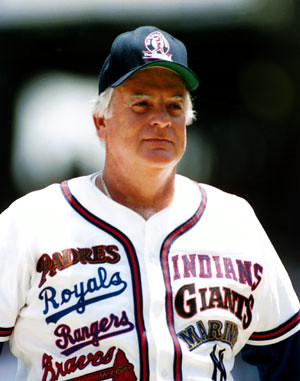
-He was inducted into the Hall of Fame in 1991, his third year of eligibility. He has appeared in some old-timer's games, and famously wears a jersey depicting the wordmarks of all eight of his big league teams.
#193 Gaylord Perry (back)

Thursday, April 21, 2011

#50 Juan Marichal

#50 Juan Marichal
Well lookie here! It's our first solo Hall of Famer since Yaz cropped up a few weeks ago. Juan Marichal is showing off his best yearbook smile.

Fun facts about Juan Marichal:

-Juan was born in Laguna Verde, Monte Cristi in the Dominican Republic. The Giants signed him at age 19 in 1957.

-He made his big league debut in the summer of 1960, earning three consecutive complete game victories to begin his career. This included a 1-hit, 12-strikeout domination of the Phillies in his first game on July 19.

-He made the All-Star Game for the first of eight consecutive seasons (and nine total) in 1962, when he went 18-11 with a 3.36 ERA and 18 complete games. Juan baffled hitters with his delivery, which began with a trademark sky-high leg kick. He started Game Four of the World Series and shut out the Yankees for four innings before being relieved by Bobby Bolin with a 2-0 lead; the Giants won the game 7-3.

-Marichal truly became an elite pitcher in 1963, when he went 25-8 with a 2.41 ERA, 18 complete games, and a career-high 248 strikeouts. He also no-hit Houston on June 15. Despite his league-leading wins total, he lost out to Sandy Koufax in the Cy Young voting, and never would win the award despite two more 25-win seasons. In 1966, Koufax bested him again; in 1968, it was Bob Gibson who had the superlative numbers.

-He gained infamy in a game against the Dodgers on August 22, 1965. After brushing back opposing leadoff hitter Maury Wills twice, the pitcher batted against Sandy Koufax in the bottom of the third inning. L.A. catcher Johnny Roseboro began buzzing his return throws to the mound dangerously close to Marichal's head. The two began arguing, and when Roseboro stood up and removed his mask and helmet to escalate the confrontation, Marichal began clubbing the unprotected catcher in the head with his bat. This touched off a 15-minute bench-clearing brawl. The pitcher was ejected, fined a then-record $1,750, and suspended for nine days. Roseboro, who was escorted to the clubhouse by Willie Mays, required 14 stitches to close a head wound but was able to return to the field a few days later. The victim filed a lawsuit against his attacker, and they eventually settled out of court for $7,000. Years later, the pair reconciled and became good friends.

-He had several standout seasons, but the best may have been 1966: 25-6 (his fourth straight 20-win season), 2.23 ERA, 25 complete games, and league-best numbers in WHIP (0.86), hits per nine innings (6.7), walks per nine (1.1), and strikeout-to-walk ratio (6.17!).

-On September 21, 1966, he hit a walkoff home run off of Pittsburgh's Roy Face, breaking a 5-5 tie with one out in the bottom of the ninth. It was one of four career homers for Juan.

-In 1968, he went 26-9, setting a career high and leading the N.L. in wins. He also paced the senior circuit with 30 complete games, 325.2 innings pitched, and a 4.74-to-1 strikeout-to-walk ratio. His 2.41 ERA was nothing to sneeze at either.

-Retired after stints with the Red Sox in 1974 and Dodgers in 1975. In parts of 16 seasons he was 243-142 with a 2.89 ERA, 244 complete games, 52 shutouts, 2,303 strikeouts, and a 1.10 WHIP (18th-lowest all-time). He was the winningest Latin American pitcher in major league history until Dennis Martinez surpassed him in 1998.

-Juan was elected to the Baseball Hall of Fame in 1983. That same year, he began scouting for the Athletics. In 1996, Dominican President Leonel Fernandez named him to the cabinet as Minister of Sports.
#50 Juan Marichal (back)

Monday, February 21, 2011

#482 Bob Priddy

#482 Bob Priddy
Given the sophomoric humor that is often associated with baseball players, I imagine that it couldn't have been easy being a pitcher named Priddy.

Fun facts about Bob Priddy:

-Bob was born in Pittsburgh and signed with the Pirates out of high school before the 1959 season.

-He debuted in the majors at age 22 on September 20, 1962, earning the win with a ninth inning of scoreless relief. He had entered with the Bucs trailing 3-1, and notched the victory when Bob Bailey hit a walkoff two-run double off of Cincinnati's Bill Henry.

-Priddy spent all of the 1963 season and all but two months of 1964 in the minors before being traded to the Giants. He allowed 2 runs in a 10.1 inning cameo in San Francisco in 1965.

-In 1966, he went 6-3 with a save and a 3.96 ERA out of the Giants bullpen in his first full big league season.

-The following year, Bob was traded to the Senators and set career bests with a 3.44 ERA and 4 saves in 46 games.

-His first career complete game came on August 23, 1967, as he five-hit the Red Sox at Fenway in a 3-2 Washington win.

-He was traded yet again in 1968, winding up in a swingman role for the White Sox. He took his lumps, compiling a 3-11 record and a 3.63 ERA in 114 innings.

-On June 19, 1968, Priddy hit his only career home run, a solo shot off of Luis Tiant of the Indians. It was the only run Tiant allowed in a 3-1 Tribe victory.

-After bouncing from Chicago to California to Atlanta in 1969, he finished his career with two so-so seasons in the Braves bullpen. In parts of 9 seasons he was 24-38 with 18 saves and a 4.00 ERA.

-His 18 saves are the most all-time for a native Pittsburgher.

#482 Bob Priddy (back)

Friday, February 11, 2011

#395 Jim Hart

#395 Jim Hart
For some reason, I'm really drawn to the bright blue sky behind Jim Hart. There aren't many cards in this set with such a clear backdrop.

Fun facts about Jim Hart:

-Jim Ray Hart was born in Hookerton, NC and signed with the Giants at age 18 in 1960.

-He debuted with San Francisco in mid-1963 but had a rude initiation. In his second game, a Bob Gibson fastball broke his shoulder blade. He missed more than a month, and then was beaned by Curt Simmons in his fifth game back and missed the balance of the season!

-His second season in the big leagues went more smoothly. He finished a distant second to Dick Allen in Rookie of the Year voting with a .286 average, 31 home runs, and 81 RBI.

-Jim avoided the sophomore slump in 1965, leading the team with 30 doubles. He also boosted his average to .299. Although he dropped to 23 home runs, his 96 RBI trailed only Willie Mays for the team lead.

-His only All-Star selection came in 1966, when he clouted a personal-best 33 home runs and drove in 93 runs with a .285 average.

-A fourth straight standout year saw Jim hit 29 home runs and achieve career highs of 98 runs scored, 99 RBI, and a .373 on-base percentage in 1967. He paced the Giants in runs and RBI.

-Hart had a game for the ages on July 8, 1970 against the Braves. In just his second game after missing the first half of the season with injuries, he hit for the cycle in a 4-for-5 effort and drove in 7 runs as the Giants romped 13-0.

-He struggled with his weight and shoulder injuries in his late twenties, both of which hampered his already-suspect defense and cut into his playing time. He totaled only 131 games from 1970 through 1972.

-Jim closed his career out in 1974 with the Yankees, and was only 32 at the time. In parts of 12 seasons he hit .278 with 170 home runs and 578 RBI.

-Hart worked as a warehouse man for Safeway Stores in California until his retirement in 2006.
#395 Jim Hart (back)

Friday, January 14, 2011

#559 Ed Bailey

#559 Ed Bailey
Considering that this was a high-numbered card, you could say that Topps did good work in quickly grabbing a hatless photo of Ed Bailey and identifying him as a Giant - he was traded from the Braves for Billy O'Dell on February 1, 1965. However, Ed had already been with San Francisco from 1961 through 1963. It seems to me that they could have just as easily recycled an old photo of him. But what do I know?

Fun facts about Ed Bailey:

-Ed was born in Strawberry Plains, TN and briefly attended the University of Tennessee before signing with the Reds in 1950.

-Despite missing all of 1951-1952 due to military service he got a late-season cup of coffee with Cincinnati in 1953. He but struggled offensively in MLB stints in 1954-1955 and was sent back to the minor leagues to hone his skills.

-The 25-year-old returned to the majors in 1956 and claimed the Reds' starting catcher role early in the season. He hit .335 with 14 home runs in his first 58 games to earn the first of five All-Star selections. For the season, he wound up at .300 with a .385 on-base percentage, 28 home runs, and 75 RBI - all career highs. He also led the National League with 23 runners caught stealing, the first of six straight top-five finishes in that category.

-His younger brother Jim pitched in three games for the Reds in 1959, making them a rare sibling battery.

-Bailey was traded to the Giants early in the 1961 season, and was a contributor to their 1962 N.L. pennant. Although he batted .232 that year, his ability to draw walks (.351 OBP) and hit home runs (17 total) made him an above-average hitter.

-From June 26-29, 1962, Ed hit three crucial late-inning homers in a span of four games: a seventh-inning game-tying pinch grand slam, a sixth-inning go-ahead two-run homer, and a walkoff solo shot in the bottom of the 12th.

-He caught Juan Marichal's no-hitter on June 15, 1963.

-Though Ed was nearing the end of his career in 1965, he still factored into a few highlight reels. On July 22, he almost single-handedly beat the Phillies with this stat line: 4-for-4, 2 HR, 8 RBI. His second-inning three-run homer and fifth-inning grand slam accounted for seven of the Cubs' ten runs that day. He also completed his second career unassisted double play in another game that year, making him one of ten catchers to ever achieve that feat.

-He joined the Angels in 1966 but was cut loose in May to finish off his career. In parts of 14 seasons he hit .256 with a .355 on-base percentage, 155 home runs, and 540 RBI.

-Bailey retired to Knoxville, TN, where he served as a city councilman for 13 years and was inducted into the city's Sports Hall of Fame. He passed away at age 75 in 2007 after a bout with throat cancer.
#559 Ed Bailey (back)

Monday, January 03, 2011

#531 Chuck Hiller

#531 Chuck Hiller
Well if it isn't Chuck Hiller, another member of the "30-going-on-50" club. Life must have been harder in those days.

Fun facts about Chuck Hiller:

-Chuck was born in Johnsburg, IL and attended St. Thomas University in St. Paul, MN. He signed with the Indians in 1957.

-The Giants drafted him away from Cleveland after his second pro season. He hit over .300 in each of his three seasons in the San Francisco farm system, including an MVP effort with the Texas League's AA Rio Grande Valley squad in 1960 (.334 AVG, .400 OBP, 47 2B, 74 RBI).

-Hiller made the Giants' roster to start the 1961 season, but the 26-year-old was demoted to AAA in early July with a .228 average. He showed some improvement in a brief return engagement, batting .289 with a .400 on-base mark in 11 games at season's end to boost his overall average to .238.

-Back for good in 1962, Chuck batted .276 in a career-high 161 games. He also set personal bests with 94 runs scored, 22 doubles, 48 RBI, and a .341 OBP. His defense left a little something to be desired, however; he committed a league-high 29 errors at second base and earned the moniker "Iron Hands".

-Though the infielder wasn't known for his power, he slugged .500 in the 1962 World Series as four of his seven hits went for extra bases (3 2B, 1 HR). In Game Four, his seventh-inning grand slam broke a 2-2 tie and boosted the Giants to a 7-3 win. It was the first bases-loaded homer by a National Leaguer in the history of the Fall Classic.

-He delivered the only walk-off home run of his career in the bottom of the ninth on July 26, 1963. The two-run shot off of Roy Face broke a 4-4 tie.

-Hiller lasted barely more than two seasons in San Francisco after his good showing in the Series. The Giants dealt him to the Mets in May 1965 after his offense went south.

-He was a capable sub for the Mets in 1966, batting .280 overall and .348 (16-for-46) as a pinch hitter.

-Chuck played sparingly with New York and Philadelphia in 1967 and saw action in just 11 big league games as a Pirate in 1968, his final pro season. In parts of eight seasons he batted .243 with 20 home runs and 152 RBI.

-He stayed involved in the game as a minor league manager and major league coach for two decades following his retirement, often coaching under Hall of Fame skipper Whitey Herzog. The organizations he worked for included the Mets, Rangers, Royals, Cardinals and Giants. His managerial record was 304-320, which included a 74-66 mark with the 1975 Tidewater Tides in his only season at the AAA level. Hiller passed away in October 2004 at age 70.
#531 Chuck Hiller (back)

Wednesday, December 22, 2010

#512 Cap Peterson

#512 Cap Peterson
You are not going to believe this, but for the second consecutive day we're featuring someone whose nickname is comprised of his initials. Charles Andrew Peterson was commonly known as "Cap". I would go by a similar moniker, but it's hard to pronounce "Kmb".

Fun facts about Cap Peterson:

-Born in Tacoma, WA, Cap signed with the Giants right out of high school in 1960 for a $64,000 bonus.

-He was named MVP of the AA Texas League in 1962, when he hit .335 with 34 doubles, 29 home runs, 130 RBI, and a 1.013 OPS for the El Paso Sun Kings. He debuted with the Giants that September, shortly after his 20th birthday.

-Cap hit .259 in a few short stints totaling 22 games in 1963. The highlight was a May 30 game against Cincinnati in which he went 3-for-5 with the first two extra-base hits of his career, a home run and a double.

-He spent the next three seasons as a backup outfielder for the Giants, batting .233 in that span while Willie Mays, the Alous, and Len Gabrielson got the lion's share of playing time.

-A trade to the Senators allowed Peterson to play in a career-high 122 games in 1967. He hit .240 (the league average was .236 and the Sens batted .223 as a team) with 17 doubles, 8 home runs, and 46 RBI.

-May 30 must have been Cap's lucky day: four years to the day that he had hit his first double and home run, he hit his only career walk-off home run. It came on May 30, 1967, in the second game of a doubleheader against the A's. With two outs in the bottom of the 11th inning, Cap took Jack Aker deep for a 4-3 Senators victory.

-Two weeks later, the outfielder went 4-for-9 with two homers and three RBI against the White Sox in a game that Washington pulled out in 22 innings(!). Both home runs came in the early stages of the game, and both were hit against Joel Horlen, who would go 19-7 with a league-best 2.06 ERA that season. In the 22nd inning, Peterson singled in the midst of the game-winning rally; Mike Epstein came up after him and was intentionally walked to load the bases, at which point Paul Casanova singled to end the 6 hour, 38 minute slog.

-Peterson slumped to .204 in 1968 and finished his big league career as a part-timer in Cleveland the following year. He spent the next three years hanging on in the minors before walking away for good in 1972. In parts of eight seasons he had a .230 average, 19 home runs, and 122 RBI.

-After baseball, Cap joined his family's construction business.

-He died tragically young, succumbing to kidney disease in 1980 when he was only 37.
#512 Cap Peterson (back)

Thursday, December 02, 2010

#465 Tom Haller

#465 Tom Haller
I like the green-painted gates and the red-clad ushers behind Tom Haller in this photo. Can any of you eagle-eyed readers help me figure out which ballpark this is?

Fun facts about Tom Haller:

-Tom was born in Lockport, IL and played quarterback at the University of Illinois. He signed with the Giants in 1958.

-He debuted with San Francisco in 1961, but an April 12 home run against Vern Law was one of just 9 hits in a 30-game introduction to the majors. He batted .145 and spent the rest of the year at AAA Tacoma for seasoning.

-Returning to the bigs in 1962, Haller established himself as the Giants' primary catcher with a .261 average, .384 on-base percentage, 18 home runs and 55 RBI in 99 games. He started four games in the World Series that year and went 4-for-14 (.286). His two-run homer off of Whitey Ford in the second inning of Game Four gave his team an early lead in a contest they would win 7-3.

-On May 31, 1964, he caught all 23 innings of the Giants' 8-6 win over the Mets! He was 4-for-10 at the plate with a triple and an RBI.

-Tom made the All-Star team in three consecutive seasons: 1966 (career-high 27 HR, 67 RBI), 1967 (117 OPS+), and 1968 (.285 AVG, 27 2B, 128 OPS+ in his first season with the Dodgers).

-Throughout his career, he had a reputation as an adept defensive catcher. His overall fielding percentage was .992, and he led the National League in runners caught stealing with 48 in 1968. That was also the year that he set an N.L. single-season record with 23 double plays turned as a catcher.

-Haller hit two game-winning pinch homers in 1970. The first was a two-out, seventh-inning grand slam off of Montreal's Claude Raymond on July 22 to turn a 10-7 deficit into an 11-10 lead for Los Angeles. The other was a three-run shot with nobody out in the top of the tenth on September 13; Jerry Johnson of the Giants was the victim as the Dodgers won 5-3.

-Imagine how the Royals felt on July 14, 1972 when they saw Tom catching for the Tigers while his older brother Bill (an American League umpire from 1963-1982) served as home plate umpire! If the latter showed preferential treatment to his kin, it didn't show up in the box score; K.C. won 1-0. It was the only instance in Tom's lone season in the A.L. that both were behind the plate, but naturally Earl Weaver complained to league president Joe Cronin about the general possibility of bias.

-He hit .207 in spot duty with the Tigers and retired at the end of the 1972 season. In parts of 12 years in the majors, he hit .257 with 134 home runs and 504 RBI.

-Haller stayed with the Giants long after retiring, wearing the mantles of coach (1977-1979), farm director (1980-1981), and general manager (1981-1985). In 1986, he served a brief tenure as assistant GM for the White Sox. He passed away at age 67 in November 2004 after battling a viral infection.
#465 Tom Haller (back)

Friday, November 05, 2010

#428 Bob Shaw

If you noticed the "29" on Bob Shaw's glove, I can confirm that it was his uniform number with the Giants. That's the kind of thing that's up my alley.

Fun facts about Bob Shaw:

-Bob was born in the Bronx and attended St. Lawrence University in New York before signing with the Tigers in 1953.

-He debuted with Detroit in 1957 at age 24, but won just one game for the club before being dealt to the White Sox in midseason the following year.

-Shaw had a career year in 1959, as he led the league in winning percentage (18-6, .750) and posted a 2.69 ERA. He was third in the A.L. in wins and ERA despite starting only 26 games (he relieved in 21 more). He finished third in Cy Young voting, as teammate Early Wynn captured the honors.

-After being tagged with a 4-3 loss in Game Two of the 1959 World Series, he bounced back to shut out the Dodgers over 7.1 innings and outduel Sandy Koufax in a 1-0 Chicago win in Game Five. Ultimately, L.A. prevailed in six.

-Bob could not follow up on his great season, turning in two average years with the White Sox and Athletics. A pre-1962 trade to the Braves seemed to rejuvenate him, as he earned his lone All-Star selection in his first season in Milwaukee (15-9, 2.80 ERA, 12 CG). He also led the National League with only 1.8 walks allowed per nine innings.

-On May 4, 1963, he set a major league record by committing five balks in a single game, including three in the third inning alone!

-Shaw was shifted to the bullpen and led his team in saves in 1963, when he shut the door 13 times for the Braves, and in 1964, when he earned 11 saves for the Giants.

-He did not let another change in roles bother him, as he started 33 games for San Francisco in 1965 and went 16-9 with a personal-best 2.64 ERA. He was the second-best pitcher on a staff that included Juan Marichal (the team ace), a still-learning Gaylord Perry, and Jack Sanford and Warren Spahn as elder statesmen.

-Bob retired after pitching for the Mets and Cubs in 1967. In parts of 11 seasons he was 108-98 with a 3.52 ERA and 32 saves.

-He stuck around as a minor league manager and major league pitching coach for the Dodgers and later coached for the Brewers before embarking on a successful second career in real estate in Florida. He died this past September of liver cancer at age 77.

Tuesday, August 24, 2010

#341 Bobby Bolin

#341 Bobby Bolin
Eat your heart out, Bobby Bonilla...real fans know who the true "Bobby Bo" is.

Fun facts about Bobby Bolin:

-Born in Hickory Grove, SC, Bobby signed with the Giants in 1956 at age 17.

-He cut a swath through the minors, winning 57 games in his first four pro seasons.

-Appeared in 37 games as a rookie in 1961, all but one as a reliever. He saved five games and had a respectable 3.19 ERA, though he struggled with his control (6.9 BB/9 IP).

-Received incrementally larger starting assignments in his first four seasons. Went 23-18 with a 3.34 ERA and 13 saves from 1962-1964.

-Starting 13 games and relieving in 32 more, he went a career-best 14-6 with a 2.76 ERA (seventh-best in the N.L.) in 1965.

-1966 was Bobby's lone season as a full-time starter. He completed ten games and his 2.89 ERA placed him in the league's top ten for the second straight year, but he managed just an 11-10 record for the 93-win Giants. Call it hard luck - his game logs show that he received an average of 3.35 runs of support from his offense. Though he failed to complete six innings in ten of 34 starts, many of his no-decisions could have been wins; his ERA was 2.93 in the 14 games in which he did not receive a decision. He basically had to be flawless to win (0.85 ERA in 11 wins).

-Had a pair of one-hit shutouts in his career: August 14, 1964 vs. the Braves and October 1, 1966 at Pittsburgh.

-Despite starting only 19 of his 34 games in 1968, Bolin qualified for the ERA title and finished second to Bob Gibson with a 1.99 mark. His 0.985 WHIP was fourth-best, and he went 10-5.

-After a rough patch in the early 1970s, he finished his career with two good years out of the Boston bullpen in 1972 and 1973. Went out on top with a 2.70 ERA and a team-best 15 saves in his final season.

-In 13 seasons he was 88-75 with a 3.40 ERA, 32 complete games, and 50 saves.
#341 Bobby Bolin (back)

Wednesday, August 04, 2010

#318 Matty Alou

#318 Matty Alou
Ah yes, the Alous, the Molinas of the 1960s and 1970s. All three appear in the 1965 Topps set, and Matty is the first that I've posted on the blog.

Fun facts about Matty Alou:

-Born in Bajos de Haina in the Dominican Republic, Matty signed with the Giants in 1957.

-As mentioned above, he was the middle child of three brothers who were all major-league outfielders. His older brother was Felipe, and Jesus was the younger. They were teammates for the 1963 Giants. The family tree also includes cousin Jose Sosa, who pitched for the Astros in the mid-1970s, and nephews Moises Alou (outfielder from 1990-2008) and Mel Rojas (pitcher from 1990-1999)!

-After a cup of coffee with San Francisco in 1961, he made the club as a 22-year-old part-timer the following season and hit .310 in 200 at-bats.

-Matty's offensive output dwindled during his years with the Giants, and he was traded to the Pirates after the 1965 season.

-Paired with famed hitting instructor Harry "the Hat" Walker, Alou was rejuvenated in Pittsburgh. In his first year there he led the league with a .342 average, beating out brother Felipe by .015.

-In all, had four straight top-four finishes in the N.L. batting race, hitting .335 over that span. Swatted an impressive .332 in 1968 when the league hit .243 collectively and made the first of two straight All-Star teams. Paced the Senior Circuit with 41 doubles and 231 hits in 1969.

-He was largely a slap hitter; in his lone full season in St. Louis (1971), he set career highs with seven homers and 74 RBI. The home runs represented 22.5% of his career total, and there was only one other season in which he topped 50 RBI.

-Was a helpful pennant-drive addition for the 1972 A's, hitting .281 in 32 games and following up with a .381 average (8-for-21) and four doubles in the ALCS. He eked out just one hit in 24 World Series at-bats, but Oakland triumphed over the Reds anyway.

-Also spent time with the Yankees and Padres before finishing his career with three seasons in Japan as a Taiheiyo Club Lion. In parts of 15 major league seasons he batted .307 with 31 home runs and 427 RBI.

-In 2007, Matty was inducted into the Hispanic Heritage Baseball Museum Hall of Fame along with current-day shortstop and Venezuelan native Omar Vizquel.
#318 Matty Alou (back)

Tuesday, April 06, 2010

#228 Jack Sanford

#228 Jack Sanford
In case you're keeping score, this is the seventh card in a sequence, all sent as part of the huge contribution by Jamie Whyte. There's one more to come, which means that I knocked #222-229 off of my checklist all at once!

Fun facts about Jack Sanford:

-Born in Wellesley Hills, MA, Jack was signed by the Phillies as a teenager in 1948.

-Jack's ascent to the major leagues was slowed by a year-plus spent in military service. He also struggled with his control, as it pertained to both pitching mechanics and his temper. In 1954, he was suspended for ten games after refusing to give the ball to his manager as he was being removed from a game.

-He finally debuted with the Phillies at age 27 in 1956, winning his first career start on September 16 by pitching around eight walks, four hits, and a hit batter!

-Sanford was an All-Star and the runaway choice for Rookie of the Year in 1957, as he went 19-8 with a 3.08 ERA and 15 complete games. He led the National League with 188 strikeouts and a hits-per-nine-innings ratio of 7.4.

-After a sophomore slump (10-13, 4.44), he was dealt to the Giants. His first three seasons with the club were solid, as he won 40 games, lost 35, and compiled a 3.73 ERA.

-1962 was a career year for Jack. He helped San Francisco to its first pennant on the West Coast by posting a 24-7 record (including a 16-game win streak that stretched from June to September) and a 3.43 ERA. Despite a seventh-place finish in MVP voting, he lost out on the Cy Young Award to the Dodgers' Don Drysdale, who was 25-9 with a 2.83 ERA and 232 strikeouts.

-He shined in the World Series, shutting out the Yankees on three hits in Game Two before pitching into the eighth in a 5-3 loss in Game Five. He returned in the decisive seventh game and lost a heartbreaker, surrendering the lone run that made the difference in the fifth inning. His earned run average for the Series was 1.93.

-A league-leading 42 starts totaling 284.1 innings in 1963 may have been the root of arm troubles for the righty. He moved to the bullpen after that season, toiling for the Giants, Angels, and Athletics over the next four years.

-Jack retired in 1967, wrapping up his dozen years in the majors with 137 wins, 101 losses, 76 complete games, and a 3.69 ERA.

-He coached for the Indians in 1968 and 1969 and later scouted for the Red Sox. He was also a golf course director. Sanford died of brain cancer in 2000 at age 70.
#228 Jack Sanford (back)

Monday, December 07, 2009

#379 San Francisco Giants Team

#379 San Francisco Giants Team Card
I don't know if you can see it, but there's a bright yellow line on the left border of this card. I guess that's a printing irregularity. Have you seen anything like it before?

Anyhow, the San Francisco Giants probably wish that division play had been in place in 1964. It's tough to win 90 games and finish fourth, as manager Alvin Dark's charges did. They spent 53 days in first place but were not on top from late July onward. The glow was still on the club seven years after their move west from New York, as 1,504,364 rooters helped them finish third in the National League in attendance.

The Giants were a patient and powerful team on offense, leading the N.L. in home runs and walks. Having MVP Willie Mays helped, as he clubbed 47 home runs, drove in 111, and reached base at a .383 clip. Other heavy hitters included corner infielders Orlando Cepeda and Jim Ray Hart, who each went deep 31 times; Cepeda also hit a team-best .304. Mays and Cepeda were All-Stars.

Pitching-wise, San Francisco finished third in ERA at 3.19. Juan Marichal was the ace, with a 21-8, 2.48 ERA, 22 complete game season. Oddly enough, Gaylord Perry was the only other pitcher to start more than ten games and post a winning record (12-11, 2.75). Marichal was the lone Giant pitcher in the Midsummer Classic.

The Giants would be in contention for the rest of the decade with negligible results, notching five consecutive second-place finishes from 1965-1969. They won the N.L. West in 1971, but bowed to the Pirates in the NLCS in four games. They wouldn't reach the World Series again until 1989, and still haven't won it all since 1954.
#379 San Francisco Giants Team Card (back)